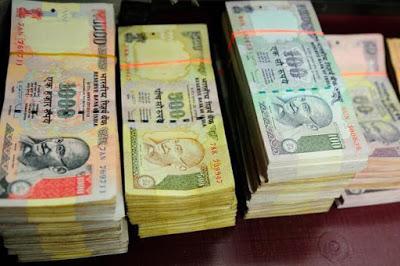
 Let's say you
like the look of a house that is for sale. You judge it is worth - for
argument's sake - 100 rupees. The chances are the seller will tell you he will
only take, say, 50 rupees as a formal payment and demand the rest in cash. That
cash payment is what Indians refer to as "black money". It means the
seller can avoid a hefty capital gains tax bill. Buyers benefit too because the
lower the declared value of the property, the lower the property tax they will
be obliged to pay.
What it also
means is that Indians tend to have much smaller mortgages compared to the real
value of their properties than elsewhere in the world. At the peak of the
property boom in the US and the UK it was common for lenders to offer mortgages
worth 100% of the value of the property. Some would even offer 110% mortgages,
allowing buyers to roll in the cost of finance and furnishing their new home. That's
why when the crash came, the balance sheets of the big banks collapsed along
with property prices.
In India, by
contrast, mortgage loans can only be raised on the formal house price. So, says
Mr Basu, a house worth 100 rupees would typically be bought with a mortgage of
50 rupees or less. So when prices fell in India - and they did fall in 2008 and
2009 - most bank loans were still comfortably within the value of the property.
That's why India managed to avoid the subprime crisis that did so much damage
elsewhere.
India did
experience a slowdown, but it was collateral damage from the global recession
rather than the result of any national problem. Indeed, within a year India had
begun to pull out of the crisis, returning to growth of almost 8% a year
between 2009 and 2011. That is not to say that Mr Basu approves of petty
corruption. Basu says only those who
take bribes should be held criminally responsible. He compares it to the effect
of an unpleasant disease: it may have some positive side effects - encouraging
your hair to grow, for example - but you would still prefer not to have the
illness.
Indeed, Mr
Basu is famous for having devised a particularly clever and characteristically
radical way of rooting out corruption - legalising bribery. A few years ago, he
proposed that instead of both bribe-givers and bribe-takers being held
criminally responsible for their actions, only the bribe-taker should face
sanctions. It is a simple change, but radically alters the relationship between
the two parties. It means people who give bribes no longer have a shared
interest in keeping their nefarious activity secret. Freed from the risk of
prosecution, bribe-givers would have a powerful incentive to reveal corruption.
Unfortunately,
says Mr Basu, his innovation has still not found its way into mainstream Indian
law. ….. what is
your take on this ?
With regards – S.
Sampathkumar
22nd Feb
2016
Let's say you
like the look of a house that is for sale. You judge it is worth - for
argument's sake - 100 rupees. The chances are the seller will tell you he will
only take, say, 50 rupees as a formal payment and demand the rest in cash. That
cash payment is what Indians refer to as "black money". It means the
seller can avoid a hefty capital gains tax bill. Buyers benefit too because the
lower the declared value of the property, the lower the property tax they will
be obliged to pay.
What it also
means is that Indians tend to have much smaller mortgages compared to the real
value of their properties than elsewhere in the world. At the peak of the
property boom in the US and the UK it was common for lenders to offer mortgages
worth 100% of the value of the property. Some would even offer 110% mortgages,
allowing buyers to roll in the cost of finance and furnishing their new home. That's
why when the crash came, the balance sheets of the big banks collapsed along
with property prices.
In India, by
contrast, mortgage loans can only be raised on the formal house price. So, says
Mr Basu, a house worth 100 rupees would typically be bought with a mortgage of
50 rupees or less. So when prices fell in India - and they did fall in 2008 and
2009 - most bank loans were still comfortably within the value of the property.
That's why India managed to avoid the subprime crisis that did so much damage
elsewhere.
India did
experience a slowdown, but it was collateral damage from the global recession
rather than the result of any national problem. Indeed, within a year India had
begun to pull out of the crisis, returning to growth of almost 8% a year
between 2009 and 2011. That is not to say that Mr Basu approves of petty
corruption. Basu says only those who
take bribes should be held criminally responsible. He compares it to the effect
of an unpleasant disease: it may have some positive side effects - encouraging
your hair to grow, for example - but you would still prefer not to have the
illness.
Indeed, Mr
Basu is famous for having devised a particularly clever and characteristically
radical way of rooting out corruption - legalising bribery. A few years ago, he
proposed that instead of both bribe-givers and bribe-takers being held
criminally responsible for their actions, only the bribe-taker should face
sanctions. It is a simple change, but radically alters the relationship between
the two parties. It means people who give bribes no longer have a shared
interest in keeping their nefarious activity secret. Freed from the risk of
prosecution, bribe-givers would have a powerful incentive to reveal corruption.
Unfortunately,
says Mr Basu, his innovation has still not found its way into mainstream Indian
law. ….. what is
your take on this ?
With regards – S.
Sampathkumar
22nd Feb
2016
** reproduced from : http://www.bbc.com/news/world-asia-india-35610332