
PFAS in the News—What is it and How Does it Impact You?
Search news articles, science journals, or social media sites, and it might seem like PFAS is forever in the spotlight. Reports of tap water contamination, multi-billion-dollar settlements, and tighter government oversight have increased national attention. But what exactly is PFAS, and should you be concerned?
What is PFAS?
PFAS, short for per- and polyfluoroalkyl substances, is a family of nearly 15,000 synthetic chemicals whose structures make them resistant to oils, stains, heat, water, or food gunk. The most studied PFAS are:
- PFOS (Perfluorooctane Sulfonic Acid)
- PFOA (Perfluorooctanoic Acid)
- PFBS (Perfluorobutane Sulfonate)
- HFPO-DA (Hexafluoropropylene Oxide Dimer Acid, more commonly called GenX Chemicals)
Because of their super-strong carbon-fluorine bonds, PFAS chemicals are highly stable and break down extremely slowly, if ever. Incredibly, these chemicals can remain in the environment for centuries or millennia, hence the nickname “forever chemicals.”
What is PFAS used for?

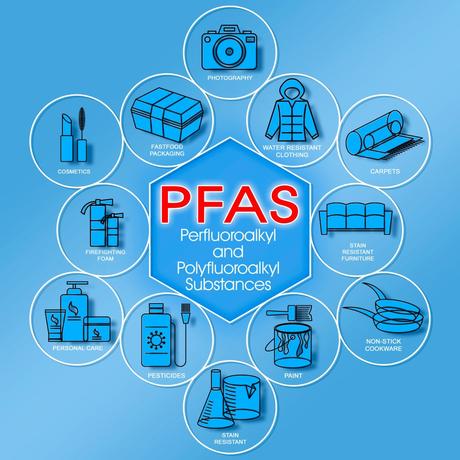
First manufactured in the 1940s, PFAS chemicals are commonly used in products and materials to make them slick, nonstick, or waterproof. Some of these products include:
- Nonstick cookware (e.g. Teflon pans)
- Food packaging (pizza boxes, grease papers, etc.)
- Water-resistant fabrics like rain jackets, yoga pants, sports bras, umbrellas, and tents
- Carpets, leather, and apparel, including outdoor gear, clothing, and oil- and water-repellent paper and leather
- Cosmetics and personal care (think: dental floss, sunscreens, shampoo, eye makeup, nail polish, micro-powders, toilet paper, tampons, and pads)
PFAS is also used in some roofing materials, concrete seals, paint, fertilizers, and pesticides. Electronics like phones and computers rely on PFAS chemicals for insulation and heat resistance, while medical manufacturing companies use them in devices like surgical patches and stents. Even cars benefit from forever chemicals; they are used in gaskets, bearings, wiring, seals, and lubricants. While you may not interact with many of these items directly, they all contribute to the widespread PFAS contamination in the environment.
How are people exposed to PFAS?
With PFAS so persistent in the environment and an ingredient in countless products, it’s no surprise that almost all Americans have measurable amounts in their bloodstream. But how did it get there, to begin with?
Drinking water
When PFAS from factories, airports, military bases, or landfills is released into the environment, they can leach into nearby soil and waterways and contaminate drinking water sources. Similarly, toxic sewage sludge used for composting may contain PFAS chemicals that could enter waterways via runoff—a concern sparking debates in places like Williamstown, Massachusetts. Unless the chemical is filtered out, you risk ingesting it.
Learn more: 1 in 5 Americans May Have PFAS in Their Tap Water, Study Finds
Food and food packaging materials
Scientists have detected PFAS in food products like milk, eggs, fruit juice, and crops grown near contaminated sites. Seafood varieties such as salmon, haddock, shrimp, lobsters, canned tuna, and others from polluted waterways have also been found to contain PFAS. Further, the chemicals can also migrate into food from nonstick cookware or microwavable containers and grease-resistant packages like burger wrappers.
In the workplace
According to the National Institute for Occupational Safety and Health (NIOSH), occupations like firefighters and chemical manufacturing workers may be more exposed to PFAS than the general public. After all, repeatedly inhaling PFAS particles, touching contaminated surfaces, or directly handling PFAS-laced materials can significantly increase exposure. Workers in plating and electronics manufacturing also come into contact with PFAS through specialized coatings and lubricants. However, firefighters often face even higher exposure risks, as PFAS in firefighting foam can be absorbed through their gear or inhaled during training and emergencies.
Related: How AFFF Firefighting Foam Can Pollute Drinking Water
Other routes
One might also be exposed to PFAS by swallowing PFAS-contaminated soil or inhaling dust or certain chemicals. Scientists have also reported that PFAS can be passed from the mother to the fetus through the placenta or to newborns via breastfeeding
How harmful are PFAS Chemicals?
While more research is underway to better understand the health harms of PFAS, the findings thus far are quite alarming. Just as PFAS can persist in the environment for who knows how long, they can bioaccumulate in your body and stay there for an incredibly long time. Worse yet, some studies suggest that, once in the body, high levels of PFAS can wreak havoc on delicate organ systems and raise the risk for a range of serious health problems.
More specifically, PFAS chemicals may increase the risk of kidney and testicular cancer. They may also contribute to weight gain—a Harvard study found that women in a weight-loss program with higher levels of PFAS in their blood regained the lost weight faster than those with lower PFAS levels. Some PFAS are also linked to type 2 diabetes, high blood pressure, and higher total and LDL cholesterol levels, which are all risk factors for heart disease. The Agency for Toxic Substances and Disease Registry lists other possible health outcomes from PFAS exposure, including decreased vaccine response in children, liver damage, obesity, hormonal disorders, fertility problems, and lower birth weight.
Learn more: The Toxic Effects of PFAS in Drinking Water | PFAS Exposure May Raise Diabetes Risk in Middle-Aged Women, Study Reveals
PFAS Regulation: What’s being done to address forever chemicals in US drinking water?
In April 2024, the EPA established its first-ever drinking water limits for five types of PFAS—a move the agency estimates will reduce PFAS exposure for approximately 100 million US residents. Under the new rule, drinking water should contain no more than 4.0 parts per trillion (ppt) of PFOA and PFOS individually, and 10 ppt for PFNA, PFHxS, and HFPO-DA (GenX Chemicals). The goal, however, is to hit zero, as the EPA also cautioned that no level of PFAS exposure is safe.
Several states have issued limits on PFAS in drinking water, but we’re seeing these efforts pick up steam as of late. For instance, Minnesota’s comprehensive “Amara’s Law” kicked in in January 2025, banning products containing “intentionally added PFAS.” Around that same period, California imposed a law prohibiting the manufacturing, distributing, or selling of apparel or textile products containing intentionally added PFAS.
Many states also have upcoming reporting requirements, forcing companies to disclose where they’re using PFAS. We’re constantly seeing new bills proposed, too. States like Illinois, Maryland, and New Mexico are considering comprehensive PFAS bans similar to Maine and Minnesota’s.
Learn more: EPA Proposes First-Ever Federal Regulations for PFAS in Drinking Water
Are PFAS chemicals in your drinking water?
No matter your water source, there’s a chance it’s tainted with PFAS. Unfortunately, you can’t tell if the water is contaminated by looking at it, smelling it, or tasting it. You’ll need to test it to be certain.
It’s always advisable to have your water tested by a certified laboratory to ensure the most accurate results. When you purchase a water testing kit, it has clear instructions for collecting the water sample from your tap and sending it to the corresponding laboratory. Usually, you’ll receive the test results in a few days to around one or two weeks.
If testing isn’t accessible and you receive a monthly water bill, reach out to your local water provider, request a copy of their latest water quality report, and read through it to see if there have been any recent PFAS contamination reports in the local water supply. You can also check the EWG’s Tap Water Database to see if any recent contamination has been reported in your water supply.
How do you reduce your exposure to PFAS?
Admittedly, completely avoiding PFAS is next to impossible. After all, it’s all around us—in the air we breathe, the water we drink, the food we eat…everywhere! The good news, however, is that there are ways to minimize your exposure to those toxic forever chemicals:
- Avoid cooking with pans with nonstick coatings. Instead, use ones made with ceramic, glass, cast iron, stainless steel, and other PFAS-free materials.
- Limit how often you eat takeout food.
- Transfer food out of its original container or packaging when you can.
- Check your local fish advisories before eating locally sourced fish or shellfish.
- Avoid reheating food in its original container.
- Buy fewer products labeled water- or stain-resistant (refer to this list of PFAS-free products).
- Dust surfaces regularly with a damp cloth to reduce PFAS-laced dust.
- Read labels carefully to ensure the products you’re buying don’t contain PTFE or “fluoro.”
If a water test shows PFAS in your drinking water, filtering the water with an under-sink reverse osmosis filter can help remove most chemicals (and other pollutants and impurities), making your water cleaner, safer, and healthier to drink and use.
Large-Scale Treatment Technologies for Reducing PFAS in Drinking Water
US water utilities have been exploring better ways to capture and destroy forever chemicals before they reach your tap. Here are some of the most commonly used methods, as well as their pros and cons:
Granular Activated Carbon (GAC)
Nature reports that in Wilmington, North Carolina, water treatment plants have been using methods involving granular activated carbon (GAC) to soak up harmful chemicals from the city’s drinking water. As water flows through the porous carbon material, the PFAS chemicals get trapped and housed inside its tiny nooks and crannies. Typically, the used GAC gets hauled off via trucks, sometimes hundreds of miles, to off-site furnace-like ovens. The carbon is exposed to temperatures as high as 1000°C to burn off the PFAS and “reactivate” the carbon. Although GAC has been shown to work well on longer-tailed PFAS like PFOA and PFOS, short-tailed varieties don’t adsorb as effectively. Plus, there are concerns that trucking the carbon over long distances worsens climate change.
Learn more: Activated Carbon Filters: What Do They Remove from Water?
Ion Exchange Resin
Think of ion exchange resin as small, porous, positively charged plastic beads packed tightly in a filter tank. Since many PFAS molecules carry a negative charge in water, they are attracted to the positively charged beads (opposite charges attract, remember?). The resins pull the PFAS molecules from the water and keep hold of them until the system regenerates.
Depending on the choice of resin, bed depth, and water flow rate, among other factors, ion exchange can be very effective against PFAS, even grabbing some of those shorter-chain PFAS that carbon filters struggle with. One downside is that resin systems can be more expensive than activated carbon. Sometimes, a “single-use” anion exchange resin (AER) is used. Once the resin becomes saturated, the whole thing is taken out and incinerated so there’s no contaminant waste stream to handle, treat, or dispose of.
The Membrane Filtration
The most powerful of the bunch, this method uses high-pressure membranes, like reverse osmosis (RO) or nanofiltration, to combat PFAS in drinking water. The concept is simple: contaminated water is forced through the membrane under pressure. The membrane contains super-fine pores that physically block the PFAS molecules from passing through and letting the water through. These techniques, especially RO, often remove over 90 percent of PFAS, including some of the more stubborn short-chain ones. The catch, however, is that none of these standard methods destroy the PFAS. They capture them, which leaves utilities with a new problem: filters or waste streams loaded with concentrated forever chemicals.
Learn more: Reverse Osmosis Water Filtration Explained
Emerging PFAS Water Removal Technologies
Due to the above concerns, researchers and companies are seeking better PFAS-removal solutions. Some aim to improve the efficiency of filters themselves, while others are developing new ways to destroy the PFAS using things like plasma, supercritical water (water under extreme pressure), or chemical reactions that break the PFAS molecules apart at lower temperatures. While these “destruction technologies” are still largely in development, they offer hope for a more permanent solution than just capturing and trying to contain forever chemicals.
Related: Biomimicry: 6 Examples of How Nature is Inspiring Water Filtration Innovation
Final Thoughts
PFAS contamination is a matter we can’t afford to ignore. We’re constantly exposed to these forever chemicals through consumer products and, alarmingly, our air, food, and drinking water. This is quite concerning because they never leave our bodies and may raise our risk for various health problems. While we can’t completely avoid PFAS, it’s good to be informed. Knowing the risks, testing your water, making smarter choices about the products you buy, and investing in a reliable reverse osmosis water filter are crucial steps you can take right now to cut down your exposure and safeguard your health.