


"As part of the move out of solitary confinement, I think the masks will be useful," said Johnson earlier this month, saying the masks would help give the public "the confidence that they can return to work". .
But the prospect of a new society in which the public is hiding faces has far-reaching implications for crime and security, as well as for social interaction.
"The main problem that people wearing masks throw away is the volume of people who suddenly cover their faces," said Francis Dodsworth, lecturer in criminology at the University of Kingston near London. "It could create opportunities for people who want to cover their faces for harmful reasons. They could potentially do it now without raising suspicion."
This may seem dramatic to some in Asian countries that have suffered from SARS and other epidemics, where masks have been worn for more than a decade. But evidence is already emerging from crimes committed by masked offenders in the United States and Western Europe.
A high-profile case took place in Spain, where the Interior Ministry said last month that it had arrested an ISIS terrorist who is believed to have been hiding in the southern city of Almeria since fleeing from Syria. . The press release indicated that he had adapted his behavior because of the pandemic, having barely died out. When he did, it was "always with a mask to avoid being detected".
Facial recognition becomes a new art
Experts have said that the massive wearing of masks could also complicate criminal investigations, as facial recognition is becoming an increasingly important element in the tracking of criminals.
While humans are very good at recognizing familiar faces and facial recognition algorithms have better identified patterns, the masks are throwing new headaches into the mix.
"Many of the testimonies are already problematic," said Dodsworth. "Even when a group of people witness the same crime, one person will see someone with a mustache and a hat, while another will see someone with a beard and sunglasses."
CCTV footage is sometimes the only piece of evidence in an investigation, said Eilidh Noyes, a professor of cognitive psychology at the University of Huddersfield in northern England.
"At the moment, we are not sure how facial masks will affect the accuracy of human or algorithmic face identification," she said.
A Chinese company has previously claimed to have developed software that can accurately identify people, even if they are wearing masks. However, experts still believe that we are far from becoming a standard that can be used in all circumstances.
"I think it's important that if we see claims around a specific algorithm, then we don't apply it to all algorithms because each has its own strengths and weaknesses. We need to do a lot more research "said Noyes.
Face darkening creates other problems for law enforcement, particularly when it comes to determining what constitutes suspicious behavior.
It was only last year that places like Hong Kong and France passed laws making it illegal to darken your face during a protest.
Now the police will have to make tough judgments about people's motives for covering their faces, said Dodsworth.
"What constitutes suspicious behavior is quite difficult to define as it stands. The police will have to balance public health advice when they justify arresting and searching them."
Since police in much of the world have already been criticized for being unnecessarily burdensome and overzealous during the pandemic, any new criteria will be a concern for minority groups who are already more likely to be arrested, interrogated and even killed. by the police .
Adapting to new social signals
Of all of Covid's preventative measures, the massive coverage of faces is, at least visibly, among the most dramatic.
Masks are not mandatory in most western countries due to fears over human rights concerns and privacy invasions, and stigma has generally been directed against those who wear face covers . It is possible that this is now the case for those who do not.
"People are asked to fend for themselves and suggest that they wear masks. Normally, if you walk around alone and see someone with a mask, you might be worried and avoid it. But now it is less clear when and if you should be afraid, "said Dodsworth.
In the United States, Jorge Elorza, mayor of Providence, Rhode Island, went so far as to say that citizens should "socially shame" the maskless "so that they line up."
But the fact that the use of the mask can be exploited by violent criminals could put law-abiding citizens at risk. Whether someone wants to hurt or not, not seeing someone's face hides crucial emotional signals that humans rely on for survival.
"When you see a face, you do two things at once. You are trying to determine identity: do I know them? How do I know them? And you are trying to read their emotions," said Noyes.
"Emotion recognition is important from an evolutionary point of view because it helps us to assess the threat and can also facilitate positive social interactions. This is true for people we know well and those we have never met . "

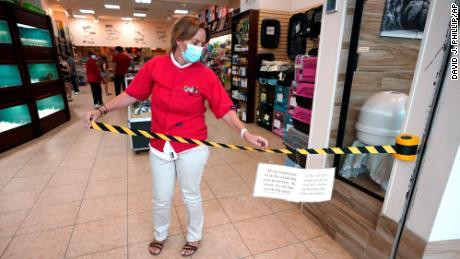
If the wearing of masks is adopted in a major way, this will inevitably affect the way humans interact and could lead to greater tension between members of the public, with implications for personal safety.
"For reasons of survival, you need to know what someone's intentions are when you meet them. Not being able to do it easily will naturally make people more cautious and defensive, which could, in some cases, unfortunately, lead to violent clashes, "said Ian. H. Robertson, Professor of Psychology at Trinity College Dublin.
Clearly, any movement towards a faceless society will be a huge problem for Western nations. As Dodsworth said, "we can initially become extremely suspicious of each other."
"It is not a culture that is familiar to us and we can adapt to it by avoiding each other."
However, he adds that all hope is not lost. "Predatory crimes are becoming more and more rare and we can find other ways to read them."
Kate Gray of the University of Reading, who specializes in processing emotions, said she thought people would probably adapt quickly.
"I think we will get used to the social and emotional cues from voice signals or body language fairly quickly," she said.
So, while the wearing of masks has been common for years in certain Asian countries, the massive adoption by Westerners will constitute a big change for citizens who appreciate personal freedoms and who are not used to heavy governance.
However, the state of readiness with which these populations have taken containment measures suggests that if face covering becomes common, the herd mentality could come into play. There will be a big new unknown: how will countries do it faced with populations who are more nervous in the company of others and distrustful of their fellow citizens?






