Years back we made the mistake of visiting Washington, D.C., over Christmas. It was bitterly cold. I vowed no more icy vacations!
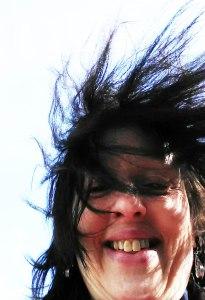
My wife’s windblown selfie
So this time we chose . . . Iceland. Well, how cold could it be in April? And wet, and windy? I didn’t realize it’s supposedly the third windiest place on Earth. The other two are uninhabited.
But it was fun. Long underwear helped.
Iceland is a small country, and sparsely settled; population only a third of a million (about equal to Anaheim’s). Partly because it is indeed fairly inhospitable. Its first settlers, in the Ninth Century, could just barely eke out survival. They came from Norway. How awful must Norway have been?
During Iceland’s next thousand years things only got worse. They quickly consumed all the island’s trees, thereafter making do with driftwood. And it grew colder.
The only saving grace was self government, of a sort, embodied in the Althing, an annual gathering for making laws and settling disputes (which seemed to be legion), presided over not by a king but the “law speaker.” Iceland’s Althing continued more or less continuously since the year 930; today the parliament still bears that name. We visited the place where the ancient Althings were convened.
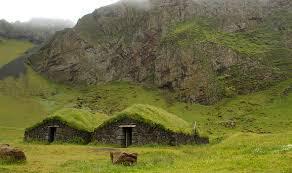
Luxurious traditional Icelandic homes
But otherwise Iceland’s history was grimly depressing. Windy though the place is, the winds of progress passed Iceland by, and the Middle Ages continued there until the middle of the Twentieth Century. Epitomizing this is the language being virtually unchanged over the millennium. Try reading or understanding Ninth Century English (if you could call it “English”).
Also, Iceland never developed the modern convention of people having last names. Instead, Bjorn’s son Eric goes by Eric Bjornsson; his daughter Ingrid is Ingrid Bjornsdottir. (I suppose transsexuals change both their names.) This makes it fun trying to look someone up in a phone book.
Iceland was finally blasted from a medieval existence into modernity during World War II. A possession of Denmark, which was occupied by the Nazis, Iceland was preemptively occupied by the Brits and Americans. Then it took the opportunity to declare independence from Denmark in 1944. Foreign investment, and tourists, poured in, and Iceland, in a few decades, vaulted into First World ranks.

Nevertheless, its people are imbued with a very positive attitude. We got a wool-making demonstration, by a gal named Harpa who characterized herself as “hyper.” She was so animated and bubbly that it made this wool demonstration a highlight of the trip for me.
Speaking of positive attitude, my wife’s, as always, greatly enhanced the experience. She enthusiastically appreciates everything and never complains about anything.
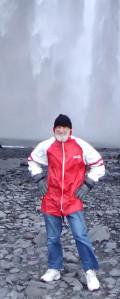
Me, under a waterfall
Another trip highlight was our glacial lagoon boat ride. That glacier is the biggest in Europe. The lagoon had only just unfrozen, and was still full of ice crunching under our open rubber boat. We were encased in rubber ourselves — looking like astronauts in space suits. Getting suited up took longer than the boat ride. And it didn’t keep us from getting wet in the cold rain. But . . . you had to be there.
We also visited the Eyjafjallajokull Volcano, whose 2010 eruption messed up European air travel. Actually, we couldn’t see the volcano itself; but a farm at its foot had set up a visitor center, showing a really excellent home-made film about the eruption’s impact on them. Our visit was just about the last before the facility was closing so the family could get back to full-time farming.