Gjirokaster Castle is one of the most impressive places I visited in southern Albania.
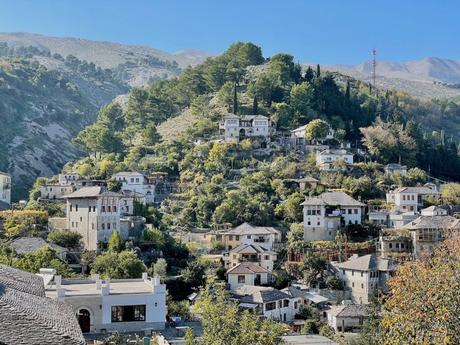
It sits high above the old stone town, with views over the Drino Valley and the slate rooftops that give Gjirokaster its nickname, the “Stone City”.
The history is just as dramatic, from Ottoman pashas to Cold War bunkers.
I ended up spending hours wandering around up here, ducking into tunnels, checking out rusting artillery and peering into the old prison cells tucked behind the museum.
Below I’ll share how to get there, what to see, and a few simple ways to dodge the worst of the midday crowds.
Table of Contents
Toggle- History of Gjirokastër Castle
- How to Get to Gjirokastra Castle
- Best Time to Visit
- Opening Hours & Entrance Fees
- What to See Inside
- Artillery Gallery
- The Clock Tower
- Gjirokaster Museum
- Prison Wing
- Cold War Tunnel
- Festival Stage
- American Airplane Wreckage
- Other Unique Features
- Italian Fiat L6/40 Tank
- Bektashi Tomb
- The Castle Columns and Cannons
- The Best Views from Gjirokaster Castle
- Exploring the Castle Grounds
- Facilities
- Where to Stay in Gjirokaster
- Luxury: Hotel Kodra
- Mid-Range: Hotel Kalemi
- Budget: Stone City Hostel
- Using Gjirokaster as a Base
- Is Gjirokaster Castle Worth Visiting?
- Practical Tips for Visiting
- Final Thoughts
Need help planning your next trip? Hire me as your Personal Travel Planner!
History of Gjirokastër Castle
Gjirokaster Castle has been watching over the Drino Valley since at least the 12th–13th centuries, when the first serious fortifications were built on this rocky ridge.
Over time, different rulers added to it and strengthened the walls. One of the most famous was Ali Pasha of Tepelena, who turned it into one of his strongholds during the late Ottoman period.
Most of what you see today dates from the Ottoman era, when the fortress was expanded, re-fortified and used to control this part of southern Albania.
Later, in the 20th century, the castle’s role shifted again and parts of it were turned into a prison.
Under the communist regime it held political prisoners, and you can still walk through some of those cells today.
How to Get to Gjirokastra Castle
Getting to Gjirokaster from Tirana is straightforward.
Daily buses run from the main bus terminal and usually take around 4–5 hours, depending on traffic and stops. It’s the cheapest option and works fine if you’re not in a rush.
If you’d rather have more freedom, renting a car is the way to go. The drive is quicker and you can stop for coffee or viewpoints along the way instead of being stuck to a fixed timetable.
There are also organised day tours from Tirana if you prefer everything handled for you.
From Saranda, the drive to Gjirokaster takes roughly 1 to 1.5 hours. For a day trip, I’d definitely recommend hiring a car so you can come and go on your own schedule.
Buses do run, but timetables can be patchy, so check times locally.
Driving in Albania is generally fine, but expect narrow, winding roads and the odd pothole. Take it steady on the mountain bends and avoid driving too fast at night.
Once you’re in Gjirokaster, you can either take a taxi or walk up to the castle through the Old Town’s cobbled streets.
The walk is steep but very scenic and takes about 15–20 minutes from the Old Bazaar.
Best Time to Visit
Spring and autumn are the best times to visit Gjirokaster Castle. I went in October and it was perfect.
The temperature was comfortable, the air felt clear, and I could wander around the courtyards without roasting on the exposed stone.
Summer is fine too, but it gets hot up here and shade is limited.
If you want a quieter visit, go early in the morning or later in the afternoon.
The castle feels much calmer at these times, and the light is softer, which makes the views over the Drino Valley even better for photos.
Winter can be chilly and occasionally misty, but the castle is still open and you’ll likely have large parts of it entirely to yourself.
Many restaurants (and some guesthouses) in town will be shut though, so I wouldn’t really recommend visiting Gjirokaster then.
Opening Hours & Entrance Fees
Gjirokaster Castle is usually open from 9.00 am to 7.00 pm in the high season (roughly April to October) and from 9.00 am to 5.00 pm in the colder months.
Hours do change from time to time, so it’s worth checking locally when you arrive.
The entrance fee is 400 LEK per adult. Children under 12 can enter for free.
The Gjirokaster Museum sits inside part of the castle and has its own ticket, which costs 200 LEK per adult.
Tickets are cash only, so make sure you’ve got some lek with you before you head up the hill.
What to See Inside
Artillery Gallery
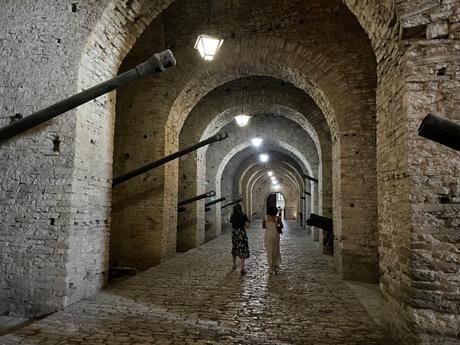
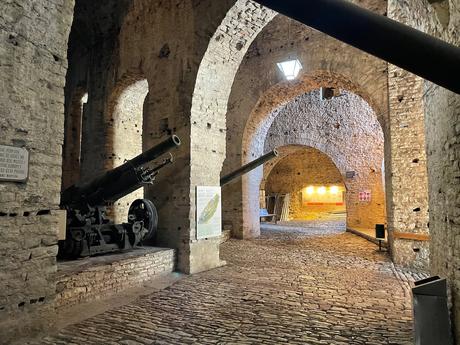
One of the first places I wandered into was the long corridor lined with old cannons and bits of artillery. The light is dim and the air feels cool, which adds to the atmosphere.
You don’t need to be into military history to find it interesting. It gives you a real sense of how heavily fortified this place once was.
The Clock Tower
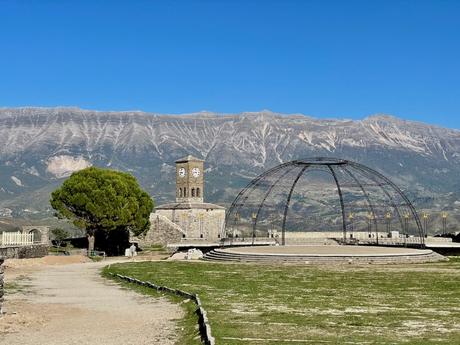
The Clock Tower rises above the main walls and is one of the best spots for views.
From up here you can see the whole stretch of stone rooftops running down the hillside, with the Drino Valley opening up behind them. I took far too many photos here.
Gjirokaster Museum
The museum inside the castle is small but useful for understanding the city’s story.
It covers everything from local traditions to more recent history, and it helps tie together what you see in the rest of the fortress. It’s worth popping in if you want a bit more context.
Prison Wing
The prison wing is one of the parts that stuck with me most. You walk through dim corridors and past old cells that still feel heavy with the stories of the people held here during the communist era.
It’s not a cheerful place, but it’s important and very memorable.
Cold War Tunnel
This isn’t inside the main fortress itself, but the entrance sits just below the castle hill.
It’s a network of bunkers built during the communist period, with long concrete corridors and rooms designed for officials to shelter in during an attack.
You’ll need a separate ticket and guide to visit, and access can vary, so check the times before you go up.
Festival Stage
At the far end of the castle you’ll find the stage used for Albania’s National Folk Festival, which takes place every few years.
Even when there’s nothing happening, it’s an interesting spot to stand for a minute.
The open space, the backdrop of mountains and the size of the seating area give you a sense of how big a deal the festival is here.
American Airplane Wreckage
One of the more unexpected sights inside the walls is a US Air Force T-33 jet. It’s been sitting here since the Cold War and has become part of the castle’s odd charm.
Stories differ on how it ended up in Albania, which only adds to the mystery. It’s a strange thing to stumble across in a medieval fortress.
Other Unique Features
Italian Fiat L6/40 Tank
Near one of the outer courtyards you’ll come across a small Italian tank from the Second World War.
It’s rusty and a bit battered, but it’s a reminder of how many different periods of history cross over in this place.
Bektashi Tomb
Tucked away in a quiet corner is a small Bektashi tomb. It’s easy to miss if you’re not looking for it.
If you do find it, take a moment to step inside and be respectful. It’s a peaceful contrast to the huge walls and heavy military relics outside.
The Castle Columns and Cannons
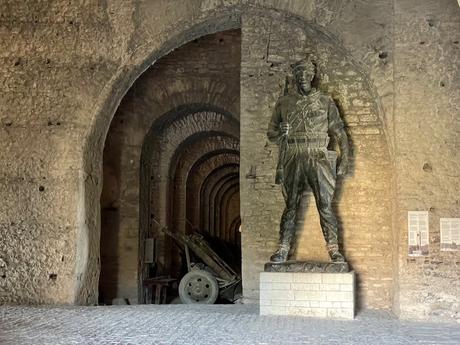
All around the grounds you’ll spot thick stone columns, old cannons and crumbling arches.
They’re not labelled or roped off, which makes wandering around feel a bit like exploring an open-air maze. I found myself stopping every few minutes to look at some detail worn into the stone.
The Best Views from Gjirokaster Castle
The views from the castle are one of the main reasons to come up here.
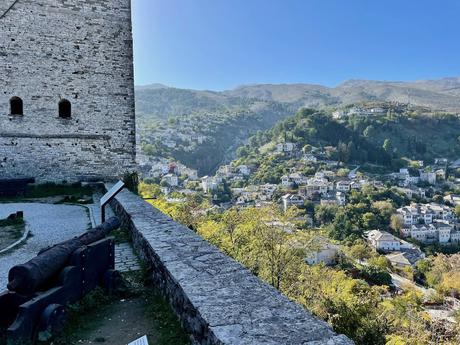
From the walls you can see the slate rooftops of the Old Town dropping down the hillside and the Drino Valley stretching out in the distance.
The mountains frame everything and change color throughout the day.
My favorite spot is near the Clock Tower. The angle from there gives you both the town and the wider valley, and it looks completely different as the light shifts.
Late afternoon is especially nice, when the stone houses pick up a warm glow and the shadows get long.
If you like taking photos, give yourself time to wander between different viewpoints. There are loads of natural vantage points.
Exploring the Castle Grounds
Once you’re inside the main gate, you realize how big the place actually is. The central courtyard opens up in front of you, with views over the city on one side and the mountains on the other.
It’s a great spot to pause for a minute before deciding which direction to head first.
Walking along the walls is a must. The paths are uneven in places and the drops can feel steep, but the views make it worth taking your time.
I kept finding little stairways disappearing into corners, so it’s worth exploring rather than sticking to one set route.
You’ll also come across a few quiet pockets away from the main paths. These are good places to rest for a moment and take in the scale of the fortress without anyone else around.
Wear comfortable shoes for this part. There’s a lot of stone underfoot and some of the older sections are easy to trip on if you’re not paying attention.
Facilities
You can explore the castle on your own or join a guided tour if you want more background. Audio guides are sometimes available too, but most people are happy wandering at their own pace.
The layout is simple enough once you’re inside.
There are bathrooms, which is handy because you can easily spend a couple of hours up here.
It’s nothing fancy, but it’s a good spot to cool off before or after the climb.
If you plan to visit the museum or the prison section, you’ll buy those tickets separately at the counters inside. Everything is cash only, so keep a bit of lek on you during your visit.
Where to Stay in Gjirokaster
Most places to stay cluster around the Old Bazaar, which is ideal if you want to be within easy walking distance of cafés, craft shops and the main sights.
The castle sits above everything, so wherever you stay, expect a bit of uphill walking at some point.
Luxury: Hotel Kodra
Hotel Kodra sits in a restored stone house and has a terrace with great views over Gjirokaster.
The rooms mix traditional details with modern touches, and the whole place feels calm and comfortable.
It’s a good choice if you want somewhere a bit special without losing the character of the Old Town.
Mid-Range: Hotel Kalemi
Hotel Kalemi is set in an Ottoman-style building and feels very true to the city’s architecture.
The rooms have carved wooden ceilings and traditional furnishings, and the atmosphere is warm and homely. It’s a solid mid-range pick if you want something authentic at a decent price.
Budget: Stone City Hostel
Stone City Hostel is popular with backpackers and budget travellers. The rooms are simple but comfortable, and the shared areas make it a sociable place to stay.
They also run free walking tours, which is a great way to get your bearings when you first arrive.
Using Gjirokaster as a Base
Gjirokaster works well as a base if you want to explore more of southern Albania without rushing around.
The Blue Eye is the easiest trip from town. It’s about 45–60 minutes by car and the route is straightforward, so it makes a good half-day outing.
If you’re into hiking, Fir of Hotova-Dangëlli National Park is another option. It’s around 70 kilometres away, so it’s better if you have your own car or are happy to join a tour.
The scenery there is wild and quiet, with mountain roads and long stretches of forest.
You can also combine Gjirokaster with nearby villages or a loop down to the coast if you’re traveling onwards to Saranda or Ksamil.
The roads around the region are slow but scenic. Staying in Gjirokaster means you can explore during the day and come back to a relaxed, atmospheric old town in the evenings.
Is Gjirokaster Castle Worth Visiting?
Yes, absolutely. Gjirokaster Castle is an amazing place to visit.
The mix of history, strange Cold War relics and huge valley views gives it a completely different feel from other castles in the Balkans.
Exploring the fortress was one of my favourite experiences in Albania.
I kept drifting off down side tunnels and finding corners I didn’t expect, including the old prison section, which I found both fascinating and a bit eerie.
The views over the Drino Valley alone make the climb worth it.
Add the atmosphere of the old stone walls and the layers of history packed into one hilltop, and it becomes a very easy place to recommend.
Practical Tips for Visiting
Wear comfortable shoes. Almost everything inside the castle involves stone steps, uneven paths and a fair amount of walking.
Bring water with you, especially if you’re visiting in summer. There’s a small café near the bottom of the hill, but you’ll be glad to have a bottle with you while exploring the upper sections.
Shade is limited, and the open courtyards can feel very hot in the middle of the day.
If you like photography, try to come early or late. The low light makes the stone glow and the valley views look far better than they do at midday.
It’s also much quieter, which makes wandering the walls more enjoyable.
Take your time. Some stairways are narrow and easy to miss, and slowing down helps you notice details you’d otherwise walk straight past.
Bring cash for tickets.

Final Thoughts
Gjirokaster Castle brings so many parts of Albania’s story together in one place. You’ve got medieval walls, Ottoman history, Cold War bunkers and huge valley views all sitting on the same hilltop.
Standing on the upper walls and looking out over the Drino Valley was one of my favorite moments in Gjirokaster.
The rooftops below, the mountains in the distance and the quiet up there make it easy to linger longer than you meant to.
If you want more ideas for your trip, check out my post on things to do in Gjirokaster. It’s a great town to base yourself in and there’s plenty to explore once you’ve spent time at the castle.