 Villa Rides (1968) is one of those oddball movies that, by all rights, should be good but manages to botch almost ever. Sam Peckinpah wrote the script during his post-Major Dundee exile, but Yul Brynner objected to his cynical portrayal of Pancho Villa, fired him from the project and retooled it into a conventional action movie. At best Saturday night cable filler, there's nothing to distinguish Rides from a score of similar Mexican Revolution films.
 American pilot Lee Arnold (Robert Mitchum) runs guns into revolutionary Mexico. Initially apolitical, he becomes radicalized witnessing a Villista village ransacked by reactionary Colorados led by Captain Ramirez (Frank Wolff). He's conscripted into fighting with Pancho Villa (Yul Brynner), who employs his airplane in his raids against Colorado forces. Villa feuds with General Huerta (Herbert Lom), who resents the bandit's guerrilla skill and popularity with the people; his brutal tactics, and particularly his psychotic aide Fierro (Charles Bronson), wear Arnold's patience thin, even as he romances a Mexican woman (Maria Grazia Buccella). Eventually, Villa wins one battle too many, leading to a confrontation with Huerta that threatens to upend the Revolution.
Surely an effort to capitalize off The Professionals, Villa Rides jettisons that film's wit and style for a thoroughly generic experience. Whatever Peckinpah's original intentions, his script (credited to him and Robert Towne, then a young script doctor) is mostly a knot of cliches connecting familiar set pieces. The early scenes espouse some cynicism about Villa's cause - he delays rescuing a village from Colorados until the latter have killed a sufficient number of civilians to radicalize the survivors - but afterwards it turns into standard South of the Border cliches: fiery dances, spicy cuisine, sombreros and shootouts. It's interchangeable with a million Spaghetti Westerns, though without the crude Marxist politics of those films.
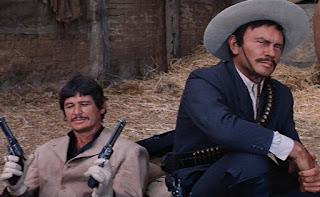
Indeed, Villa Rides lacks discernible politics of any kind, which seems a major handicap for a film about the Mexican Revolution. We're told about Villa's devotion to the liberal President Madero (Alexander Knox) but not what they actually plan to achieve; his feud with Huerta comes down entirely to a personal clash. Nor does Villa really have much personality, aside from his penchant for marrying every girl he falls for; he's a dashing tough guy and guerrilla strategist, but rarely seems like more than a cardboard cutout. He's marginally less bland than Arnold, a generic gringo character who witnesses and occasionally takes part in Villa's revolution without taking much initiative. That leaves the color to Fierro, whose creative execution methods enliven a few scenes: at one point, he shoots a boorish comrade then orders him to die outside: "Where are your manners?"
Villa Rides's spectacle is as pedestrian as everything else. Director Buz Kulik mostly worked in television, and filming in Spain with a decent budget struggles to stage the necessary action. Rides has a parcel of genre-mandated action scenes (a bloody river battle, the obligatory train ambush) but they're staged with a minimum of creativity, all falling horses, blood squibs and inexplicable zooms that dissipate any epic feeling. Kulik lets many scenes run too long: what on Earth is the point of dragging out the ridiculous scene where Villa confronts a reluctant firing squad? Only the gag of Arnold dropping cigar-lit bombs on Federales shows any wit, and even that's ancillary to generic shootouts. It's the perfect example of what one critic dubbed "chili con carnage," reducing Mexico's complex history and culture to redundant gundowns.
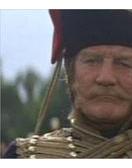
Yul Brynner plays Villa with a mangy toupee and one note of steely resolution; very little humor, humanity or even charisma leaks into his performance, giving the film a dull center. Robert Mitchum seems utterly bored, barely finding the motivation to react to the mayhem around him. Charles Bronson relishes the chance to chew scenery; normally sedate, he has fun playing one-man firing squad to Villa's prisoners or shouting bombastic threats at Mitchum's nonplussed gringo. Herbert Lom and Frank Wolff make dependably slimy villains, but Alexander Knox barely has more screen time than the uncredited John Ireland, who turns up for a meaningless cameo at the end.
Sam Peckinpah made the most of his experience on Villa Rides: even though most of his script was discarded, he incorporated his research into The Wild Bunch, a much more authentic and original film that treats the Mexican Revolution setting with more gravity. Rides has no perspective on the Mexican Revolution, despite its absurd onscreen dedication to Villa, while treating his country as nothing more than a shooting gallery for hard-boiled action heroes.