


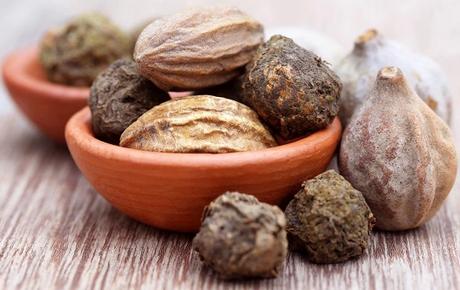
- Amalaki
- Hritaki
- Bibhitaki
DESCRIPTION
1. AMALAKI
Amla is also known as Indian gooseberries. The Amla contains Vitamin C.
SYNONYMS OF AMLA:-
- Phyllanthus emblica
- Emblic
- Emblic myrobalan
- Myrobalan
- Indian gooseberry
- Malacca tree
- Cicca emblica (L.) Kurz
- Diasperus emblica (L.) Kuntze
- Dichelactina nodicaulis Hance
- Emblica arborea Raf.
- Emblica officinalis Gaertn.
- Phyllanthus glomeratus Roxb. ex Wall. nom. inval.
- Phyllanthus mairei H.Lév.
- Phyllanthus mimosifolius Salisb.
- Phyllanthus taxifolius D.Don
SANSKRIT NAME OF AMLA:-
- Amalaki
SCIENTIFIC NAME:-
- Phyllanthus Emblica
CLASSIFICATION OF AMLA:-
- Kingdom – Plantae
- Division – Magnoliophyte
- Class – Magnoliopsida
- Higher Classification – Leafflower
- Order – Malpighiales
- Family – Phyllanthaceae
- Genus – Phyllanthus
- Species – emblica
AYURVEDIC PROPERTIES OF AMLA:-
Rasa (Taste) Madhura, Amla, Katu, Tikta, Kashaya
Guna (Property) Laghu, Ruksha
Virya (Potency) Sheeta
Vipaka (Post Digestion Effects) Madhura
USES OF AMLA:-
- The Amla has immuno-booster and it helps to body recover from illness
- The Amla has several health benefits
- The Amlka is helpful in improve memory
- The benefits of amla in type 2 diabetes patients, it controls the blood sugar levels
- Amla regulate bowel movements and it help to relieve in conditions like irritable bowel syndrome.
- Amla berries contains fibers that helps the body High levels of vitamin C, so it helps to body absorb other nutrients like iron and mineral supplements
- The Amla berries are rich in vitamin A and this improving the eye health
- Amla helps to improves the vision
- Amla lower the risk of age-related macular degeneration
- This acts as a good antibiotics by fighting bacteria
- It protect from conjunctivitis (pink eye)
- Amla treats eyes infections and other infections of the body
2. HARITAKI
Haritaki is also known as Terminalia chebula.
SYNONYMS OF HARITAKI:-
- Haritakiare Abhya
- Pathya
- Kayastha
- Putna
- Amrita
- Haimvati
- Avyatha
- Chetki
- Sreyasi
- Shiva
- Vayastha
- Vijiya
- Jivanti
- Rohini
REGIONAL NAMES OF HARITAKI:-
- English name:- Indian walnut, Indian hot plum
- Hindi name:- Harad
- Telugu:- Karakkaya
- Tamil:- Kadukkai
- Gujarati:- Harade, Hardi, Harara
- Arbian:- Heleelaz
- Farsi:- Hallel
- Assam:- Shilikha
- Kannada:- Ordo, Hardi
- Malayalam:- Kadukka
- Marathi:- Hirda
- Persian:- Halela
CLASSIFICATION OF HARITAKI:-
- Kingdom – Plantae
- Subkingdom – Spermatophya
- Division – Magnoliphyta
- Class – Magnoliopsida
- Subclass – Rosida
- Order – Myrtales
- Family – Combretaceae
- Genus – Terminalia L.
- Species – T. chebula
AYURVEDIC PROPERTIES OF HARITAKI:-
Rasa (Taste) Madhur, Amal, Katu, Tikta, Kashay
Guna (Property) Ruksha, Laghu
Virya (Potency) Ushna
Vipaka (Post Digestion Effects) Madhur
USES OF HARITAKI:-
- Haritaki is used to treat indigestion and gastric problems
- Haritaki is used in the treatment of lung disease like Asthma, cold and cough
- This helps to reduce the body weight in the patients of obesity
- It also cures vision defects
- It treats urinary tract infections
- Haritaki is also very helpful in all types of skin infections
- This is used in hair problems
- It helps to controls acidity
- Haritaki prevents Diabetes as it helps to regulate the blood sugar levels and decrease resistance in the body
- Haritaki churna is used to purify the blood
- Haritaki makes the heart muscles stronger
- It also cleans the arteries of the heart
- It helps to maintain the blood pressure
- This improves the absorption of fluid
- It increases the digestive enzymes and improves digestion
- Haritaki has brain-boosting properties
- It is a powerful antioxidant
- Haritaki progression the neurogenerative disorders like Parkinson disease
- Haritaki plant contains neuroprotective elements, and it helps to prevent loss of memory
- It also relieves the tension from the brain
- Haritaki also boosts sexual health and stamina of both male and female
- It also works as memory boosting food
- It also improves the fertility of both male and female
- It treats several reproductive diseases
- Haritaki improving the gut health
- This helps to treat many gastric disorders like diarrhea, flatulence, esophagitis, heartburn, peptic ulcers, gastroesophageal reflux disorder, indigestion, constipation, and stomach pain
- It also helps to eliminate abdominal gas and reduces abdominal distension, gaseous cramps, and bloating
- Haritaki plays the role of strong anti-bacterial, anti-viral, and anti-fungal
- It helps to remove the germs and bacteria from the body
- It also treats the wound and improves healing
- Haritaki contains a bioactive compound that treats various skin problems like sores, ulcers, and skin fungal, etc
- Haritaki provides the hair health
- It also strengthens the hairs from their roots
- It prevents hairs from breakage and loss of hairs
- This also provides silky soft and smooth hairs
- Haritaki provides a healthy heart as it reduces the risk of heart attacks, heart blocks, blood clots, and atherosclerosis
- It is used to balancing the Vata and pitta disorders
- It prevents malnutrition
- Haritaki also prevents the stiffness of joints and fatigue
3. BIBHITAKI
SYNONYME OF BIBHITAKI:-
- English names – bahera or beleric or bastard myrobalan
- Malayalam – Tanikaya
- Telugu – Taddi
- Tamil – Todikai
- Bengali – Taida
- Gujrati – Baheda
- Hindi – Bahera
- Kannada – Tare Kayl
SANSKRIT SYNONYMS:-
- Aksha
- Karshaphala
- Bhootavasa
- Kalidruma
- Kaliyugalaya
SCIENTIFIC CLASSIFICATION:-
- Kingdom – Plantae
- Clade – Angiosperms
- Clade – Eudicots
- Clade – Rosida
- Order – Myrtales
- Family – Combretaceae
- Genus – Terminalia
- Species – T. bellirica
CHEMICAL CONSTITUENTS:-
- Chebulagic Acid
- Chebulinic Acid
- Gallotannins
- Ellagic Acid
- Anthroquinone glycosides
- Tri-Terpenoids
- Bellericoside
- Bellericanin
- Termilignan
- Thannilignan
AYURVEDIC PROPERTIES OF BIBHITAKI:-
Rasa (Taste) Kashaya (Astringent)
Guna (Property) Ruksha (Dry), Laghu (Light)
Virya (Potency) Ushna (Hot)
Vipaka (Post Digestion Effect) Madhur (Sweet)
USES OF BIBHITAKI:-
- Bibhitaki Is used in purgation therapy
- Bibhitaki is useful in the treat respiratory problems like cough, hoarseness of voice, and asthma
- This is used in hair problems
- Bibhitaki is also used to pacify kapha dosha and vata dosha
- Bibhitaki helps to reduce cholesterol level in blood as it has anti atherogenic agents
- It is a natural blood purifier
- Its dietary fibers are good for digestive system
- It helps to relieve constipation
- Bibhitaki is a natural laxative and used for purgation therapy
- It is also a good skin tonic
- Bibhitaki cure many types of skin allergies
- Bibhitaki contains anti-bacterial properties
- It helps to heal acne and ulcer spotted skin
- This also used to treat sore throat and gingivitis
- It helps to expel out extra mucus from the respiratory track
- Bibhitaki is a great immuno booster
- Regular use of Bibhitaki is very beneficial for the health
- Bibhitaki is very good remedy for diabetes, it regulate the glucose levels in blood as it decrease the sensitivity of insulin
- Bibhitaki is a good pain killer
- It has anti-inflammatory properties
- Bibhitaki is also used to treat rheumatism
- The paste of Bibhitaki fruit is applied over the eyelids to treat the conjunctivitis, corneal opacity, and cataract, etc
- It has anti-diarrheal properties
- Bibhitaki helps to enhance mental focus and alertness as it has adaptogenic behavior
- It helps to regulate blood pressure
- Vibhita has hepato protective properties due to the presence of gallic acid in Bibhitaki
- Bibhitaki has properties of anti-helminthic, anti-fungal
- It has also anti-malarial properties
- Bibhitaki contains gallotannins which is used in the treatment of Parkinson disease, Alzheimer disease, and retro degenerative diseases.






