"You can't judge him by ordinary standards. They wouldn't fit him. He was too big."
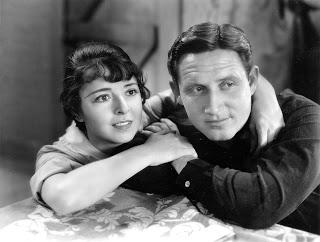
William K. Howard's The Power and the Glory (1933) was lost for decades, despite a perennial star (Spencer Tracy) and script by Preston Sturges. An archetypical tale of a tycoon's rise and fall, it's especially interesting as an unacknowledged progenitor to Citizen Kane (1941). More conventional than Orson Welles' masterpiece, it nonetheless deserves rediscovery.Railroad tycoon Tom Garner (Spencer Tracy) commits suicide, leaving behind a contentious legacy. To admirers, he was a hard worker who climbed his way up the corporate ladder. To detractors, he was a brutal taskmaster who bullied his competitors, oppressed his employees and betrayed his long-suffering wife Sally (Colleen Moore) for socialite Eve (Helen Vinson). His lifelong friend Henry (Ralph Morgan) tries to sort good from bad in recounting Tom's life.
The Power and the Glory packs a lot into its 76 minute runtime. Sturges' script frames Tom's life as a rags-to-riches tragedy. Unlike Kane, Tom's s a genuine self-made man. An illiterate track walker, he blossoms with Sally's love and tutelage into an ambitious entrepreneur. Unsurprisingly, he hardens as he grows richer, able to browbeat his board of directors and face down strikers but unable to navigate personal problems. Sally's endlessly faithful, even casting herself aside when Tom falls for Eve. Tom's son (Phillip Trent) becomes a loutish dilettante expelled from college and uninterested in the family business.
Howard's film is much more conventional than Welles'; the direction is straightforward rather than stylish, the flashback scheme more schematic in contrasting Tom's youthful naivety and elderly disconnect. Tom seems less an enigma, with only one individual recounting his life to a skeptical wife (Sarah Padden). For all that, Glory's rounded portrait of personal downfall still resonates.
Being pre-Code, The Power and the Glory is surprisingly direct. Tom's adultery is handled sympathetically, alongside explicit discussion of pregnancy and suicide. Far more striking is Howard's depiction of labor unrest. Tom tries intimidating strikers into giving up; when that fails, an army of Pinkertons descends on them. The result's surprisingly violent, a running gun battle culminating in a fiery massacre. Not until The Grapes of Wrath would Hollywood tackle class conflict so bluntly.
Spencer Tracy's role amounts to a dual performance: Tom as eager young go-getter and antiquated tyrant. Tracy handles both roles well, with a smattering of make-up and hair dye to make the transformation creditable. Colleen Moore, in one of her last roles, is endearing and tragic showing Sally's disillusionment with her husband; Helen Vinson's Eve can't generate the same sympathy. Ralph Morgan (The Life of Emile Zola) is saddled with narration duties.
Modern viewers can't help noticing that The Power and the Glory prefigures an entire genre of cutthroat corporate dramas. While its melodrama seems simplistic compared with contemporary iterations, it's still effective as an archetypical tragedy.