A critical topic for us, our children, their children and so forth for generations.
US carbon emissions in the energy sector have dropped since 2007 and will remain under the 2007 peak for the next few decades if projections on natural gas hold and exports fail to materialize. Historically cheap natural gas, enabled by hydro fracture drilling technology has granted a temporary reprieve through the economic destruction of the US coal generation industry.
 The politicizing of the carbon management debate by monied interests has prevented thoughtful debate over optimal economic approaches to manage carbon such as tax and dividend with tariffs on trade. Instead, in a surprising SCOTUS decision, the Clean Air Act will be used to manage carbon through emission cap regulation. The problem is that it's a rather blunt instrument. With any luck, the new regulation proposed by the Administration will engage shortly. New coal plants will be constrained to operate with emissions comparable to small natural gas turbine plants. This implies that to build a new coal plant, you'll have to put ~40% effective carbon capture and sequestration on the plant or you can't get a license.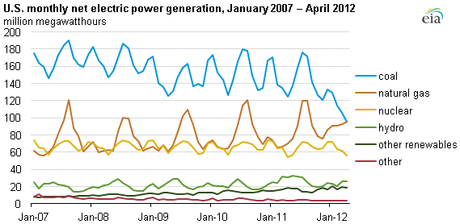
Declining power generation from coal, January 2007 to January 2012 (EIA)
There's really no more thermal efficiency that can be pulled out of new super-critical coal plants except by going to co-generation. Usually, the capital risk economics don't work out on that. The short answer is that this will likely block most new coal generation. Meanwhile, old coal plants are struggling to meet new emission limits on mercury and the cost of upgrades is not competitive against decommissioning and building a combined cycle natural gas plant. Old plants are retiring at a steady clip and new plants will be blocked. If this continues, in a couple decades, the coal era will end in the US. You can imagine the angst in the coal States.
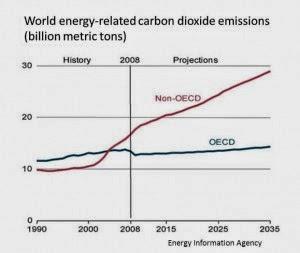
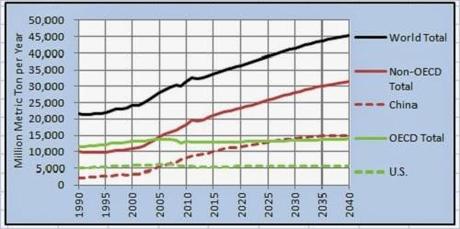
Renewables? Yes! Nuclear? Yes and lots of it! Natural gas? Yes! But to execute a Marshall Plan we need to disconnect the advantage of cheap coal in the developing world. In the first instance that means carbon tariffs on trade (perhaps the most important mechanism of all since we're the dumping ground of cheap products based on coal electricity). It also means getting our natural gas glut into the international market to get the price of electricity up high enough to convert the infrastructure.
Hopefully President Obama's big push on new LNG terminals will move forward quickly because of the Ukraine geopolitics. Monied interests, fat and lazy sucking down cheap US natural gas, and a few odd confused environmentalists lacking a global perspective, have battled the Administration all the way. We need low carbon technology. All of it at massive scale right away.
___________________________________
Jon Phillips, PhD, is a Senior Technology Expert at the International Atomic Energy Agency in Vienna, Austria, and is the Director of the Sustainable Nuclear Power Initiative at Pacific Northwest National Laboratory, in Richland, Washington. The opinions expressed are his own and do not necessarily reflect those of the IAEA or PNNL.