They may not be good looking and display a lazy gait - but still are an attraction. We find them at Guindy park and more at Crocodile bank nearer Mahabalipuram. Muggers are found in large water bodies. Crocodile attacks on people are common in places where large crocodiles are native and human populations live. Only six of the 23 crocodilian species are considered dangerous to adult humans, and only individuals 2 metres (6.6 ft) in length or more represent a serious danger to humans, as smaller crocodiles are considered incapable of killing a person. The two species with the most well-known and documented reputation for preying on humans are the Nile crocodile and saltwater crocodile. Each year, hundreds of deadly attacks are attributed to the Nile crocodile in sub-Saharan Africa. The mugger crocodile is also very dangerous to humans, killing many people in India every year. The attack of crocodile could be in defense of its territory, nest, or self or can be predatory, accidental or in the course of handling by the people. In one of my visits to Coimbatore, I went to the VOC park maintained by the Municipality. There was an old person, who entered into the crocodile enclosure, with some difficulty and great effort using sticks opened the mouth of the mugger crocodile and shoved the meat pieces into its mouth.Astonished I asked him, why would he do that ? - he responded that crocodiles are generally lazy and would not devour the food immediately. The pieces may get eaten by crows and other birds… so much devoted to his work was he but little did he realize the danger.. The other day at Crocodile park near Mahabalipuram, saw those big ungainly creatures move rather fast when pieces were thrown. One or two fell closer to the compound wall… the caretaker here, harried the crocs farther by rapid tapping of sticks , jumped inside to take out and upon climbing threw the chops closer to them. When he asked, he said, these animals can be very angry, react very fast and a bite can cause even lose of a limb ! Now read this article in today’s Times of India. : A Singaraj betrays no hint of fear as he enters the cages of the VOC Park mini-zoo where crocodiles and snakes are kept. As one of the longest-serving employees of the zoo, the man, in his 60s, has been taking care of these animals for several years. He has even named a few of them.
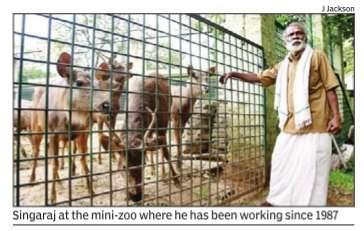 Though
Singaraj has learnt the art of handling reptiles from his grandfather and
father, the journey has not been always been smooth.Singaraj has been bitten by
snakes and attacked by crocodiles several times. The risky job has left many
scars on Singaraj but those have never deterred this animal lover who feels all
the creatures treat him like a friend. “I have named a few deer and while most
of the female ones have goddess' names, males are usually named after men who
are known for their strength and valour,“ he says. Singaraj joined the minizoo
in 1987 to look after the snakes. “My grandfather and father earned their
living by handling snakes. They taught me that art too. It takes a lot of
courage to catch and feed them. One should understand the reptile or the animal
we are handling and ensure that we do not cause it any discomfort,“ he says.
Singaraj
was instrumental in setting up the zoo. When DrPalanisamy was the zoo director,
it was Singaraj who traveled with him till Amaravathi and brought 10
crocodiles from there. He traveled to the Nandankanan Zoological Park in
Bhubaneshwar and brought two lions, one tiger, one bear, deer and other animals
for the mini-zoo.“Though I was in charge for snakes, I have taken care of all
the animals. Due to government regulations, we had to send back many animals,“
he said. He brought snakes from Alandurai and other forests near the city. Many
were rescued from farms.
While
there are some Singarajs’ doing their work with passion – they perhaps are not
well trained and are not fully aware of the dangers that they are exposed to !
With
regards – S. Sampathkumar
Though
Singaraj has learnt the art of handling reptiles from his grandfather and
father, the journey has not been always been smooth.Singaraj has been bitten by
snakes and attacked by crocodiles several times. The risky job has left many
scars on Singaraj but those have never deterred this animal lover who feels all
the creatures treat him like a friend. “I have named a few deer and while most
of the female ones have goddess' names, males are usually named after men who
are known for their strength and valour,“ he says. Singaraj joined the minizoo
in 1987 to look after the snakes. “My grandfather and father earned their
living by handling snakes. They taught me that art too. It takes a lot of
courage to catch and feed them. One should understand the reptile or the animal
we are handling and ensure that we do not cause it any discomfort,“ he says.
Singaraj
was instrumental in setting up the zoo. When DrPalanisamy was the zoo director,
it was Singaraj who traveled with him till Amaravathi and brought 10
crocodiles from there. He traveled to the Nandankanan Zoological Park in
Bhubaneshwar and brought two lions, one tiger, one bear, deer and other animals
for the mini-zoo.“Though I was in charge for snakes, I have taken care of all
the animals. Due to government regulations, we had to send back many animals,“
he said. He brought snakes from Alandurai and other forests near the city. Many
were rescued from farms.
While
there are some Singarajs’ doing their work with passion – they perhaps are not
well trained and are not fully aware of the dangers that they are exposed to !
With
regards – S. Sampathkumar
23rd Nov. 2015.