



Many people are learning a hard lesson about writing options this month. As the markets crash, they’re seeing losses in their accounts from option writing. It seemed like they were printing money up until this point, but now many of their positions are underwater and their account values are declining. In this article we’ll take a look at the dark side of covered call writing.
Yes, writing covered calls (and collateralized puts) can be a good way to generate income from your stocks, but there are some downsides. How you handle things when things go wrong is important. In this article we’ll talk about the dark side of covered call writing that you should consider before you take up the strategy.
(Note, this site contains affiliate links. As an Amazon Associate I earn from qualifying purchases. When you click on an affiliate link and buy something, The Small Investor will get a small commission for the referral. You are charged nothing extra for the purchase. This helps keep The Small Investor going and free. If you like this article or the many others available for free on this site, please think about visiting Amazon through this link and buy something you need anyway. The Small Investor will get a small commission when you do, again at no cost to you.)
Aren’t Covered Calls Safer than Just Holding Stocks?
So, when you write a covered call, you give someone else the option to buy your shares for a certain price before a certain date. In exchange, you receive cash from them, the premium. Because you’re receiving money back, the total amount you have invested after writing the call is reduced. Your risk is therefore lower than it would be if you just bought the stock.
I’ve been investing for more than 40 years. In that time, I’ve learned a lot about what to do and what not to do. I’ve refined it all down into what I call the “Investing to Win Method.” I’ve put it all in my newest book, Investing to Win. Whether you’re a new investor or someone who is really not getting the kind of returns you desire, you can benefit greatly from reading this book.
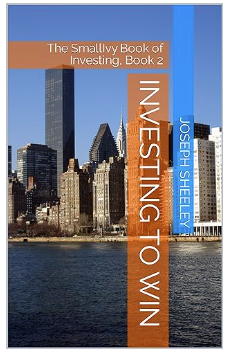
Investing to Win
For example, let’s say you bought 100 shares of XYZ and paid $100 per share, or $10,000 total for the stock. If you write a covered call at $100 with an expiration a couple of months out, you might get $500 for the call. You’ve now reduced the money you’ve invested by $500, so your cost basis is $9500. (This is a reduction in a practical sense, not for reporting gains on taxes.) If the call expires without being exercised and you’re able to do this again all year, you could theoretically make $3000 or a 30% return. Very nice!
In a way, because you’re pulling some money out of the market, you’re reducing your risk. Your possible loss has decreased because you’ve collected the premium. If you just held XYZ, you could lose up to $10,000. Now, having sold a call, the most you could lose is $9500. Your possible loss has decreased!
But two things could happen. XYZ could go up in price and be way above your stock around expiration time. The other thing that could happen is that the stock drops a large amount before expiration. While your possible loss has been decreased by writing the call, these two events can create more issues than you’d have if you just owned the stock. We’ll look at both of these possibilities and see why.
Do you know how to select mutual/index funds to maximize your returns? If you’d like a little guidance, check out Sample Mutual Fund Portfolios . This gives sample portfolios you can use for reaching all sorts of different goals, including retirement.

What happens if the stock goes up?
Let’s say that the price of XYZ goes from $100 to $110 within a month after you sell the call and stays there. If that happens and you do nothing, you would probably get assigned and need to sell your shares for $100. You would then pocket the $500 but, since you bought the stock at $100, you would make nothing on the stock. You would also need to pay taxes on the option sale and pay whatever fees your brokerage charges. You’d also be paying for the spread when you sold the option and when you bought the stock.
Once the stock has gone up past your strike price, you would make nothing more on the stock appreciation regardless of how high it goes in price. This means you have “lost opportunity cost,” cutting your potential gain short. The issue here is that if you are writing options on most of the stocks in your portfolio, you’re selling your winners and cutting your gains. It is the big gains of 100%+ that offset the stocks you lose money in, but you’re limiting your gains to 10% or so by writing the options. You therefore won’t get the 10-12% returns a portfolio of stocks should get.
Options traders will tell you that you can just “roll the gain up.” Here you’re rolling up to a higher strike price, say $115 by selling a call for that strike price and buying back the call you wrote at $100. Because the call at $100 will cost more than the one at $115, you will get less for the new call than you need to pay for the one you’re closing. If the stock has gone up to $110, you might need to pay $10 per share more to close the original call. You’ve lost the gain from $100 to $110 and are adding more money to the position, increasing your cost basis. If you do this and then the stock drops down to $100 again, you’re out that $10 per share.
We actually use Pretty Litter and really like it. The bags are light and delivered right to your door. There is no odor. Clean-up is a breeze, just a few seconds a day. And rather than dealing with clumps from urine, is just gets absorbed into the litter and you just change out the liter every few weeks. It even changes colors if you cat has an issue so you can get them checked out!
Give it a try! Click on the picture below to get started and support The Small Investor when you do.

One trick options traders do here is to roll up and out. Let’s say the original option with a strike price of $100 is expiring in a week. You might sell a $115 call that doesn’t expire for a few months. By doing so, you’ll get more for the new one you’re writing and offset more of the loss on the option you’re closing. You might even come out ahead on premiums if the stock has not risen too much. If the stock has shot way past your strike price, however, you’ll probably need to add more money to the position to roll up.
You may also not get as good a rate of return for the option position by rolling out. You might avoid losing money with the new position, but you may only get an effective rate-of-return of a few percent for the extra months you must now wait for the new option to expire. You may be expecting to make 30% per year, but end up only making 5% after rolling the option out.
If the stock keeps going up, you’ll eventually run out of the ability to roll up and lose the shares. It is also possible that the stock may run up a long ways and then drop way back down. When this happens, you can find yourself underwater with a much higher cost basis than you started out at.
Other articles on personal finance by SmallIvy:
Three Habits to Grow Your Net Worth
Pay Yourself First and Grow Your Wealth
Why Your Cash Flow is So Important
Need a good primer on the basics of stocks and bonds, along with other types of investments? Check out SmallIvy Book of Investing: Book1: Investing to Grow Wealthy

What Happens if the Stock Goes Way Down?
Another thing that could happen is that the stock drops in price after you write the call. A small drop in price is fine. In fact, you might be able to close the call early and then sell another if the price drops soon after you write the call and then goes back up. If the stock drops in price a lot and stays down, however, you’re left with a difficult decision.
Let’s say you had bought XYZ at $100 and it drops down to $70. This is something that would be very common for individual stocks. If you had just bought XYZ and were planning to hold for a long time, you would probably just hold on and wait for the stock to recover. You might even add to the position, taking advantage of the inexpensive stock price.
Because you’re writing options, however, you’d be thinking of getting premiums from the stock. Let’s say that you wrote a $5 call at $100 and therefore collected $500. Maybe the option drops to $0.10 when the stock drops and you buy it back for $10, collecting a $490 profit on the option position. Great!
But now the stock is worth $70, or $7000 for your position, and you paid $10,000 for the shares. You would be very tempted to write a call at $75 or something since you would want to be collecting premiums rather than having your money sit around, earning nothing. But now if the stock jumps up to $80 or $90, you’d be in the position described before where you need to roll up and maybe out. If you simply sat on the position, you’d risk having the option assigned to you and then you’d lock in the $2500 loss.
So, you end up with a tough decision: Write a call for a lower strike price, taking the risk of the stock coming back and either selling at a loss or needing to roll up and add to your cost basis, or wait for the stock to recover without selling calls and not collect premiums for an unknown period of time. Theoretically you’ve lost less than you would have if you had just bought the stock since you collected the call premium, but you are more likely to end up selling the shares for a low price because you’re writing calls than you would be if you were just buying stocks and holding them.
Bottom line
Writing covered calls to earn extra money sounds great. It is a good way to earn income if you need a portfolio to generate income for you. But there are some risks involved.
The primary issue is that you are cutting your gains short and making it more likely that you’ll sell and lock in losses that you have. Limiting your gains means that you will not necessarily see a positive return for the portfolio overall. You don’t have the huge gains that offset the stocks that decline. You therefore need to make up for this loss of income with the premiums you are collecting. In general, you’ll do better just buying stocks and holding them than you will writing covered calls.
Follow me on Twitter to get news about new articles and find out what I’m investing in. @SmalllIvy_SI
Disclaimer: This blog is not meant to give financial planning or tax advice. It gives general information on investment strategy, picking stocks, and generally managing money to build wealth. It is not a solicitation to buy or sell stocks or any security. Financial planning advice should be sought from a certified financial planner, which the author is not. Tax advice should be sought from a CPA. All investments involve risk and the reader as urged to consider risks carefully and seek the advice of experts if needed before investing.





