Learning music would be one of the best decisions of your life if you follow through and go deeper. Just like beats and notes, Music Key Signatures are a critical aspect of any music. Through them, musicians can accurately read, play, and transpose music.
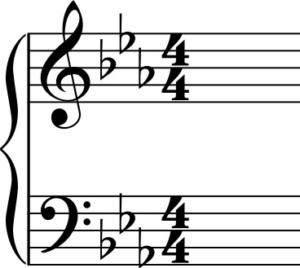
For Piano players, especially, piano key signatures are essential. They show groups of shrps and flats, helping the pianist to be pitch perfect.
What is a key signature in Piano?
Every key signature of the piano has a personality—bright, moody, hopeful, dramatic—and musicians feel these differences instantly. They shape how a song moves, how a melody breathes, and even how a chord progression lands on your ears.
When you understand the key signature guide, you start seeing patterns you never noticed before. Chords make more sense. Scales stop feeling like random sequences. And the whole idea of “playing by ear” gets a lot easier because you start to hear what should come next.
That small constellation of sharps or flats from the clef, quiet, with almost shy impact, holds more power than expected. The key signature shapes the musical landscape, much like a painter choosing a color palette before the first stroke. It anchors which notes will naturally shimmer, which will darken, and which will be molded into the mood the composer intended.
For piano students at the best music school, understanding key signatures piano is one of those skills that flips the switch from playing mechanically to playing with intention while being part of piano lessons milton. It’s the point where reading music stops feeling like deciphering a puzzle and starts feeling like entering a familiar room where you already know how the light falls.
Learning any musical instrument, including flute lessons, is exhilarating. You start with the basics, and you go on to learn whole songs and tunes. Eventually, you become able to compose and play with tunes and melodies. In between, you can
On the piano, this matters even more because muscle memory is everything. Once you internalize a key, your fingers begin to drift toward the right notes almost instinctively. C major feels wide and open, like sunlight hitting a blank page. G major sits comfortably under the fingers, bold but uncomplicated among piano key signatures. Step into E minor and suddenly everything feels more atmospheric, like you’ve walked into a room where the curtains are drawn halfway.
Paying attention to details like key signatures while learning any form of music can take you far and high.
Major vs. Minor Keys: The Emotional Twins
Every key signature belongs to two possible keys: one major and one minor.
They’re called relative keys, and they share the exact same sharps or flats.
For example:
G major and E minor share one sharp.
F major and D minor share one flat.
It’s like two stories told with the same alphabet—one bright and open, the other more introspective.
This is why a piece in A minor doesn’t suddenly use different symbols from its major counterpart. The emotional shift comes from where the music begins, ends, and centers itself—not the symbols at the front.
The Circle of Fifths: Your Secret Weapon
If there’s one diagram in music theory worth printing, framing, and possibly tattooing (okay, maybe not, but still), it’s the Circle of Fifths. This little masterpiece shows you every key signature in a beautiful, predictable order.
Move clockwise: each step adds one sharp.
Move counterclockwise: each step adds one flat.
How to Read Key Signatures Quickly?
Here’s a simple system musicians use to identify keys at a glance:
If the key signature has sharps:
Look at the last sharp (the one furthest to the right) and go one note higher. That’s your major key.
Example:
If the last sharp is C#, the key is D major.
If the key signature has flats:
Look at the second-to-last flat. That’s your major key.
Example:
If the flats are B♭ and E♭, the key is B♭ major.
For minor keys, simply find the relative minor: go three half steps down from the major key.
Once you practice this a few times, it becomes second nature.
Common Keys and How They Feel
Different keys genuinely feel different to musicians and listeners. Here’s how many players describe the most common ones:
C Major — clean, open, honest.
G Major — bright and friendly.
D Major — bold and confident.
A Minor — sad but beautifully expressive.
E Minor — dramatic with a hint of mystery.
Of course, these associations aren’t hard rules, but they help students connect emotionally with theory instead of treating it like a math class.
Conclusion
Once you internalize key signatures, everything becomes smoother:
You miss fewer accidentals.
Your fingers start automatically reaching for the right notes.
Sight-reading improves dramatically.
Improvising feels more intuitive.
Playing with other musicians becomes way easier.
It’s one of those skills that pays off faster than you expect.
Tips to Master Key Signatures
Here are a few ways students strengthen their key signature fluency:
Practice scales—slowly at first, then faster.
Use flashcards or quick quizzes.
Listen to songs and guess their keys.
Try playing simple tunes in different keys.
Explore the Circle of Fifths visually. To learn with the best growth potential, contact Mississauga Piano Studios at 416-543-2022. The more you expose yourself to keys in everyday playing, the more natural they feel. Piano key signatures enrich your insight, adding depth to your understanding.