


That “Perfect” Budget Rule You Keep Hearing About
If you’ve ever searched online for “how to save money,” you’ve probably stumbled upon the 50/30/20 rule. It’s everywhere. Financial experts love it, and budgeting apps often use it as a default. It sounds simple, neat, and maybe a little… impossible.
The rule is popular because it’s easy to remember and offers a balanced approach to managing money. It promises a clear path to financial stability. But if you’re living on a tight budget, especially in an Indian city, you might look at those numbers and feel a sense of disconnect. You’re not alone.
This guide is for you. We’re going to break down what the 50/30/20 rule is, look at why it often doesn’t fit the reality of a low or moderate income, and—most importantly—explore practical alternatives that actually work.
What the 50/30/20 Rule Really Means
The 50/30/20 rule was https://www.investopedia.com/ask/answers/022916/what-502030-budget-rule.asp#:~:text=U.S.%20Sen.,to%20meet%20your%20financial%20goals. in her book, “All Your Worth: The Ultimate Lifetime Money Plan.” It’s a simple framework for dividing your after-tax (or in-hand) income into three categories: Needs, Wants, and Savings.
Here’s the breakdown:
- 50% for Needs: This is for your absolute essentials—the expenses you must pay to live and work. Think of things like rent or home loan EMI, groceries, utility bills (electricity, water, gas, internet), essential transportation to work, insurance premiums, and minimum loan payments.
- 30% for Wants: These are non-essential expenses that improve your quality of life but aren’t necessary for survival. This category includes dining out, entertainment like movies or streaming subscriptions (Netflix, etc.), shopping for non-essential items, hobbies, and vacations.
- 20% for Savings & Debt Repayment: This is your “Future You” fund. It’s money set aside for building an emergency fund, saving for big goals (like a down payment for a house or a child’s education), investing, and paying off debt above the minimum required payments.
Let’s see how this looks with a simple example. Say your monthly in-hand salary is ₹30,000.
- Needs (50%): ₹15,000
- Wants (30%): ₹9,000
- Savings (20%): ₹6,000
On paper, it looks perfectly balanced. But real life rarely fits neatly on paper.
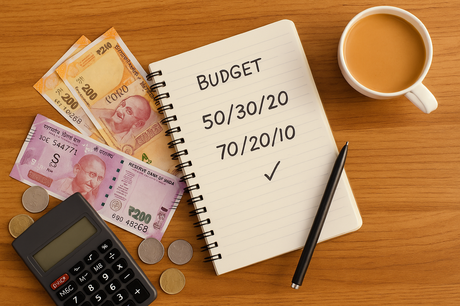
The Reality Check: When Your “Needs” Break the Budget
Here’s where the textbook plan hits a real-world wall. For many people, especially those living in Indian metro cities, the “Needs” category alone can swallow most of their paycheck, making the 50% limit feel like a fantasy.
Let’s take our ₹30,000 monthly salary and place it in a realistic context, like living as a single person in Delhi. The cost of living in urban India means that essential expenses are often much higher than what simple budgeting rules account for. Rent for a basic 1BHK or a spot in a Paying Guest (PG) accommodation, groceries, utilities, and a metro pass can quickly add up.
This isn’t a matter of poor spending habits; it’s a matter of basic arithmetic. The cost of survival in many places is simply higher than 50% of a modest income.
The 50/30/20 Rule vs. A Realistic Delhi Budget (for a ₹30,000/month salary)
Category 50/30/20 “Ideal” Budget Realistic Delhi Budget (Approx.) Percentage of Income
Needs ₹15,000 ₹22,000 ~73%
Rent (1BHK/PG) ₹10,500
Groceries ₹6,000
Utilities (Elec/Water/Int) ₹3,000
Transport (Metro) ₹2,500
Wants ₹9,000 ₹5,000 ~17%
Savings ₹6,000 ₹3,000 10%
Total ₹30,000 ₹30,000 100%
Note: Figures are approximate based on average low-end costs for a single person in Delhi.
As you can see, just covering the basics can take up nearly 75% of the income. This leaves very little for wants and cuts the ideal savings amount in half. If this table looks familiar, it’s crucial to understand this: You are not bad at budgeting. The rule is a bad fit for your reality.
Feeling like a failure because you can’t stick to a budget that was never designed for your financial situation is demotivating. The good news is, you can ditch the guilt and find a better way.
Step 1: Forget the Percentages. Just Track Your Spending.
Before you can make a plan for your money, you need to know where it’s actually going. The first step isn’t to budget; it’s to become aware. For one month, simply track every single expense.
Don’t judge yourself or try to change your habits just yet. The goal is to gather honest data. Whether you use a small notebook, a simple spreadsheet, or a free expense-tracking app, just write it all down. This financial health check-up gives you a clear picture to work with.
Step 2: Adopt the Most Powerful Habit: Pay Yourself First
This is the single most important shift you can make in how you handle money. Most people follow this formula:
Income – Expenses = Savings (if anything is left)
This approach makes saving an afterthought. The(https://www.investopedia.com/terms/p/payyourselffirst.asp) flips the script entirely:
Income – Savings = Expenses to Live On
With this mindset, saving becomes the first and most important “bill” you pay each month. It’s not about how much you save; it’s about the habit of saving first. For someone on a low income, this is far more powerful than aiming for a high percentage and failing. A small, consistent action builds momentum and a sense of control that a missed target can’t.
Here’s how to put it into practice:
- Pick a small, achievable amount. It could be ₹1,000, ₹500, or even ₹200. The amount should be small enough that you won’t panic.
- Open a separate savings account. This creates a barrier and makes you less likely to dip into your savings for daily expenses.
- Automate it. On the day after your salary is credited, set up an automatic transfer (a standing instruction or a Systematic Investment Plan – SIP) to move your chosen amount from your salary account to your savings account. This removes willpower from the equation and ensures it happens every single month.
Step 3: Find a Guideline That Actually Fits
Once you’ve started paying yourself first, you can use a more flexible budgeting guideline to manage the rest of your money. The 50/30/20 rule is just one option. Here are a few alternatives that are often more realistic for people with lower incomes or high living costs.
This rule acknowledges that for many, essential costs are high and the line between a “need” and a “want” can be blurry. It simplifies spending into one large bucket.
- 70% for Living Expenses: This combines all your needs and wants.
- 20% for Savings/Debt: This maintains a strong savings goal.
- 10% for Fun/Wants: A dedicated, guilt-free fund for splurges.
This framework is great if you find categorizing every expense exhausting and just want to ensure your core savings goal is met.
This is a direct and realistic tweak to the 50/30/20 rule. It gives you more breathing room for essentials while still keeping your spending categories separate.
- 60% for Needs: An extra 10% for those non-negotiable costs.
- 30% for Wants: A generous amount for lifestyle spending.
- 10% for Savings: A more manageable starting point for saving.
This is perfect if you like the structure of the original rule but find the 50% needs limit too restrictive.
This is the ultimate simplification, also known as the “Pay Yourself First” budget in practice.
- 80% for All Spending: Spend this however you need to on both needs and wants.
- 20% for Savings: Your only job is to make sure this 20% gets saved.
This rule is ideal for absolute beginners who feel overwhelmed. It focuses on the single most important action: saving.
Three Budget Makeovers for a ₹30,000 Salary
Budget Rule Allocation Amount What it Means for You
70/20/10 Rule 70% Living Expenses ₹21,000 Covers your needs and some wants without strict separation.
20% Savings/Debt ₹6,000 An ambitious but powerful savings goal.
10% Wants/Fun ₹3,000 Dedicated guilt-free spending money.
60/30/10 Rule 60% Needs ₹18,000 Gives you more breathing room for essentials.
30% Wants ₹9,000 A generous bucket for lifestyle choices.
10% Savings ₹3,000 A realistic and achievable starting savings goal.
80/20 Rule 80% All Spending ₹24,000 Maximum flexibility. No need to track needs vs. wants.
20% Savings ₹6,000 A clear, simple, and strong savings target.
Small Wins Matter: Consistency is Your Superpower
Budgeting isn’t about perfection; it’s about progress. Saving ₹500 every single month for a year (totaling ₹6,000) is far more powerful than saving ₹2,000 one month and then giving up because it was too hard.
Think of it like exercise. You don’t start by trying to run a marathon. You start with a walk around the block. That small, consistent effort builds the habit and the confidence you need to go further. Every month you stick to your plan—no matter how small the savings—is a win that builds momentum.
Your First Savings Toolbox: Simple, Safe Places for Your Money
Once you start saving, you need a place to put that money where it’s safe and can grow a little. Here are a few simple, beginner-friendly options in India.
- A Basic Savings Account: This is the best place for your emergency fund (money for unexpected costs like a medical issue or job loss). It’s safe and easily accessible, but the interest it earns is very low.
- (https://www.hdfcbank.com/personal/save/deposits/recurring-deposit): An RD is a fantastic tool for disciplined saving. You commit to depositing a fixed amount every month (say, ₹1,000) for a specific period (e.g., one year). In return, the bank gives you a higher interest rate than a regular savings account. It’s a perfect way to automate your “Pay Yourself First” habit.
- Public Provident Fund (PPF): This is a government-backed, long-term savings scheme. It’s incredibly safe, offers good, tax-free returns, and is great for goals that are far away, like retirement. The main thing to know is that it has a 15-year lock-in period, so it’s not for short-term needs.
Tech to Help You Along: Beginner-Friendly Budgeting Apps
If you prefer using your phone over a notebook, a simple budgeting app can be a great assistant. The best app for a beginner isn’t the one with the most complicated features; it’s one that is simple, intuitive, and preferably free.
Paid apps like YNAB are powerful but add another monthly expense, which doesn’t make sense when you’re starting out on a low income. Instead, look for apps with free tiers that help you track your spending without overwhelming you. Apps like Goodbudget, which uses a digital “envelope” system to help you portion out your money, or Money Manager, which offers simple expense tracking, are excellent starting points.
A Guideline, Not a Rulebook
Remember, any budgeting rule—whether it’s 50/30/20 or 70/20/10—is just a guideline, not a strict law. Your financial situation is unique, and your budget should be too.
Check in with your budget every few months. If your income changes or your expenses shift, adjust the percentages. You are in control. The goal of a budget isn’t to restrict you; it’s to empower you. It’s about giving you the freedom that comes from knowing where your money is going, feeling in control, and confidently building a better future, one small, consistent step at a time.






