Format: DVD from Sycamore Public Library on gigantic television.
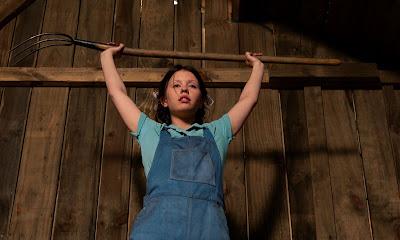
I need to deal with my Mia Goth issue. Everyone seems to like Mia Goth more than I do. I am convinced that this stems from where I was introduced to her on the screen. I first saw her in A Cure for Wellness, a film that should have been better and was also marred by the presence of Dane DeHaan, an actor I have never warmed to. Goth probably deserves better from my opinion, and the fact that she is the clear darling of the modern horror crowd means I’m going to have to get used to her. Pearl, a film I have avoided for a couple of years, is the next step in this evolution for me.
Pearl is prequel to Ti West’s X, the first movie where we are introduced to the Pearl character. In the first film, Goth plays both Maxine and Pearl (under a good amount of prosthetic makeup to age her). Pearl is a disturbed character, something that tends to be fascinating to horror movie fans, so it makes sense that people would want this—an origin story. That said, if you haven’t seen X, this discussion is necessarily going to involve spoilers for that film. We can’t talk about Pearl without talking about the character, after all. Consider the rest of this under a spoiler tag specifically for X and not Pearl. You’ve been warned.
You don’t really need to have seen X to understand Pearl, which is genuinely noteworthy. You could make perfect sense of this series by watching the films in chronological order. That might affect some of the suspense from the first film, but no more than any horror sequel has that suspense affected by knowing the source of the killings. You’re not shocked when Michael Myers shows back up in Halloween II or that Freddy will be the bad guy in a Nightmare on Elm Street sequel.
Pearl takes place during World War I. Pearl’s husband Howard (Alistair Sewell) has gone to war, leaving Pearl at home with her severely disabled father (Matthew Sunderland) and her oppressive and abusive mother (Tandi Wright). Pearl’s only friend is Mitsy (Emma Jenkins-Purro), her sister-in-law.
Pearl wants to leave the farm, is desperate to do so, but knows that when Howard returns he will want nothing more than to stay on the farm. She lives out any mild fantasy life at the movies, dreaming of being on camera and dancing. This attracts the attention of the projectionist (future Superman David Corenswet), who starts to pursue Pearl, going so far as to screen early rudimentary pornography for her after hours.
Things come to a head when Mitsy informs Pearl about an audition for a dance troupe to travel around the state. Desperate to get out, Pearl decides that this is going to be how she finally leaves the farm…and things degenerate badly from there.
One of the better aspects of Pearl is just how much we are shown that her slow descent into madness wasn’t really that slow and wasn’t really that much of a descent. Long before Pearl starts to turn murderous there are plenty of indications that something is very wrong going on with her. Pearl eventually acts out (and that’s what we’re here for), but the ice was already cracking before that happens. When it finally does, it feels natural and expected, and even a little bit righteous, given the nature of her mother. But long before we get to this point, we see Pearl abusing her defenseless father and feeding animals to an alligator that lives in the lake on the family farm.
Just as effective is that Pearl’s decline is indicated not simply by Goth’s acting more and more unhinged, but by the world around her. Mitsy brings a roast pig to the family farm, and within a couple of days, it’s still sitting on the front porch, covered in maggots. There’s a very clear nod to the rabbit in Repulsion, and Pearl is headed down the same path.
I don’t know that I was prepared for Pearl to be as smart as it is. Setting the film during World War I, a time that featured a terrible pandemic that killed millions around the world, gives the film a clear connection to the modern era and makes the film that much more relevant.
Perhaps the most impressive part of the film comes near the end, when Mitsy and Pearl are talking. Pearl says that she has things about herself that she is terrified to tell anyone else and that she can’t ever tell her husband and Mitsy asks her to open up. And she does…and her monolog becomes more and more unhinged as she continues. The growing, slow dread and the evident depths of Pearl’s disturbance become clear, and it’s a terrifying moment.
This is a better film than I wanted to admit. It’ll be interesting when I get to the third film to complete the trilogy.
Why to watch Pearl: It’s a solid vision of the birth of a psychotic.
Why not to watch: If you’ve seen X, at least some of the conclusion is a known quantity.