


Unprecedented is a dangerous word in journalism, but in reality it has never happened before.
On Wednesday, four of the biggest names in technology will test members of Congress in the United States.
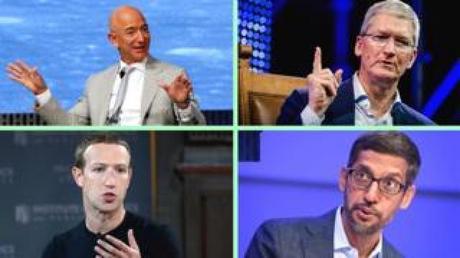
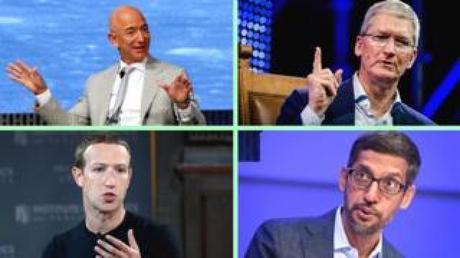
Mark Zuckerberg (Facebook), Sundar Pichai (Google), Tim Cook (Apple) and Jeff Bezos (Amazon) will all be grilled.
Jeff Bezos - the richest man in the world - has never testified before either house. They have never been interrogated together.
How these tech leaders do, how they resist control, could be a defining moment in their future relationship with the government.
At the heart of the interrogation will be whether these tech giants are simply too large.
The Covid pandemic has brought this into focus. Where other companies have struggled, Big Tech companies have thrived. Together they are now worth $ 5 billion. It has led to accusations that - just like banks - are simply too big to fail.
The number of complaints addressed to these companies is so numerous that there are too many to name them individually here.
Jeff Bezos published his opening statement to Congress on Tuesday.
"At Amazon, customer obsession has made us who we are and allowed us to do bigger and bigger things," he says.
"I know what Amazon could do when we were 10 people. I know what we could do when we were 1,000 and when we were 10,000. And I know what we can do today when we are almost a million."
"... I think Amazon should be scrutinized. We should scrutinize all the big institutions, be they companies, government agencies or nonprofits. Our responsibility is to make sure we pass that scrutiny with flying colors," he adds later.
Dominant position
The general theme is that these companies do not only manage services, but own Internet utilities. The charge is that they use that dominant position unjustly at the expense of others.
Take one of the criticisms against Amazon, for example, which promotes its products over others on its Amazon market.
Or Apple charges a 30% reduction on the money generated by apps that use the App Store.
The app makers' complaint: where else are we going to sell our apps? Apple and Google (which respectively own iOS and Android, the operating systems of almost all smartphones in the world) control the market and therefore control who can play and who cannot. And of course they can fix the charges.
Google, with its dominant search engine, has also been charged (and fined) earlier for burying competitors' searches. Again, the accusation is that no company should have such a dominant position in an essential part of our Internet.
And there are general criticisms that can be leveled even by all the tech giants. For example, the alleged copy / acquisition / killing strategies that all four are accused of using.
Copy the ideas of others, buy a company that threatens you - and even potentially kill it. Is it just a shrewd affair, even if ruthless? Or is this Big Tech flexing its muscles unfairly?
That's why this was such a difficult area for the police. Traditionally, anti-competitive law - in this case the "antitrust" law - focused on consumer prices.
In a typical monopoly or cartel, there is a simple test. Do consumers pay more because of the lack of competition?
US "trusts" of the early 20th century - hence antitrust legislation - have driven up prices. Companies such as Standard Oil and railway companies have used their dominant position to harm consumers.
It is much more difficult to demonstrate with these tech companies.
For example Facebook, Instagram and WhatsApp are free. Amazon often drops prices to beat the competition. Google's search engine is free. Google-owned YouTube is free. And apps on iPhone can often be downloaded for free.
So, what is the problem?
This is the heart of the matter. Critics say these companies harm consumers more subtly, killing smaller companies and strangling other businesses. The charge is that they are actually harming the economy.
This is what lawmakers are trying to examine.
Anti-trust activists have already lost a battle even before the hearing. They wanted the tech garments to be grilled one by one.
"We want to leave as little space as possible to hide behind each other," Sarah Miller, of the American Economics Liberties Project, told me last week.
But this will not happen. They will be questioned together and the hearing - perhaps rightly so - will be virtual.
There are also concerns that members of Congress will use the opportunity to trouble - to prey and prey - rather than ask the most difficult technical questions that might strike them.
Off-topic questions are also likely, particularly for Mark Zuckerberg. For example, Facebook is currently in the middle of an advertising boycott. He is accused of being too slow in removing racist and hateful content, and this could very well be a line of questions.
And of course, before the U.S. election, Facebook should expect to receive both Republican and Democratic congressmen. Democrats are generally concerned about far-right content on the platform, Republicans that society is structurally left-wing. And of course there are still concerns about foreign interference.
Expect China to come too - and be promoted by technology leaders. With companies like TikTok and Huawei attracting the wrath of the Trump administration, a defense will go something like: "Break us up, overdo it and give more power to Chinese tech companies."
Trying to reward the four from their scripts will be the most difficult job. It worked more effectively during Zuckerberg's interrogation on Capitol Hill in 2018. But it's more difficult to say than done.
Congress has a great opportunity here. The opportunity to truly examine these powerful men does not come often, and the evidence they give can shape their future relationships with the government and their clients.
But whatever happens on Wednesday, this will not be the end of the story. Earlier this week, the Senate Judiciary Committee antitrust committee said that a hearing will be held in September to discuss Google's dominance of online advertising.






