


The figure, which the Swedish public health authority has confirmed to CNN, is roughly similar to that of other countries that have data and well below the 70 to 90% needed to create "collective immunity" in a population.
It comes after the country has adopted a very different strategy to stop the spread of the coronavirus to other countries by imposing only very slight restrictions on daily life.
Sweden's chief epidemiologist Anders Tegnell said the number was "a little lower" than expected "but not remarkably lower, perhaps one or two percent".
"It fits pretty well with the models we have," he added at a press conference in Stockholm.
The study by the Swedish Public Health Agency aims to determine the potential herd immunity in the population, based on 1,118 tests carried out in one week. It aims to perform the same number of tests every seven days over an eight-week period. Results from other regions will be released later, said a spokesperson for the Public Health Authority.

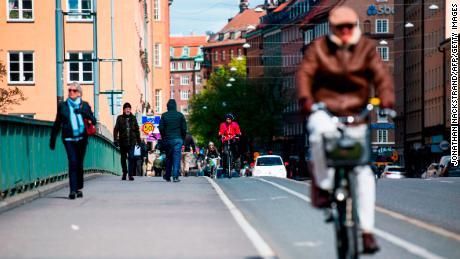
Sweden adopted a different strategy from that of other Nordic countries during the pandemic, choosing to avoid a lockout and to keep most schools, restaurants, lounges and bars open. However, he asked people not to take long trips, emphasizing personal responsibility.
The strategy was criticized early on by Swedish researchers, who said the attempt to create collective immunity had little support. But the authorities denied that achieving collective immunity was their goal.
Collective immunity is achieved when the majority of a given population - 70 to 90% - becomes immune to an infectious disease, either because they have become infected and recovered, or through vaccination. When this happens, the disease is less likely to spread to people who are not immune, because there are simply not enough infectious carriers to reach them.
No community has yet achieved this goal and a vaccine "will bring us to collective immunity faster" than infection, said Michael Mina, assistant professor of epidemiology at Harvard TH Chan School of Public Health, in a recent interview with The World from Public Radio International.

The percentage of people with antibodies in Sweden is not far from that of other countries that have imposed bans. In Spain, 5% of people had developed anti-coronavirus antibodies by May 14, according to preliminary results of an epidemiological study conducted by the government.
According to Martin Kuba, an official region of Jihocesky in the Czech Republic who conducted a mass test of randomly selected coronavirus among the general public and front-line workers, the first results showed that the proportion of people who had the disease was "one percent" rather than "fraction of one percent".
Michael Osterholm, director of the Center for Infectious Disease Research and Policy at the University of Minnesota, estimated earlier this month on CNN Tonight with Don Lemon that between 5% and 15% of people in the United States have been infected .
He said the coronavirus would circulate and infect at least 60% to 70% of the population before it slows down, but warned that the country had "a long way to go" to reach a level of collective immunity. A report he wrote with other epidemiologists and a historian estimated that it would probably take 18 to 24 months.
Dr. Mike Ryan, Executive Director of the World Health Organization's (WHO) Health Emergencies Program, said the concept of collective immunity was a "dangerous calculation".
When asked if he would be comfortable with immunity passports based on his company's tests, the CEO of Swiss drug maker Roche Severin Schwan told Julia Chatterley of CNN: "I think that we are in a world with a lot of ambiguity, and we also have to make decisions on incomplete information. So I think it is valuable information, but we should not trust it fully. "
On April 24, chief epidemiologist Tegnell told BBC radio that authorities believed that Stockholm had "a level of immunity ... somewhere between 15 and 20 percent of the population".
He said the strategy had "worked in some ways ... because our health system was able to cope. There have always been at least 20% of the empty intensive care beds able to care for Covid patients -19 ".
Asked if Sweden's approach will help him withstand a possible second wave, Tegnell replied that he thought so.
"It will certainly affect the reproductive rate and slow the spread," he said, but added that it would not be enough to obtain "collective immunity".
But Swedish Foreign Minister Ann Linde and Peter Lindgren, director general of the Swedish Institute for Health Economics (IHE), said last month that they had failed to prevent a high number of deaths. in nursing homes.
Sweden has registered 32,172 cases and 3,871 deaths, according to figures from Johns Hopkins University.






