 Seventeen
days after the accident, on 22 August, a note written in bold red letters
appeared taped to a drill bit when it was pulled to the surface after
penetrating an area believed to be accessible to the trapped workers. It read
simply "Estamos bien en el refugio, los 33" (English: "We are
well in the shelter, the 33 of us").
The nation of Chile erupted into a
wave of euphoria and demanded that Chile's leaders find a way to bring the
trapped workers safely home to their waiting families. Once the rescuers, and
the world, knew that the men were alive, Chile implemented a comprehensive plan
to both care for the workers during their entrapment and to rescue the miners
from the depths.
The plan included the deployment of three large, international
drilling rig teams, nearly every Chilean government ministry, the expertise of
the NASA space agency and more than a dozen multi-national corporations from
nearly every continent; the rescue was truly a global effort.
After 69 days
trapped deep underground, all 33 men were brought safely to the surface on 13th Oct 2010 by a winching
operation that lasted nearly 24 hours.
Various lawsuits and investigations
resulting from the accident were made but on 1st Aug 2013, after a three-year
investigation, all ended with no charges
filed. The
survival was certainly great – they had lived underground without seeing the
sunlight but carrying on with great expectations. At one point there was the starting revelation
that it would take as long as four months to dig a new tunnel wide enough to
life the miners to the surface. The
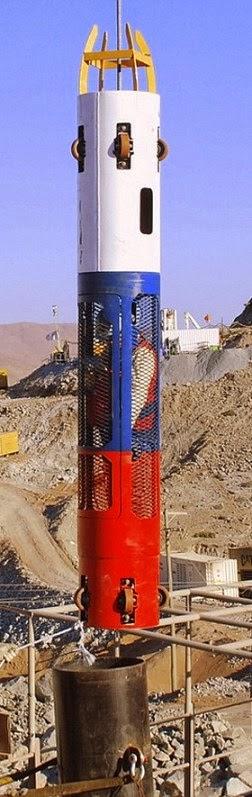
positive note was that food, water and medicine could reach them in the
meantime through reinforced bore hole and in capsules nicknamed ‘palomas’. ….
Not many would now care to know how they are ….and unfortunately, it is not a
happy news as enunciated in Daily Mail report of 5th April 2014.
It is one of the most uplifting tales of courage and survival in
modern times – a story of life snatched back from the jaws of almost certain
death. More than a billion people round the world sat transfixed in front of
their televisions as 33 Chilean miners were finally hauled to freedom after 69
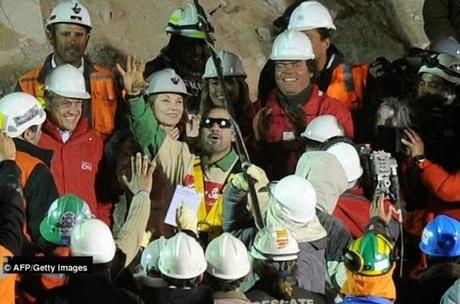
days trapped in the darkness thousands of feet beneath the unforgiving surface of the Atacama Desert. And when Mario
Sepulveda burst out of the ground
joyfully crying: ‘Viva Chile!’, he was the undisputed star.
Seventeen
days after the accident, on 22 August, a note written in bold red letters
appeared taped to a drill bit when it was pulled to the surface after
penetrating an area believed to be accessible to the trapped workers. It read
simply "Estamos bien en el refugio, los 33" (English: "We are
well in the shelter, the 33 of us").
The nation of Chile erupted into a
wave of euphoria and demanded that Chile's leaders find a way to bring the
trapped workers safely home to their waiting families. Once the rescuers, and
the world, knew that the men were alive, Chile implemented a comprehensive plan
to both care for the workers during their entrapment and to rescue the miners
from the depths.
The plan included the deployment of three large, international
drilling rig teams, nearly every Chilean government ministry, the expertise of
the NASA space agency and more than a dozen multi-national corporations from
nearly every continent; the rescue was truly a global effort.
After 69 days
trapped deep underground, all 33 men were brought safely to the surface on 13th Oct 2010 by a winching
operation that lasted nearly 24 hours.
Various lawsuits and investigations
resulting from the accident were made but on 1st Aug 2013, after a three-year
investigation, all ended with no charges
filed. The
survival was certainly great – they had lived underground without seeing the
sunlight but carrying on with great expectations. At one point there was the starting revelation
that it would take as long as four months to dig a new tunnel wide enough to
life the miners to the surface. The
positive note was that food, water and medicine could reach them in the
meantime through reinforced bore hole and in capsules nicknamed ‘palomas’. ….
Not many would now care to know how they are ….and unfortunately, it is not a
happy news as enunciated in Daily Mail report of 5th April 2014.
It is one of the most uplifting tales of courage and survival in
modern times – a story of life snatched back from the jaws of almost certain
death. More than a billion people round the world sat transfixed in front of
their televisions as 33 Chilean miners were finally hauled to freedom after 69
days trapped in the darkness thousands of feet beneath the unforgiving surface of the Atacama Desert. And when Mario
Sepulveda burst out of the ground
joyfully crying: ‘Viva Chile!’, he was the undisputed star.
 Mario
Sepulveda shot to fame when he came out of the mine crying 'Viva Chile' but he
said that life since the ordeal has left him penniless and suffering from
insomnia. ‘Super Mario’, the leader of the miners, became an instant celebrity
around the world.There were free trips to Disney World, to the Greek islands,
to Israel and even to watch his beloved Manchester United play at home.
Hollywood came calling with a £40 million
movie, The 33, in which Antonio Banderas played Mario. In a troubling indictment of what he calls the
‘hell’ of his new-found fame, Mario says that he and his fellow miners feel
abandoned and exploited by the world and that, staggeringly, he is now
preparing to go back down into the earth that once entombed him – to work
as a miner once again.
Mario
is quoted as saying ‘I am going back to
the mines because it is the one place I feel safe. They are making a film but
our real life has no Hollywood ending.’
In the report Mario, now 44, is at the door of his nondescript hotel room
in Copiapo in northern Chile. A 90-minute flight from the capital, Santiago,
this is the remote mining town where, in 2010, the drama unfolded. He is back
in one of the most inhospitable places on Earth working as an ‘extras co-ordinator’ on the Hollywood
movie that also stars Juliette Binoche as a miner’s wife and Gabriel Byrne as
the engineer who masterminded the rescue. Mario has not spoken publicly since
the first months of joy and relief – and it soon becomes clear why. As he
ushers me into his room, I am struck by the heavy curtains which are drawn to
block out all trace of the searing desert sun beating down outside. He shrugs:
‘I prefer to live in darkness. It is more comfortable. In the dark I feel safe.
I feel safe alone. ‘When I leave this room I have people coming up to me, they want pictures
and to shake my hand. 'I have fame but
not money. It is the worst possible thing.’
Mario
says he and his fellow miners suffer from nightmares and depression, brought on
by the psychological trauma of being trapped for so long – and the stress of
being thrust in front of the world’s cameras.
‘In there are antidepressants and tablets to make me sleep and have less stress. Most of the miners are on medication. I will be on it for the rest of
my life. ‘We were all simple, working-class men who went down the mine and came
up 69 days later into a circus. 'For the
first few months we were superstars. But then slowly the world forgot about us
and left us to suffer in silence.’
Mario
Sepulveda shot to fame when he came out of the mine crying 'Viva Chile' but he
said that life since the ordeal has left him penniless and suffering from
insomnia. ‘Super Mario’, the leader of the miners, became an instant celebrity
around the world.There were free trips to Disney World, to the Greek islands,
to Israel and even to watch his beloved Manchester United play at home.
Hollywood came calling with a £40 million
movie, The 33, in which Antonio Banderas played Mario. In a troubling indictment of what he calls the
‘hell’ of his new-found fame, Mario says that he and his fellow miners feel
abandoned and exploited by the world and that, staggeringly, he is now
preparing to go back down into the earth that once entombed him – to work
as a miner once again.
Mario
is quoted as saying ‘I am going back to
the mines because it is the one place I feel safe. They are making a film but
our real life has no Hollywood ending.’
In the report Mario, now 44, is at the door of his nondescript hotel room
in Copiapo in northern Chile. A 90-minute flight from the capital, Santiago,
this is the remote mining town where, in 2010, the drama unfolded. He is back
in one of the most inhospitable places on Earth working as an ‘extras co-ordinator’ on the Hollywood
movie that also stars Juliette Binoche as a miner’s wife and Gabriel Byrne as
the engineer who masterminded the rescue. Mario has not spoken publicly since
the first months of joy and relief – and it soon becomes clear why. As he
ushers me into his room, I am struck by the heavy curtains which are drawn to
block out all trace of the searing desert sun beating down outside. He shrugs:
‘I prefer to live in darkness. It is more comfortable. In the dark I feel safe.
I feel safe alone. ‘When I leave this room I have people coming up to me, they want pictures
and to shake my hand. 'I have fame but
not money. It is the worst possible thing.’
Mario
says he and his fellow miners suffer from nightmares and depression, brought on
by the psychological trauma of being trapped for so long – and the stress of
being thrust in front of the world’s cameras.
‘In there are antidepressants and tablets to make me sleep and have less stress. Most of the miners are on medication. I will be on it for the rest of
my life. ‘We were all simple, working-class men who went down the mine and came
up 69 days later into a circus. 'For the
first few months we were superstars. But then slowly the world forgot about us
and left us to suffer in silence.’
 The
Chilean government and the recently deposed President Sebastian Pinera come in
for the most savage criticism. The San
Jose gold and copper mine had a reputation as a death trap where safety
measures were routinely ignored. In the
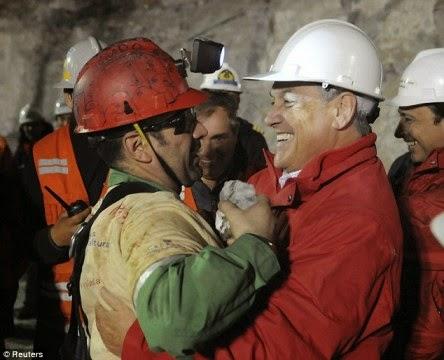
photo, Mario embraces then president Sebastian Pinera but he says 'Chile is a
corrupt country.' 'The president supported our rescue effort, and for that I am
eternally grateful. But it was good PR for him. His popularity shot up’ . Yet
the official investigation into the cause of
the accident was closed last August with no charges being brought
against the mine owners.
Poignantly, Mario says the first 17 days
underground – when the men were trapped 2,300ft below the surface and had no
idea if a rescue would be mounted – are now his happiest memories. As the ‘face’ of the disaster he embarked on a
career as a motivational speaker commanding between £3,000 and £10,000 a time,
but says that after the first year invitations were ‘few and far between’. He
is not the only one to fare badly. Edison Pena, who became famous for his Elvis
impressions, ended up in rehab for drug and alcohol addiction. Two
of the other men, Victor Zamora and Osman Araya, have eked out a living selling fruit and
vegetables at a Copiapo farmers’ market. Another, Daniel Herrera, tried going
back down a mine but suffered panic attacks and is being treated by a
psychologist. Yonni Barrios, who became
famous when his wife and long-term mistress fought at the rescue site, ended up
divorcing and marrying his mistress and now runs a mini-mart. Strangers have
cashed in on the story, writing books and making documentaries. Mario is particularly
hurt by some of the wild stories that circulated, including tales of sexual relationships developing
between the trapped men, and of drugs
being smuggled in through the rescue hole.
The
33 (Spanish: Los 33) is an upcoming Chilean survival drama film directed by
Patricia Riggen and written by Mikko Alanne and José Rivera. The film is based
on the real events of 2010 mining disaster in which a group of thirty-three
miners were trapped in the San José Mine, in Chile. The film stars Antonio
Banderas as Mario "Super Mario" Sepúlveda, who sent videos to the
rescuers to notify them about the miners' condition.
All is well that ends well ~ … ‘the end’ is not ‘what is shown
to be’… !!
With
regards – S. Sampathkumar
The
Chilean government and the recently deposed President Sebastian Pinera come in
for the most savage criticism. The San
Jose gold and copper mine had a reputation as a death trap where safety
measures were routinely ignored. In the
photo, Mario embraces then president Sebastian Pinera but he says 'Chile is a
corrupt country.' 'The president supported our rescue effort, and for that I am
eternally grateful. But it was good PR for him. His popularity shot up’ . Yet
the official investigation into the cause of
the accident was closed last August with no charges being brought
against the mine owners.
Poignantly, Mario says the first 17 days
underground – when the men were trapped 2,300ft below the surface and had no
idea if a rescue would be mounted – are now his happiest memories. As the ‘face’ of the disaster he embarked on a
career as a motivational speaker commanding between £3,000 and £10,000 a time,
but says that after the first year invitations were ‘few and far between’. He
is not the only one to fare badly. Edison Pena, who became famous for his Elvis
impressions, ended up in rehab for drug and alcohol addiction. Two
of the other men, Victor Zamora and Osman Araya, have eked out a living selling fruit and
vegetables at a Copiapo farmers’ market. Another, Daniel Herrera, tried going
back down a mine but suffered panic attacks and is being treated by a
psychologist. Yonni Barrios, who became
famous when his wife and long-term mistress fought at the rescue site, ended up
divorcing and marrying his mistress and now runs a mini-mart. Strangers have
cashed in on the story, writing books and making documentaries. Mario is particularly
hurt by some of the wild stories that circulated, including tales of sexual relationships developing
between the trapped men, and of drugs
being smuggled in through the rescue hole.
The
33 (Spanish: Los 33) is an upcoming Chilean survival drama film directed by
Patricia Riggen and written by Mikko Alanne and José Rivera. The film is based
on the real events of 2010 mining disaster in which a group of thirty-three
miners were trapped in the San José Mine, in Chile. The film stars Antonio
Banderas as Mario "Super Mario" Sepúlveda, who sent videos to the
rescuers to notify them about the miners' condition.
All is well that ends well ~ … ‘the end’ is not ‘what is shown
to be’… !!
With
regards – S. Sampathkumar
30th Oct 2014.