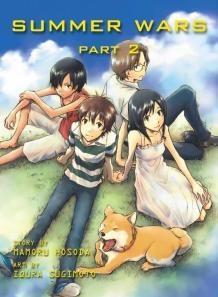
 Title: Summer Wars
Genre: Comedy, Romance, Sci-Fi
Publisher: Kadokawa Shoten (JP), Vertical Inc. (US)
Original Creator: Mamoru Hosoda
Story/Art: Mamoru Hosoda, Iqura Sugimoto
Serialized in: Young Ace
Original Release Date: December 17, 2013
Official Site
 Title: Summer Wars
Back when I reviewed Part 1, I said the Summer Wars manga maintained the spirit of Mamoru Hosoda’s film, but a few issues, some with the art and adding scenes that weren’t in the film made me hesitant to go immediately recommend it when Part 2 was coming down the pipe. If you’re going to go buy it, then surely it makes sense to see if both parts are good right?
Well, at least for me, my fears were averted: Summer Wars Part 2 is a fun conclusion to the series, featuring better character scenes that couldn’t be included in the film, and mostly improved art. Combined with the knowledge that this is the film in manga form, and you got yourself a nice two volume series that’s worth its weight on your bookshelf.
Picking up after the last chapter of Part I, Part 2 begins with the Jinnouchi men and Kenji going on the counterattack to stop The Love Machine, the program that caused widespread trouble throughout Japan and deeply affected the entire Jinnouchi family. With the combination of a family member working in the government, a family member that’s the top rated fighter in OZ, and a family member with a large boat, among other things, they end up taking on Love Machine and aim to stop it for good. The problem is one mistake ends up destroying their plan, which soon leads into a massive issue where the entire world’s safety is at stake, and…Koi Koi, a Japanese card game played with Hanafuda cards, is the only thing that stands between the world’s end?
That last sentence perfectly describes Summer Wars: a wacky, unbelievable, yet incredibly entertaining work that, despite everything going against it — from the amount of characters, to its premise — there’s something about this series that makes it all come together anyways. It might have something to do with its overall theme, which is family, and that family gets tested immediately. After the death of Granny Sakae, the Jinnouchi family, specifically the men and the women, can’t come together on what matters — stopping Love Machine from continuing to wreck havoc on OZ and reality, or properly laying to rest Granny Sakae. In theory, preventing the potential loss of life by stopping Love Machine seems like something that should be done.
Yet on the other hand, Granny Sakae died unexpectedly, and she proved to be very important to the family. Yeah, ignorance could have played a factor, since it was clear that the women (or maybe some of them) believed OZ was/is just a game, and that at this point and time, caring about people you don’t know seems foolish. But people react differently, and somehow, someway, it creates that divide where the ultimate goal gets lost. This type of conflict doesn’t always work in most forms of entertainment, but it works here because it’s established how vital family is, and that ultimately sets the tone for the rest of the series and how it’s viewed.
Now, what helps this manga is that the material is there, so all manga artist Sugimoto had to do was to capture it and turn it into something we can read. Aside from one instance where the drawing just doesn’t work out (granted, that scene where the Love Machine expanded would be difficult to draw I reckon), Sugimoto did a fine job in getting everything to work out. It also helped that he was able to do what the film could only do meekly — that was develop Kenji and Natsuki more. Oh, and also draw her in a school uniform. That was probably good too.
But no, seriously, the Summer Wars manga is just as good as the film it’s based off of, with Part 2 providing that special conclusion. With the additional touches and scenes, the solid artwork, and the spirit of the film guiding it, this is a worthwhile purchase.