


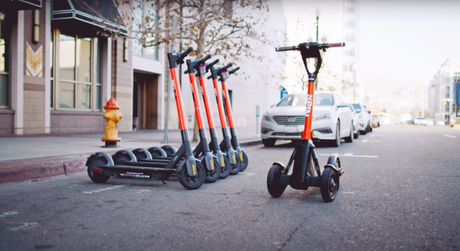
Spin, the micromobility startup acquired by Ford, has developed a new scooter with partners Segway-Ninebot and software startup Tortoise that aims to solve the problem of sidewalk clutter forever.
The Spin S-200 scooter not only has three wheels - a design change that helps it stand out in a crowded two-wheeled pool - it also features repositioning software that allows remote operators thousands of miles away to move the vehicles off the sidewalk and in a suitable parking lot. A fleet of approximately 300 Spin S-200 scooters will be tested in Boise, Idaho this spring. But the goal is much bigger. Spin eventually wants to launch remotely operated scooters in cities in North America and Europe in 2021.
These scooters, which operate on the so-called Spin Valet platform, are equipped with front and rear cameras. When combined with Tortoise's software, the scooters can be controlled remotely.
The remote operations team will initially use the repositioning software to move the scooters if they are blocking a sidewalk, pedestrian crossing, or disabled space. Eventually, users will be able to stop a scooter, which will travel up several blocks to their location, according to Tortoise co-founder and president Dmitry Shevelenko.
"We are focused on making Boise a huge success and I think if that happens then the numbers will take care of themselves," Shevelenko said in a recent interview. "If this Spin scooter gets even 25% more rentals per day than its standard fleet, it will change its fleet as quickly as possible."
If this happens, the only real obstacle is having the scooters produced. Shevelenko said a bottleneck in manufacturing is unlikely because Segway-Ninebot has the tools to make it a mass product. "They have a lot of conviction about it," he added referring to Segway.
"There has been a great deal of hype about the potential of remote-controlled electric scooters, but this partnership marks a turning point in tangible operational plans to take them to city streets," Spin's chief business officer Ben Bear said in a statement. "In addition to providing consumer reliability and more order to city streets, this could significantly improve the unit's economy, reducing carbon emissions and the operational work required to maintain and reposition fleets."
Shevelenko said that as important as the repositioning is, the design of the real scooter also deserves attention. The S-200 features three independent braking systems - a regenerative rear brake, front and rear drum brakes - and turn signals located on the handlebar and near the rear wheel.
"I think somehow the three-wheeled scooter is a big deal," Shevelenko said. "It is necessary because it solves the balance problem without a kickstand, but it is also attractive to cyclists who are not in their twenties. It's higher up, you feel sturdier, and it's really hard to tip over and fall. And so, in terms of making sure people in their 40s and 50s and 60s feel comfortable getting along, I think this is going to be very disruptive. "