


Given that the return of children to school will be one of the most tangible signs that the country is returning to normal - and will begin to take important steps towards economic recovery - the problem has a strong emotional and societal dimension.
Fauci's warning will resonate among school principals and authorities and university presidents who are trying to chart a strategy for some kind of resumption of classes in person. This underscores the reality that if children in states with low infection rates return next year, those in hotspot areas may be absent for weeks or months more.

New projections that 147,000 Americans could die by August 4 according to an Institute for Health Metrics and Evaluation model often cited by the White House suggest that difficult months may be ahead, which would inevitably complicate plans for resumption of teaching.
Meanwhile, anxiety among parents of high school and younger children is increasing, after an increasing incidence of an inflammatory syndrome that may be linked to coronavirus has weakened confidence that children are immune to the worst effects of the disease.
Parents were already concerned that returning children to school would not only make them susceptible to infection, but could turn them into asymptomatic carriers who could infect vulnerable seniors. On the other hand, the damage to education and development inflicted by months of dropping out of school also weighs on families.
But late testing made it more difficult to open schools. Fractured public budgets that could lead to job cuts also complicate the picture. And school principals have warned that without billions of dollars in additional funding, states and districts may find it difficult to implement protocol like staggering classes, social distancing, and additional bus routes to reduce infections.
Like workers who have lost their jobs, schoolchildren are also victims of the worst public health crisis in 100 years. Many have already lost weeks of crucial education that they may find it hard to make up for. Children from poor families often lack the computers or learning environments necessary for online lessons. Millions of children have to pass AP and other tests crucial to their future without proper education and at home.
And many young Americans will be leaving high school and universities in the coming weeks without the cherished rituals of adulthood like degrees and opening ceremonies.
Paul and Fauci clash over schools
The contentious nature of school closings - effective in 48 states and the District of Columbia, according to a CNN count - exploded in a Senate hearing Tuesday after Republican Kentucky senator Rand Paul warned Fauci that he was not the "end at all". authority on matters such as when children must return to class.
Paul pointed out that death rates among young people were relatively low and erroneously suggested that, outside of New England, the virus had been relatively "mild".
"I think the one solution - that we are going to have a national strategy and that no one is going to school - is a bit ridiculous," said Paul. "We really have to do it district by school district. And power has to be dispersed because people are forecasting badly.
"If we keep children out of school for a year, what will happen is that poor and disadvantaged children who do not have parents who can teach them at home will not learn for a whole year. .. I think it's a huge mistake if we don't open schools in the fall. "
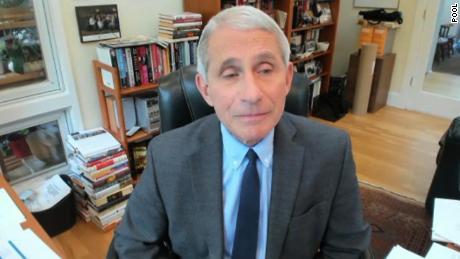
Fauci warned Paul that the country must be "very careful" to underestimate the effect of Covid-19 on young people, specifically citing the inflammatory syndrome that has killed a number of children in the United States and Europe.
"I think we had better be careful if we are not cavaliers in thinking that children are completely immune to the deleterious effects," said Fauci.
Much of the hope for a return to class rests on the administration, which keeps its repeated vows to massively intensify coronavirus screening programs and the efforts of state governors to make up for the deficit in federal effort.
The administration's repeated failure to deliver on promises to massively increase testing is one of the reasons there is skepticism about education returning to normal from August.
Randi Weingarten, president of the American union of the Teachers' Federation, who presented a plan on how to reopen American schools, complained that the tests available to everyone in the country were not up to par what Trump and Vice President Mike Pence filled in the White House.
"I really believe that if it is safe and if we can do it, we must voluntarily bring the children back to school in the summer and to school in the fall," said Weingarten.
But she added: "You need to have a testing infrastructure in a community that is large enough and large enough for you to maintain a minimum level of virus and then if you see a case you immediately trace the contact and isolate."
Trump wants schools to start
Trump, aggressively pushing to restart the economy that is vital to his re-election campaign, first pushed state governors to open schools several weeks ago.
"A lot of people are thinking about school openings. And I think it's something ... they can seriously consider and maybe go for it," said Trump.
On Tuesday, the path to education dominated the virtual Senate audience.
Tennessee Republican Senator Lamar Alexander, who chaired the panel, broke away from the White House's triumphalism over the tests to call for an increased effort to get schools and colleges back online.
"Widespread screening of entire campuses, schools or workplaces will help identify those who are sick, find those who are at risk," said Alexander. "This, in turn, should help persuade the rest of us to go back to school and go back to work."
Admiral Brett Giroir, pediatrician and United States assistant secretary of health, said at the hearing that the situation of the students would depend on the spread of the community in their regions. But he expressed optimism that the tests could be updated quickly enough for the school to resume in August.
"We expect that there will be 25 to 30 million point-of-care tests available per month. It is certainly possible to test all students," he said, but added that the strategies surveillance could alleviate the need for general testing.
Giroir also suggested some "promising" strategies that could be used to test wastewater from an entire dorm to determine if there is a coronavirus in the wastewater.
States and cities still hope to open, but warn it depends on science
The White House wants decisions about returning schools to be left to national and local authorities.
A resumption of university life is in phase two of the White House's plan to reopen America in states and regions where there is no evidence of a rebound in infections or which have met the downside criteria incidence of disease.
Many states are already going ahead with openings although they are not at all close to the guidelines for a 14 day drop in infections to even enter the first stage of the program. The White House does nothing to make states comply with the guidelines.
In the absence of strong federal leadership, the recovery of schools and colleges should reflect the broader and disparate effort to open up the national economy.
Some jurisdictions have doubled in recent days in hopes of reopening in the fall. Pennsylvania Secretary of Education Pedro Rivera said Monday that it was "fully our intention" to be ready for the next academic year, but warned that the data would guide the decisions of the Keystone state.
And New York mayor Bill de Blasio said Monday "right now" that he thought schools in the city could open in September - while warning that he was closely monitoring the inflammatory syndrome.






