 Title: Solanin
Genre: Slice-of-Life, Drama
Publisher: Shogakukan (JP), Viz Media (US)
Artist: Inio Asano
Serialized in: Weekly Young Sunday
Original Release Date: October 21, 2008
 Title: Solanin
You have to time the reading of Solanin just right. It’s one of those books that, if you read it a few years too early or too late, won’t make quite the impact that it will when timed perfectly. The best time to read it is just after or just before graduating from college, when you’re faced with the impossibly dull and bleak outlook of finally becoming an adult, because that’s what Solanin is about: a group of college friends facing the real world and trying to find the balance between still feeling like a kid and trying to be an adult.
Solanin is one of three works by Inio Asano translated into English (What a Wonderful World and Nijigahara Holograph being the other two), which is surprising given Asano’s popularity in Japan as well as his unusually realistic subject matter. Probably, though, this is due to a somewhat difficult audience to pinpoint and market, because of its young adult target and sexually graphic material. Solanin is another of VIZ’s Signature line productions, and instead of its usual two-volume release, VIZ decided to release the 432-page work as one hefty volume.
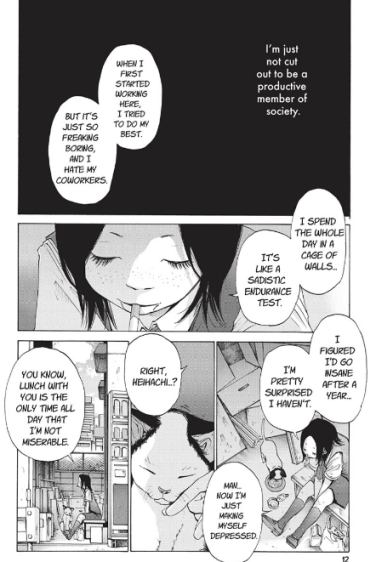
Meiko and Taneda are a recently graduated college couple, and each of them is having an existential crisis. Meiko is struggling through her first adult daytime office job and absolutely hates it. She feels it is slowly draining everything out of her and fears one day she will become an uncaring corporate drone, and what makes it worse is that she feels trapped at her job because her boyfriend Taneda doesn’t make enough at his part-time job to support the two of them. Taneda is facing his own personal dilemma, though, and is equally unsatisfied in his job, feeling that something is missing out of his life. Meiko decides to quit her job, and Taneda decides to revive his old college band and pursue his dream of making it big, and both these decisions threaten to change their lives and their relationship forever.
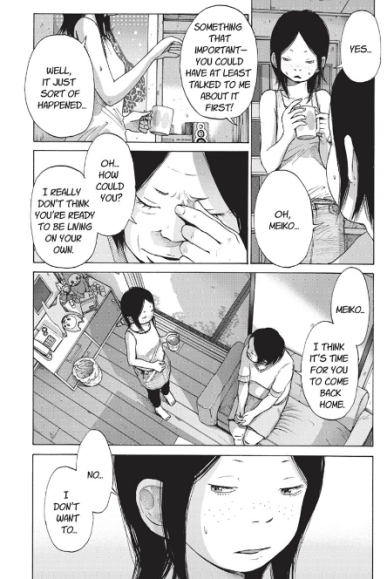
Despite all the uncertainty Meiko and Taneda are facing, there’s something oddly comforting about Solanin. America, like Japan, places incredible pressure on its youth to go to college, get a meaningful degree, and jump straight into the adult world with a high-paying job and lifelong career. Yet most people go through college unsure of what they want to major in let alone what job they want to have for the rest of their lives. Solanin explores those unspoken fears so common to college graduates (and undergraduates) and offers some solace in the relatability of its characters. However, if you’re looking for answers to your own directionless future, you’ll be hard pressed to find them in Solanin. The ending has little to offer in terms of satisfying resolution, although Meiko does manage to find an outlet for her talents and energy. It’s unclear, though, whether or not Meiko has found the answers to her own questions and doubts, and her performance in the band exists more as emotional triumph over the tragedy of Taneda’s death rather than an epiphany for her future or a resolution to her lack of passion.
Asano wrote Solanin when he was 25, the same age as the characters in the story, which makes Solanin a semi-autobiographical and incredibly lucid piece of work. The reason the ending is so open-ended is because Asano didn’t have all the answers to the questions Solanin raises. If you can get your hands on a copy of Solanin when you yourself are stuck in that awkward, uncertain transition period from child to adult, then do it. It’s not a terribly important or even lasting piece of literature, but read at the right time it can certainly impact its reader and offer some temporary solace to all the fears and despairs of the real world before we have to face it.