


Earth observation has moved from government-run missions to a crucial daily work tool, but it still has room to grow. Specifically, in the thermal infrared spectrum, if you start Satellite Vu it goes into orbit. The company expects to be able to monitor the thermal signatures of most buildings on the planet with a constellation of satellites built for the purpose.
Unveiling today at ProWellTech Disrupt Startup Battlefield, Satellite Vu co-founder and CEO Anthony Baker explained the huge market for anyone who can accurately tell how much heat is emitted from buildings, fields and other features.
Heat could indicate poor insulation, for one thing, and a waste of energy for HVAC. It could show actual (not reported) operating hours in a factory or mine. It could monitor the combustion of natural gas or waste emissions from refineries. With a resolution of 3 to 4 meters - an order of magnitude or greater than what's out there - it might even be able to estimate the presence of outdoor events or, for that matter, the concentration of troops in. war. And of course he can do all this in the dark of night.
Baker told ProWellTech that he believed the Earth observation business, despite producing successful businesses like Planet, still had plenty of room to grow.
"Planet and Google Maps can show you what's going on outside a building. We can show you what's going on inside, "He explained.
The underlying technology is new and old. Infrared sensing dates back decades, but doing it from orbit within a fraction of a degree, and at this level of detail, is a very different proposition. The technology on which the Satellite Vu is based began as a sensor developed by Oxford for the Lunar Trailblazer orbiter that would search for water on the surface of the Moon; the company has an exclusive license.
"We took the sensor and reinforced it for space, and we did all of the 'new space'," which is things like miniaturization and power optimization, Baker said. The problem with making the device smaller and more efficient, however, is that it "affects the image, distorts it and blurs it. So we've found a way to deal with it."
Satellite Vu follows in the footsteps of Apple, Google, and others, who in an effort to improve their smartphone cameras have found that there is a valuable little improvement to be made from the hardware, focusing on the software instead.

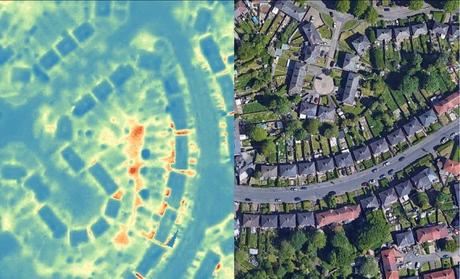
Like those of technology companies, the Satellite Vu system collects information from dozens of sequential images and interprets it into a single enhanced.
"We put the images together and we can get a higher resolution, eliminate aberrations, do many other things. And it's all patentable," Baker added.
The result is an extraordinarily cheap satellite: perhaps $ 15 million, and the company only needs $ 7 million to achieve the worldwide coverage it intends to offer. For comparison, Baker said, the European Space Agency has just approved a € 500 million project that would collect thermal images at 30 meters resolution (smaller is better).
Competition in Earth observation is stiff, but in this particular niche it is virtually non-existent in commercial space. The planet's satellites can see near-infrared spectra, but that's not enough to get detailed heat data. There are military satellites and some from NASA or ESA, but they tend to be old, special, classified, or all three. Getting regular thermal images from orbit from a commercial supplier isn't really a possibility. Drones and high-altitude flying are an option but not quite the same. And while there are a couple of startups looking to join the same domain, there's probably room for everyone.
"It appeals to a lot of people and government agencies around the world want a commercial source for this data," Baker said. "The simplest market is probably the ESG one [environmental, social and governance] and green financing. Everyone is investing in green materials and stocks, but how do you know they are green? Nobody matters. But we can measure it. "
Compliance with environmental legislation is difficult to monitor and, as new rules are established, new methods of making sure people comply with them are in high demand. It is also useful for companies that, for example, are making voluntary efforts to go green and need an objective record that demonstrates, for example, that their buildings are heated or cooled to certain efficiencies or that their data centers operate at certain capacities and schedules.
The clear demand for this service makes the daunting "We're building a satellite" business model a little less daunting for investors. "They want to know where you will make your first dollar. So if customers are willing to put money on the table, the VCs will too, "Baker said. Right now the company is operating with grant funds, but it will soon need the kind of money that those programs don't tend to part with all at once.
The immediate plan is to demonstrate the sensor in a series of flights using traditional planes, after which customers, at least Baker hopes, will start throwing money at them. The letters of intent (of which Satellite Vu is worth eight digits) are all good and good, but nothing beats a good old-fashioned contract.
The best news is that launch costs, which could have founded a company like this a few years ago, have now dropped to historic lows.
"Elon's agreement for small satellites is just great. 200 kilos for a million dollars? That's $ 5,000 a kilo - I've bought rockets in my career for $ 50,000 a kilo, "Baker said.
By going to a standard orbit in a shared run with SpaceX's Starlink launches, Satellite Vu keeps costs down and can break even with just one or two of its birds in the air. As with orbital images of the visible spectrum, applications tend to emerge once data begins to come out, so the company hopes to diversify its offering once it shows the capabilities of its constellation.






