


Samsung has not one but two phones competing for the best camera of the year. The Samsung Galaxy Note 20 Ultra is a photo monster, but the Galaxy S20 Ultra is also a photography beast. These two flagships from the same company have many similarities in terms of their cameras, but there are also many differences. Can the updated specifications of the newer Note 20 Ultra bring the decisive advantage? We want to prove that in our camera shootout Galaxy Note 20 Ultra against Galaxy S20 Ultra.
See also: The Best Samsung Phones You Can Buy
Samsung Galaxy Note 20 Ultra vs. Galaxy S20 Ultra: Camera Specifications
On the surface, it seems that the two phones have almost identical camera specs. For example, both have 108MP main sensors and each shoots the same 12MP ultra-wide sensor. The focusing systems are very different.
The Note 20 Ultra has a laser autofocus system that bypasses the problems of the S20 Ultra's time-of-flight camera. Another point where the two phones differ is in the telephoto lens. The Note 20 Ultra has a conservative 12-megapixel telephoto lens with 5x optical and 50x hybrid zoom, while the S20 Ultra has a 48-megapixel telesensor with 4x optical and 100x hybrid zoom.
If the performance of these cameras is different, they will zoom. The video recording capabilities are the same with 8K at 24 frames per second for the main cameras and 4K at 60 frames per second for the front cameras. Here are the details:
Galaxy Note 20 Ultra Galaxy S20 UltraReversing cameras
Wide angle: 108MP PD OIS ƒ / 1.8, 0.8 μm
Tele: 12 MP ƒ / 3.0, 1.0 μm, 5x optical zoom
Ultra wide: 12 MP ƒ / 2.2, 1.4 μm
Laser AF
Wide angle: 108 MP, 1 / 1.33 ", ƒ / 1.8, 0.8 µm
Tele: 48 MP, ƒ / 3.5, 0.8 µm
Ultra wide: 12 MP, ƒ / 2.2, 1.4 µm
VGA time-of-flight sensor
Front cameras
10MP 2PD AF ƒ / 2.2, 1.22 μm
40 MP AF ƒ / 2.2, 0.7 µm
The examples
Let's start with an indoor shoot. Here we see a completely different white balance. The Note 20 Ultra gets it right, while the S20 Ultra leans a little too far in the warm direction. The focus is also better in the Note 20 Ultra shot. You can see the details in the image a little easier in the recording from the Note 20 Ultra.
Connected: The best Android camera phones you can get
Here are two shots at 108MP. What I notice about these pictures is the detail visible in the brick, which is good for both shots. You can see the outline of each individual brick. The Note 20 Ultra captured a slightly brighter picture that looks a little more natural. The S20 Ultra image is a bit darker and has a higher contrast. I like the recording from the Note 20 Ultra better in this comparison.
These HDR examples show what both phones can do. The sun was right over me and I was standing in the shadow of a drawbar. The overall image quality is good. However, the Note 20 Ultra does it a bit better again. More detail can be seen under the bridge and the sky is a nicer, richer shade of blue (if just a little). The shadows of the S20 Ultra contain fewer details.
See also: Samsung Galaxy Note 20 vs Galaxy Note 10 Series: Should You Upgrade?
In this example, we have a dead heat. The color representation, white balance and overall tone are the same. The recording from the Note 20 Ultra may contain a more detailed note, but it is so small that it does not affect the assessment. I like the consistency here from Samsung.
This is the first shot that I think the S20 Ultra is the clear winner. The images from both cameras contain noise, but the noise on the Note 20 Ultra is more annoying. Overall, the S20 Ultra captured a cleaner and richer picture. I especially like the color that is truer to life.
I was a little disappointed with these pictures. Both blew out the sun, which was behind some light clouds, completely. You can see the loss of detail in the middle of the frame. The image from the Note 20 Ultra is more accurate, while the image from the S20 Ultra is more detailed in terms of color. It boils down to personal preference I guess. This is a tough question.
These two images are very close. The sky and water are each exposed roughly the same, with approximate color. Where the Note 20 Ultra pulls up is in the darker regions, where you can see some of the houses across the lake. The S20 Ultra loses the same details.
This sample selfie is a study in contrast. The Note 20 Ultra took a cooler image with higher contrast, while the sample of the S20 Ultra is warmer. I especially like how the shot from the S20 Ultra shows natural bokeh in the background, although some users may want the entire frame to be in focus. It's a nice pair of selfies.
As for the selfie portrait, we can find the same color issues as we experienced with traditional selfie shooting. I think the edge detection is the same between the two phones, with accurate trimming even around my hair. I won't name a winner here. These are excellent portraits from a phone's selfie camera that shy away from looking fake.
In this comparison, the Note 20 Ultra looks a bit warmer and slightly oversaturated in these shots of some flowers. The sample from the S20 Ultra is cleaner and looks more natural. Both images contain a lot of detail.
This series of photos examines the wide-angle, standard, and telephoto lenses on both phones. The exposures of the wide-angle cameras look identical because they should come from the same sensor. The standard 1x image shows the same color problem with the S20 Ultra that we've seen throughout this series, as does the 2x and 5x shots. All images are clean and with minimal noise. In this series, I like the pictures of the Note 20 Ultra better with the exception of the 5x show. The S20 Ultra clearly exaggerates the greens, but overall the picture just looks richer.
More Samsung camera recordings:Samsung Galaxy Note 20 Ultra vs. Galaxy S20 Ultra Camera Shootout: The Verdict

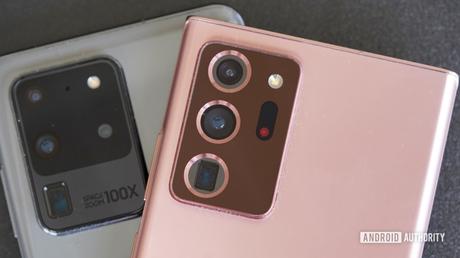
The camera on the Samsung Galaxy S20 Ultra consumed a lot of heat when it was first released. It showed focus problems and tended to use too warm a color balance in many shots. Since the sensors for the main and ultra-wide cameras are identical for both cameras, it is clear that Samsung has optimized the processing. The recordings from the Note 20 Ultra are sharper and more accurate. You may not have the super color saturation of the S20 Ultra's footage, but in this case we think the accuracy is better. All in all, we give the Note 20 Ultra the victory, if only by a hair.
Which Samsung flagship do you think takes better photos? Please vote in the poll below. For a more detailed breakdown of all the differences between the two phones, see our comparison between the Galaxy Note 20 and Galaxy S20.







