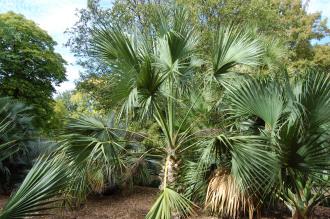
Sabal palmetto (18/10/2014, Real Jardín Botánico de Madrid)
Position: Full sun
Flowering period: Early summer
Soil: Moist, well drained
Eventual Height: 20m
Eventual Spread: 6m
Hardiness: 8a, 8b, 9a, 9b, 10a, 10b
Family: Arecaceae
Sabal palmetto is a slow growing evergreen palm tree with a single stem. Its mid green leaves are arranged radially, palmately, composed of up to 60 leaflets and up to 3.5m long. Each leaflet is up to 2m long. Its trunk may achieve a diameter of up to 35cm. Its yellow/ white flowers are up to 7mm across and are arranged in panicles which are up to 2.5m long. Its black fruit is a drupe and is up to 13mm long.
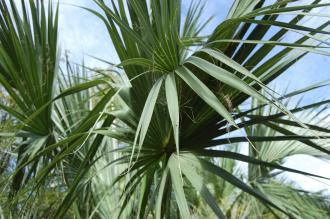
Sabal palmetto Leaf (18/10/2014, Real Jardín Botánico de Madrid)
Sabal palmetto, commonly known as Sabal Palm, Cabbage Palm, Palmetto, Cabbage Palmetto, Common Palmetto or Swam Cabbage, is native to the sub tropical Gulf coast and south Atlantic coast and adjacent islands. In its native habitat it grows in pine lands, river banks, dunes and tidal flats.
The etymological root of the binomial name Sabal is probably derived from the Native American name for this palm. Palmetto is derived from the Latin meaning ‘small palm’.
The landscape architect may find Sabal palmetto useful as an attractive palm tree with an architectural habit and suitable for use as a street tree. Once established this palm is drought tollerant. This palm is tollerant of maritime conditions and is very salt tolerant.
Ecologically, Sabal palmetto flowers are attractive to pollinating insects. The fruit of this palm is attractive to some birds.
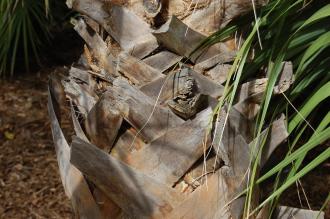
Sabal palmetto Bark (18/10/2014, Real Jardín Botánico de Madrid)
Sabal palmetto prefers moist, fertile, well-drained soils. It tolerates most pH of soil. It will tolerate salty soils.
Sabal palmetto requires little maintenance. Dead leaves may be removed from its trunk to keep a tidy appearance.