


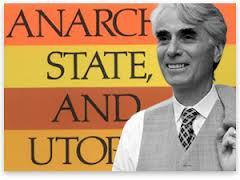
 The late philosopher Robert Nozick authored a classic libertarian text, Anarchy, State, and Utopia. Subsequently, he didn’t exactly recant it, but did decide its viewpoint was incomplete.
In an essay, The Zigzag of Politics (in his book, The Examined Life), Nozick begins by noting that democratic institutions and liberties are not only about government; they “express and symbolize, in a pointed and official way, our equal human dignity, our autonomy and powers of self-direction.” That’s what we express in voting; we do it not because we expect to affect the outcome, or even because the outcome itself is so important.

That’s why I keep saying “democracy” isn’t merely elections; it’s a culture, a way of life. Elections don’t create that, they reflect it. We see the lesson again and again. In Egypt, it was a lack of such democratic culture that caused Morsi to behave as he did; and caused the subsequent rotten behavior of his ousters.
Nozick says his previous libertarian position didn’t adequately incorporate the way politics is not just politics, but also symbolic,
Nozick goes on to suggest some work-arounds, like allowing a program’s “conscientious objectors” to opt out of the associated taxation, provided they pay compensatory taxes to fund something else.
I could scarcely take that seriously. And I found the rest of Nozick’s argument unpersuasive, especially in light of the modern realities of society and government.
My libertarianism is not anti-social. Indeed, you might call it “socialist libertarianism,”

Why did we invent society, and support it? Not because “society” is some greater entity to which we must bow down and subordinate ourselves. That pernicious idea is at the heart of all collectivist ideologies. No – it’s because society serves us, its individual members, enabling us to realize most fully our human qualities, including our human need to interact with our fellows. Empowering this is, again, the basic limited role of government, says the libertarian.
But that may conflict with other things that our social consciences may, per Nozick, want government to do, which entail restricting and coercing people (or taxing them, also coercive). Of course, nobody much wants it restricting, coercing, and taxing him. But doing it to others . . . this is where the libertarian becomes very cautious and skeptical.
It’s all well and good to talk about noble minded projects of social solidarity, as Nozick does;

But Nozick seems to be writing from Mount Olympus

* As the ward boss explained to the worried neophyte candidate at the bottom of the ticket, “Al Smith is the ferry. You’re the garbage.”







