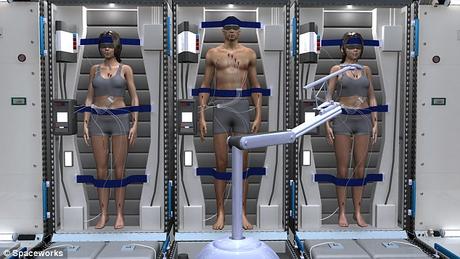
 Stopping
the flow of coolant would then wake the crew when they arrive at their
destination. This means that on the journey to Mars, they could be placed in a
fairly small capsule. Lowering body temperature and metabolism mean cells need
less oxygen, enabling their survival in conditions when oxygen cannot be
delivered. This process of artificial cooling in humans appears similar to
spontaneous torpor in animals in that it includes reduced breathing, heart rate
and metabolism. But the key difference is that animals seems to 'know' the way to safely
and spontaneously enter torpor.
The
way to get to Mars using the minimum energy involves launching in a specific
window when the two planets are aligned in such a way that a craft can catch up
to the red planet when launched from Earth and enter orbit. This launch window
opens approximately every two years and two months, which is why mission to
Mars often launch and arrive at similar times – such as India’s recent Mars
orbiter and Nasa’s Maven mission. The
next window opens in April 2018, when Nasa’s next Mars mission – Insight – will
launch towards the red planet, while the as-yet unnamed Mars 2020 rover will do
the same when the next window opens in July 2020.
Interesting !!
With
regards –S. Sampathkumar
17th
Mar 2016-03-17
Stopping
the flow of coolant would then wake the crew when they arrive at their
destination. This means that on the journey to Mars, they could be placed in a
fairly small capsule. Lowering body temperature and metabolism mean cells need
less oxygen, enabling their survival in conditions when oxygen cannot be
delivered. This process of artificial cooling in humans appears similar to
spontaneous torpor in animals in that it includes reduced breathing, heart rate
and metabolism. But the key difference is that animals seems to 'know' the way to safely
and spontaneously enter torpor.
The
way to get to Mars using the minimum energy involves launching in a specific
window when the two planets are aligned in such a way that a craft can catch up
to the red planet when launched from Earth and enter orbit. This launch window
opens approximately every two years and two months, which is why mission to
Mars often launch and arrive at similar times – such as India’s recent Mars
orbiter and Nasa’s Maven mission. The
next window opens in April 2018, when Nasa’s next Mars mission – Insight – will
launch towards the red planet, while the as-yet unnamed Mars 2020 rover will do
the same when the next window opens in July 2020.
Interesting !!
With
regards –S. Sampathkumar
17th
Mar 2016-03-17
Science article credit : www.dailymail.co.uk/sciencetech/article-3495547