


by Stuart H. Gray
At last we have reached the encounters with the risen Jesus. We will describe a few of these here and discuss a possible problem.
Is There a Disagreement Over Who Was First to Meet the Risen Jesus?
Matthew’s account:
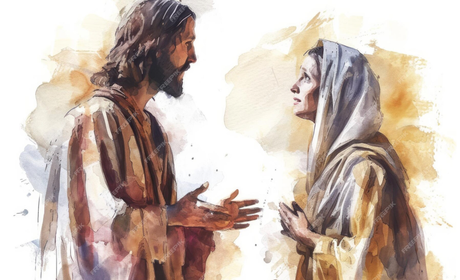
“So the women hurried away from the tomb, afraid yet filled with joy, and ran to tell his disciples. Suddenly Jesus met them. ‘Greetings,’ he said. They came to him, clasped his feet and worshipped him. Then Jesus said to them, ‘Do not be afraid. Go and tell my brothers to go to Galilee; there they will see me.’” (Matthew 28:7-10, NIV)
The first people to meet Jesus in Matthew’s account are the group of women.
Mark’s account:
“When Jesus rose early on the first day of the week, he appeared first to Mary Magdalene, out of whom he had driven seven demons. She went and told those who had been with him and who were mourning and weeping.” (Mark 16:9-10, NIV)
Mark disagrees with Matthew. He says Mary Magdalene was the first to meet Jesus, not the group of women returning from the tomb. This text comes from the longer ending of Mark. It’s not clear whether verses 9 to 20 were written by Mark, as the oldest manuscripts do not have it.
Luke’s account:
“when they came back from the tomb, they told all these things to the Eleven and to all the others. It was Mary Magdalene, Joanna, Mary the mother of James, and the others with them who told this to the apostles. But they did not believe the women, because their words seemed to them like nonsense. Peter, however, got up and ran to the tomb. Bending over, he saw the strips of linen lying by themselves, and he went away, wondering to himself what had happened.” (Lk. 24:9-12, NIV)
Luke’s narrative then moves forward in time to that afternoon. Two of Jesus’ friends are walking between Jerusalem and a town called Emmaus. This town was seven miles from Jerusalem. We know this journey happened later in the day. Luke says it was approaching evening when they arrived at Emmaus (Lk. 24:28). If we assume it would take them around 3.5 to 4 hours to walk this distance, then they must have set off in the early afternoon.
As they walk along, they encounter a man who joins them on their journey. (Lk. 24:16) They talk about Jesus’ crucifixion and the resurrection stories. They say:
“some of our women amazed us. They went to the tomb early this morning but didn’t find his body. They came and told us that they had seen a vision of angels, who said he was alive. Then some of our companions went to the tomb and found it just as the women had said, but they did not see Jesus.” (Luke 24:22-24, NIV)
Once they arrive at their destination, they discover the fellow traveler is in fact the resurrected Christ. (Luke 24:13 – 34, NIV). After realizing they have seen the risen Jesus:
“They got up and returned at once to Jerusalem. There they found the Eleven and those with them, assembled together and saying, ‘It is true! The Lord has risen and has appeared to Simon.’” (Luke 24:33-34, NIV)
It sounds like the travellers were initially skeptical about the various resurrection evidences. Their own encounter with Jesus changes their minds.
Is There A Problem Between Matthew and Luke’s Accounts?
Matthew records that a group of women encounter angels at the empty tomb. They leave the garden, and then meet with Jesus on the road (Mt. 28:9-10).
However, Luke says the group of women encounter angels at the tomb. And they go and report their experiences to the disciples. But their report does not explicitly include a meeting with Jesus. The Emmaus road travellers repeat this report to the man on the road.
Is there a contradiction between Luke and Matthew?
Does Luke’s Account Contradict Matthew’s Account?
What if Luke had said that the women never encountered Jesus in the morning? Then I would say a contradiction exists between Luke and Matthew’s accounts. But Luke does not say this. Instead, he focuses on different events compared to Matthew. Luke doesn’t deny that Matthew’s reported encounter of Jesus occurred to the women. There is therefore no contradiction. Notice that Luke does state that the men never saw Jesus on Sunday morning at the tomb.
Let’s explore this a bit.
Matthew says, “the women hurried away from the tomb, afraid yet filled with joy, and ran to tell his disciples. Suddenly Jesus met them.” (Mt. 28:8-9) However, Luke says, “when they came back from the tomb, they told all these things to the Eleven and to all the others.” (Lk. 24:9)
Matthew records the group’s encounter with Jesus while Luke does not record this. It seems plausible to me that the differences are due to the writers having different goals. Each writer concentrates on different events at different times.
Matthew’s reported female encounter with Jesus may have happened later that morning. The women initially went to John’s house and gave their report. Yet the other disciples also needed to be told what was happening too. This wider group were lodging in Bethany, 2 miles east of Jerusalem. It seems possible that the women left John’s place to travel to Bethany. They subsequently encounter Jesus on the road while traveling there.[1]
Luke’s account may summarize the ladies visit to both the disciples in Jerusalem, and then in Bethany as well:
“When they came back from the tomb, they told all these things to the Eleven and to all the others.” (Luke 24:9, NIV)
In Luke’s account, the women may have only experienced the angel at the empty tomb by this point. Tho he states that the women are talking to all eleven disciples, which suggests he is summarizing both visits.
Luke doesn’t explicitly claim the group of women encounter the risen Jesus on the road to Bethany. But he doesn’t claim they didn’t either. All we can say is he doesn’t record this event. Notice three things about this. First, this doesn’t necessarily mean Luke didn’t think it happened, just that he doesn’t record it. There are other important encounters that Luke also doesn’t narrate. Peter’s encounter with Jesus, for example. He refers to it but doesn’t narrate it. Second, Luke does say that the women have experiences to tell the disciples about. The men are initially very skeptical about what they say. (Lk. 24:11) A Jesus encounter could plausibly be part of this. Third, Luke’s focus is more on the other appearances of Jesus later on that day. He isn’t focussed on Sunday morning after reporting the empty tomb discovery by the women, and Peter. He moves to the afternoon Emmaus road experience quickly.
Luke’s account complements Matthew’s account. We see this once we observe that the authors pick out different encounters with Jesus at different times on Sunday.
John’s Account:
John’s point of view is different again. He has Mary Magdalene alone outside the empty tomb. The group of women, Peter, and John have now left the garden.
Mary sees two angels in the tomb. They speak to her, and she expresses her sadness at losing the body of Jesus. Then:
“…she turned around and saw Jesus standing there, but she did not realize that it was Jesus. He asked her, “Women, why are you crying? Who is it you are looking for?” Thinking he was the gardener, she said, “Sir, if you have carried him away, tell me where you have put him, and I will get him.’ Jesus said to her, ‘Mary.’ She turned toward him and cried out in Aramaic, “Rabboni!” (which means ‘Teacher’).” (John 20:14-16, NIV)
There might be a problem here. Matthew described the group of women meeting Jesus on the road. But John, and Mark, agree Mary Magdelene was first to encounter him. Is there a contradiction here around who meets Jesus first?
Is there a Disagreement Between the Gospels on Who Encountered Jesus First?
The longer ending of Mark does state explicitly that Mary Magdalene encountered the risen Jesus first. (Mk. 16:9, NIV) This does seem to align with John. (Jn. 20:16-17). The question is, do Mark and John contradict Matthew and Luke on who sees Jesus first?
Remember that Luke’s account does not describe a Jesus encounter for the women early on Sunday. This does not mean it didn’t happen. It just means Luke doesn’t report it. Luke is disagreeing with no one here because he doesn’t deny the women encountered Jesus in the morning.
Matthew’s account follows the wider group of women as they leave the empty tomb. He says they meet Jesus unexpectedly as they walk away from the tomb.
“So the women hurried away from the tomb, afraid yet filled with joy, and ran to tell his disciples. Suddenly Jesus met them.” (Matthew 28:8-9, NIV)
To John, Mary meets Jesus outside the tomb (Jn. 20:16-17). To Matthew, the women meet Jesus on the road. (Mt. 28:8-9) Can both reports be true at the same time? If not, then we have a contradiction between Mark/John and Matthew over who encounters Jesus first.
Identifying Mary Magdalene As the First to Meet Jesus
I think there is a reasonable harmonization of Matthew and Mark/John that has Mary Magdalene meeting the risen Jesus first. Then afterwards, the group of women meet him on the road to Bethany.
I think we can construct a series of events that harmonize the accounts. This does not seem to be a stretch. But it requires us to make three assumptions.[2]
- The first group of women who encounter the empty tomb (minus Mary Magdalene) travel to John’s house. They tell John and Peter about angels at the tomb. (Lk. 24:9)
- ASSUMPTION 1: The group follows Mary Magdalene to John’s house after their angelic encounter.
- Then the group of women decide to travel from the tomb to Bethany. They will tell the wider group of disciples about the empty tomb and the angels they saw. Bethany is 2 miles away so their journey will probably take them around 40 minutes. Maybe a bit less.
- ASSUMPTION 2: I am assuming the group of women subsequently travel to Bethany. Matthew’s text does not say this explicitly. It seems reasonable, however.
- Mary Magdalene decides not to go to Bethany. Instead, she goes back to the garden to be at the empty tomb. (Jn. 20:11)
- ASSUMPTION 3: Peter and John arrive at the empty tomb soon after the women leave for Bethany. They have come from John’s house in Jerusalem. It has only taken a few minutes to get there.
- The men stay a short time at the empty tomb and then leave. (Jn 20:10)
- Mary stays at the tomb after the men leave. She meets two angels inside the tomb, and Jesus outside of the tomb. He tells her to go and tell his brothers. (Jn. 20:17)
- Meanwhile, a larger group of women are now traveling to Bethany. They also meet the risen Jesus on the road. (Mt. 28:9)
So – the risen Jesus is with Mary Magdalene (8). Suddenly he is also with the group of women on the road (9). We might ask how he has managed to get from one place to another so quickly. He is with Mary Magdalene outside the empty tomb. Then he is 2 miles away on the road to Bethany. How did he do that in such a short time?
First, remember it would take the women 30 minutes to go from John’s house to Bethany. There is a window of time here for Mary to meet him at the empty tomb first.
Second, there are suggestions in the text that the risen Jesus could appear and disappear in an unexpected way. For example, “While they were still talking about this, Jesus himself stood among them…” (Jn. 24:36, NIV) Also, on the Emmaus road, the travellers were kept from recognizing Jesus for a while. (Lk. 24:31). The risen Jesus reportedly had non-natural abilities.
Given this situation, moving from the tomb to Bethany quickly does not seem too difficult for the risen Jesus.
Conclusion
Is there a contradiction around who meets the risen Jesus first? Not necessarily. The texts all allow Mary Magdalene to be first. But I am making three assumptions about the women’s decisions and the timing of the men’s visit to the tomb. These assumptions support my harmonization of Matthew and Mark/John. The assumptions seem reasonable to me. And they are similar to the assumptions John Wenham has made as well.
Also, we noticed that Luke focusses on the afternoon appearance of Jesus. Matthew focusses on the appearance of Jesus to the women in the morning. This makes both accounts complementary, not contradictory.
[1] John Wenham argues this is likely based on the group’s prior movements in and around Jerusalem prior to Jesus’ arrest and crucifixion.
[2] John Wenham follows a similar model. See John Wenham, Easter Enigma Do the Resurrection stories contradict each other?, (Exeter:Paternoster Press, 1984).






