


By Stuart H. Gray
In this series I am responding to the claim that contradictions make the accounts of Jesus’ resurrection unreliable. In this blog I will assess another area of potential conflict.
Was the Stone Already Rolled Away When the Women Arrived or Not?
Mark’s account:
“But when they looked up, they saw that the stone, which was very large, had been rolled away.” (Mark 16:4, NIV)
Luke’s account:
“They found the stone rolled away from the tomb.” (Luke 24:2, NIV)
John’s account:
“Early on the first day of the week, while it was still dark, Mary Magdalene went to the tomb and saw that the stone had been removed from the entrance.” (John 20:1, NIV)
In these three narratives, we have unanimous agreement that the stone was already moved from the front of the tomb. The women discovered the tomb already opened.
Could a Tomb Seal Even Be Rolled Away?
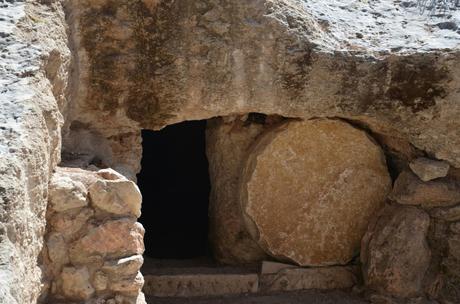
Tombs were sometimes sealed with circular pieces of rock during the 1st century, second temple period. However, it was more common to stop-up the tomb entrance with a stone that acted like a cork.
Was it a circular rock or a cork-shaped stone that was used to close Jesus’ tomb? We cannot answer this question. But it may not matter. Professor of New Testament Urban C. von Wahlde points out that cork shaped coverings are generally shaped to be rollable just like the circular ones. Archaeologists have found both types of rollable tomb seals that date to this period. The circular entrances became more common after the second temple era.[1]
This brings us to…
Matthew’s account:
“After the Sabbath, at dawn on the first day of the week, Mary Magdalene and the other Mary went to look at the tomb. There was a violent earthquake, for an angel of the Lord came down from heaven and, going to the tomb, rolled back the stone and sat on it. His appearance was like lightening, and his clothes were white as snow. The guards were so afraid of him that they shook and became like dead men.” (Matthew 28:1-4, NIV)
Matthew’s account seems wildly at odds with the others. It contains several fantastic additions not mentioned elsewhere. The women apparently witness an earthquake. Then they watch the angel of the Lord moving the stone from the tomb. They also witness the tomb guards collapsing in fright. We get none of these elements from Mark, Luke, or John.
At last! It seems we have found a massive contradiction between the gospel accounts of Jesus’ resurrection.
Assessing the Contradiction
On the face of it, the NIV English translation of Matthew contradicts with the other gospel accounts. My question is, do the original Greek renderings of these texts also contradict in the same way? I ask this question because it is only the Greek text that accurately communicates the intent of the original author. Not the NIV English translation.
Before we turn to the Greek, let’s check the Amplified Bible (AMP). The AMP translation is designed to tease out features of the Greek language in English that might be hidden. The AMP translates Matthew 28 like this:
“Now after the Sabbath, near dawn of the first day of the week, Mary Magdalene and the other Mary went to look at the tomb. And a great earthquake HAD occurred, for an angel of the Lord descended from heaven and came and rolled away the stone…” (Matthew 28:1-2, AMP)
Did you catch the crucial difference here between the NIV and AMP? In the AMP Matthew says a great earthquake had already occurred. So, the stone had already been moved by an angel who had already come down. And all this happened before the women arrived.
Is the AMP trying to rescue Matthew’s account by fixing it? Or is it communicating the author’s intent more accurately? I think it is the latter. The AMP poses a more accurate rendering of the Greek. How do I know that?
Scholars John Wenham and Jonathan McLatchie argue the earliest Greek manuscripts were written this way. They do not imply the women observed the earthquake, the moving stone, and the terrified guards. Here’s the Greek text alongside the English:

This is from the brilliant Mounce Reverse Interlinear New Testament.
McLatchie notes that:[2]
1 – In verse 2, “kai idou” does not mean, “all of a sudden.” The women did not see what is described in verse 2. Rather, ‘kai idou” is accurately translated by Greek scholar Bill Mounce as “and behold”. In that case, when did the events of verse 2 to verse 4 occur?
2 – Verses 2 to 4 describe things that had happened in the past. The tense of the passage is revealed in the Greek aorist participle at the end of verse 2. The words “angelos kyrios katabaino” means “an angel of the Lord had descended.” This reveals these as past events. The earthquake, the angel, and the moving stone are all a flashback. They help us by explaining why the tomb has been found open by the women.
3 – Matthew states explicitly in verse 11 that the guards had left the tomb before the women arrived.
“While the women were on their way, some of the guards went into the city and reported to the chief priests everything that had happened.” (Matthew 28:11, NIV)
The events that caused the soldiers to fall to the ground must also have happened before the women arrived. So, verse 2 describes what happened to make the soldiers leave before the women arrived.
4 – This same flashback technique is used by Matthew elsewhere in his gospel. It would not be an unusual way for him to write about the events at the empty tomb like this. In Mt. 14:3 he gives a flashback concerning King Herod’s casting of John the Baptist into prison.
Here’s a contemporary analogy to help us. Matthew’s account flashes different scenes on a cinema screen for us, one after another. The first scene shows the women arriving at the tomb. The second scene shows a dramatic flashback involving the earthquake, the rolling stone, and the guards. But the flashback explains what happened prior to the women arriving. We see flashbacks in movies and TV shows all the time. They help to establish context for what is happening now. That’s what is happening in Matthew’s account. He is establishing context for the women’s arrival. The stone had already been removed from the front of the tomb and the flashback explains how.
Limiting the Effect of the Contradiction to English Translation Only
What does this mean? First, there’s a contradiction introduced in English NIV translations between Matthew and the other gospel accounts. The NIV seems to imply the women observed things they could never have seen.
Second, it means that Matthew’s original writing doesn’t contradict the other authors. In Greek, the gospels agree the women did not see the stone roll away from the front of the tomb.
Conclusion
There is no contradiction in the Greek text on whether the women saw the angel move the stone. All four accounts unanimously agree they did not see this happen. Some English translations of Matthew’s gospel, including the NIV, confuse the language. It introduces a contradiction that is not present in the Greek.
Is there a contradiction here? Yes – but only in the English translation of the text. It’s the original Greek that ultimately matters. We need not think this contradiction undermines the integrity of the resurrection accounts of Jesus.
[1] How Was Jesus’ Tomb Sealed, Biblical Archaeology Society, posted March 25th, 2025, accessed April 16th, 2025, https://www.biblicalarchaeology.org/daily/archaeology-today/biblical-archaeology-topics/how-was-jesus-tomb-sealed/.
[2] Jonathan McLatchie, “Do the Resurrection Narratives Contradict? A Reply to Dan McClennan”, March 10th, 2025, accessed April 13th, 2025, https://jonathanmclatchie.com/do-the-resurrection-narratives-contradict-a-reply-to-dan-mcclellan/






