


by Stuart H. Gray
In this series, I’m exploring the accounts of the resurrection of Jesus of Nazareth from the dead. Are the different reports consistent or not? This matters because contradictory accounts need not be taken seriously. Consistency between the accounts indicates the authors are recounting a real, highly unusual event. We should try to understand its implications.
So far, I have introduced the main cast of characters. I’ve also begun to explore their movements on the weekend when Jesus was crucified. We explored spice preparations ahead of the group’s visit to the tomb. We found it likely that Luke and Mark’s accounts are complementary.
In this blog we finally arrive at the empty tomb on Sunday morning. We will explore two possible problems:
1 – Had the sun risen or was it still dark during the visit to the tomb on Sunday morning?
2 – How many women arrived at the tomb on Sunday morning?
First, some more background information. Let’s think again about the question of geography. How far did people have to go to find Jesus’ tomb?
Did the Group Have to Walk Far to the Tomb on Sunday Morning?
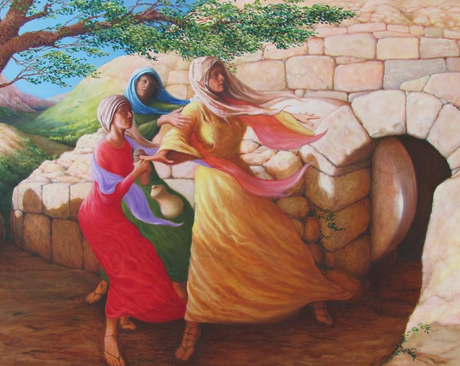
The gospels all agree that Jesus’ female disciples were the first to arrive at his grave early on Sunday morning. Is this feasible given their probably location in Bethany on Saturday? I think so.
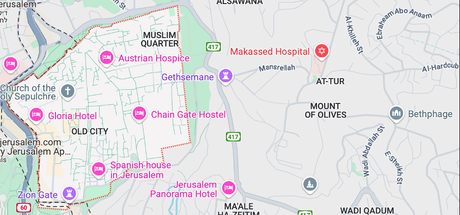
The group were likely lodging in Bethany, east of the Mount of Olives outside of Jerusalem. This location had been used before by Jesus’ group and is mentioned in various passages (e.g. Jn. 12:1, Mark 11:1-2, Luke 19:29). It seems likely that the women, and perhaps the wider group, were camped out there during the tumultuous events of the weekend. John Wenham has personally lived in Jerusalem and knows the area. The distance between the site of Bethany and the Jerusalem old city is less than two miles.[1] Can we estimate the rough distance the women would have walked from Bethany to Jesus burial site?
No-one is certain of the precise location of Jesus’ empty tomb today. An early historical argument puts it beneath the Church of the Holy Sepulchre in the Jerusalem Old Town. This argument dates to the fourth century. An alternative location is at the Garden Tomb in Jerusalem. However, this site is probably too far away from first century Jerusalem. The city was much smaller back then, covering around a square kilometer. This puts the Holy Sepulchre location in a good spot just outside the original first century Jerusalem city walls. Jews would have crucified Jesus outside the city to align with Jewish cleanliness laws (e.g. Lev. 14:33-45). The tomb’s location is described in Jn 19:41. Joseph of Arimathea’s tomb was in a garden close to the crucifixion site. In the discussion below, we will adopt the Church of the Holy Sepulchre as the site of Jesus’ empty tomb.
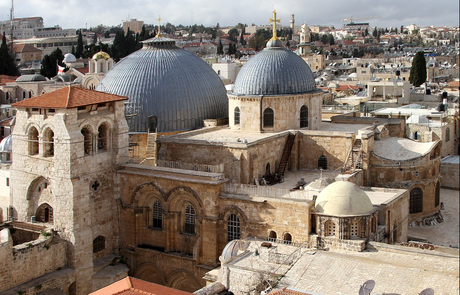
So – how far is it from Bethany to the site of the tomb?
Let’s pull up google maps. I’ll measure the distance “as the crow flies” between the Holy Sepulchre and Bethpage (close to Bethany). The distance is well under 2 miles. This seems walkable on Sunday morning for the visitors to the tomb.
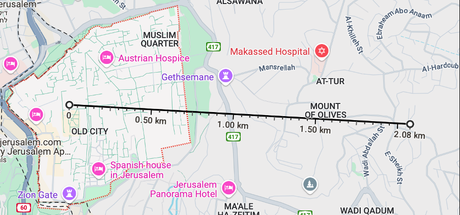
Assuming the women are lodging in Bethany, the distance to the tomb is walkable. Now we hit a potential problem. Was it dark or light when the women arrived at the tomb?
Had the Sun Risen or Was It Still Dark When They Arrived at the Tomb?
Matthew’s account:
“After the Sabbath, at dawn on the first day of the week, Mary Magdalene and the other Mary went to look at the tomb.” (Mk. 21:1, NIV)
Mark’s account:
“When the Sabbath was over, Mary Magdalene, Mary the mother of James, and Salome bought spices so that they might go to anoint Jesus’ body. Very early on the first day of the week, just after sunrise, they were on their way to the tomb.” (Mk. 16:1-2, NIV)
Luke’s account:
“On the first day of the week, very early in the morning, the women took the spices they had prepared and went to the tomb.” (Lk. 24:1, NIV)
John’s account:
“Early on the first day of the week, while it was still dark, Mary Magdalene went to the tomb and saw that the stone had been removed from the entrance.” (Jn. 20:1, NIV)
Analysis of the Accounts
Matthew, Mark, and Luke agree the women are walking to the tomb around dawn. John says it is still dark when Mary Magdalene goes to the tomb.
Remember that the women must walk over a mile to get to their destination. It is reasonable to presume it was dark when they set out. But surely the sun would have come up by the time they arrived in the garden?
Wenham notes that the phrases “while it was still dark,” and “very early,” and “just after sunrise,” are relative terms. One person might describe sunrise conditions as still quite dark, while another might think otherwise.[2]This is reasonable. But it’s a stretch to find a contradiction here.
In summary, the accounts agree that it was still quite dark when the women set out to the tomb. But after walking the distance to the tomb, it would have been lighter on their arrival. Remember too that they were returning to the place where some of them had seen Jesus buried on Friday.
How Many Women Arrived At the Tomb on Sunday Morning?
Matthew’s account:
“After the Sabbath, at dawn on the first day of the week, Mary Magdalene and the other Mary went to look at the tomb.” (Matthew 28:1, NIV)
Mark’s account:
Mark adds Salome to the group. Remember that the other Mary is referred to sometimes as Mary the mother of James:
“When the Sabbath was over, Mary Magdalene, Mary the mother of James, and Salome bought spices so that they might go to anoint Jesus’ body.” (Mark 16:1, NIV)
Luke’s account:
Luke’s description works a bit differently:
“On the first day of the week, very early in the morning, the women took the spices they had prepared and went to the tomb.” (Luke 24:1, NIV)
“When they came back from the tomb, they told all these things to the Eleven and to all the others. It was Mary Magdalene, Joanna, Mary the mother of James, and the others with them who told this to the apostles.” (Luke 24:9-10, NIV)
It is interesting that Luke agrees that Mary Magdalene and the other Mary were in the group. But he also adds Joanna to the group. She worked at the Hasmonaean palace. She seems to be an eyewitnesses Luke has used in compiling his gospel. She gives him additional details that are missed by Matthew and Mark. Luke doesn’t mention Salome by name, but he does say that there were others in the larger group. This gives room to include Salome and probably others as well.
John’s account:
John only mentions Mary Magdalene in his account.
“Early on the first day of the week, while it was still dark, Mary Magdalene went to the tomb and saw that the stone had been removed from the entrance.” (John 20:1, NIV)
Is it possible that John wants his reader to think that only Mary Magdalene visited the tomb that morning? Perhaps not. In verse 2, Mary makes an interesting statement to the men:
“They have taken the Lord out of the tomb, and WE don’t know where they have put him!” (John 20:2, NIV)
Notice his use of the first-person plural pronoun “we”. This suggests that John is aware there was a wider group of ladies visiting the tomb early that morning. However, for his purposes, he chooses to spotlight Mary Magdalene in his account.
Analysis of the Accounts
Is there a disagreement between the gospel writers about exactly who the first witnesses of the empty tomb were?
It seems at least plausible that, although Matthew only mentions two people by name, there was a wider group present including Salome and Joanna. This would align with Luke’s statement that there were other women present who were not mentioned by name in his account. John also uses “we” to refer to the wider group Mary Magdalene was a member of. There seems to be a clear way to harmonize the accounts. But are we stretching the accounts as we do so?
Dr Mike Licona has studied ancient Greek writers and their works extensively, noting several common literary devices. One of the devices he has uncovered is called literary spotlighting. This happens when one character in an account is emphasized to the exclusion of other characters. The author is not denying the other people were there. He is focussing on particular individuals while minimizing others.[3] This is very common in the works of Plutarch, for example.[4]
What has this to do with the New Testament? They gospels were originally and primarily Greek texts. Like the works of Plutarch, they are of a literary form call Greek biography. Plutarch was born in the mid-1st century. In the early 2nd century he wrote Parallel Lives, a series of biographies pairing Greek and Roman figures. Licona argues we see evidence of literary spotlighting when we compare Plutarch’s writing with the gospel accounts.
Given this common approach to writing at the time, it seems reasonable to understand the different resurrection accounts this way. The gospel authors would do something similar as a matter of course to simplify their accounts. They mentioned different individuals but recognized there was a wider group visiting the tomb on Sunday morning. Notice too that Mary Magdalene is always consistently mentioned by all the authors.
Conclusion
It seems a stretch to find a contradiction relating to how much sunlight the women had when visiting the tomb. We would have to claim a contradiction existed without any solid evidence for it.
Next, we thought about how many women visit the empty tomb. We discussed the evidence of the spotlighting literary device. We also noted the writers have implied a larger group of women. But they only name a few individuals within it. They all agree Mary Magdalene was in that group.
So, I suggest the harmonization of these accounts is a rational way to read them. It would likely be how the original Greek-speaking audience would have understood them. An argument for contradiction has to deal with this evidence before it can be compelling to me.
[1] John Wenham, Easter Enigma Do the Resurrection stories contradict each other?, (Exeter:Paternoster Press, 1984), 17.
[2] Wenham, 81.
[3] Michael R. Licona, Why Are There Differences In the Gospels What We Can Learn from Ancient Biography, (Oxford: Oxford University Press, 2017), 20.
[4] Ibid., 54.






