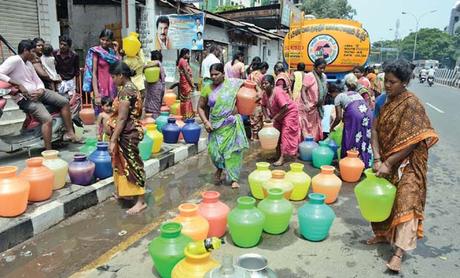
 photo from web : source not known
Water tankers and
people lining up with colourful plastic pots are seen everywhere. Metro water’s
telephone lines are ringing all the time, as the parched out residents seek
some support. By some accounts, the city requires around 830 million litres of water a
day, is not getting anything closer to
that. For sure tankers cannot meet the
demand in full, at many places, people are digging deeper. On our part, let us resolve not to waste a
single drop of water; water is precious – the sad truth is all that flowed in
buckets, eventually found its way to see or got lost ! – not stored !!
This summer too has
been exceptionally hot and the sparse rainfall in June did little to restore
the city’s depleting groundwater levels. When water levels in the four lakes
fall, MetroWater usually taps into the Veeranamlake in Cuddalore district to
make up for the shortfall. But this large lake has also run dry. This prompted
MetroWater officials to extract water from the Wallajahlake, also in Cuddalore.
But the use of these rural lakes to meet urban needs has infuriated farmers in
the district, who say they are being deprived of their water resources.
~
will monsoon provide the succor !!
photo from web : source not known
Water tankers and
people lining up with colourful plastic pots are seen everywhere. Metro water’s
telephone lines are ringing all the time, as the parched out residents seek
some support. By some accounts, the city requires around 830 million litres of water a
day, is not getting anything closer to
that. For sure tankers cannot meet the
demand in full, at many places, people are digging deeper. On our part, let us resolve not to waste a
single drop of water; water is precious – the sad truth is all that flowed in
buckets, eventually found its way to see or got lost ! – not stored !!
This summer too has
been exceptionally hot and the sparse rainfall in June did little to restore
the city’s depleting groundwater levels. When water levels in the four lakes
fall, MetroWater usually taps into the Veeranamlake in Cuddalore district to
make up for the shortfall. But this large lake has also run dry. This prompted
MetroWater officials to extract water from the Wallajahlake, also in Cuddalore.
But the use of these rural lakes to meet urban needs has infuriated farmers in
the district, who say they are being deprived of their water resources.
~
will monsoon provide the succor !!
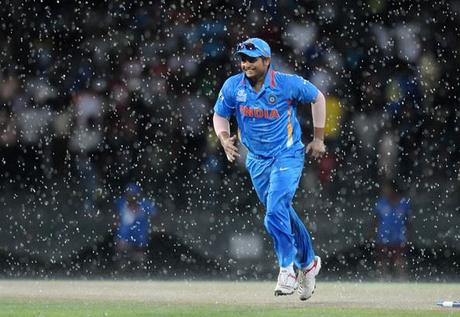 The southwestern
summer monsoons occur from July through September. The southwest monsoon is
generally expected to begin around the beginning of June and fade away by the
end of September. The moisture-laden winds on reaching the southernmost point
of the Indian Peninsula, due to its topography, become divided into two parts:
the Arabian Sea Branch and the Bay of Bengal Branch. This year, the Southwest Monsoon 2017 made
timely onset over Kerala on May 30. Simultaneously, Monsoon has also covered
parts of Northeast India. Weather
sources state that severe Cyclone Mora has played an important role in the
arrival of Monsoon over Indian region.
With its onset, Kerala witnessed on and off rains.
During 2016, onset
of southwest monsoon (SWM) over Kerala took place on 8th June, 7
days behind the normal schedule of 1st June and covered the entire southern
peninsular India by 19th June. Last year’s rainfall for June-September, 2016 over the southern Indian
peninsular region comprising of the five states of Andhra Pradesh, Telangana,
Karnataka, Kerala and Tamil Nadu and two union territories of Puducherry and
Lakshadweep was 92% of its long period average (LPA). This year in Tamilnadu, from 1st
June to 5th July 2017, the rainfall has been 52.7mm as against 54.6,
which is considered as normal.
A day
or an hour almost changed all that !~ in
one of the most intense spells of rainfall recorded over last 40 years, Chennai
on Sunday (9th July 2017 night) got pounded by a mini-Vardah-like storm,
bringing 73 mm of rainfall in just one hour. Several parts of the city,
especially low-lying areas, have reported flooding. It was by far the wettest
day so far this year.
The southwestern
summer monsoons occur from July through September. The southwest monsoon is
generally expected to begin around the beginning of June and fade away by the
end of September. The moisture-laden winds on reaching the southernmost point
of the Indian Peninsula, due to its topography, become divided into two parts:
the Arabian Sea Branch and the Bay of Bengal Branch. This year, the Southwest Monsoon 2017 made
timely onset over Kerala on May 30. Simultaneously, Monsoon has also covered
parts of Northeast India. Weather
sources state that severe Cyclone Mora has played an important role in the
arrival of Monsoon over Indian region.
With its onset, Kerala witnessed on and off rains.
During 2016, onset
of southwest monsoon (SWM) over Kerala took place on 8th June, 7
days behind the normal schedule of 1st June and covered the entire southern
peninsular India by 19th June. Last year’s rainfall for June-September, 2016 over the southern Indian
peninsular region comprising of the five states of Andhra Pradesh, Telangana,
Karnataka, Kerala and Tamil Nadu and two union territories of Puducherry and
Lakshadweep was 92% of its long period average (LPA). This year in Tamilnadu, from 1st
June to 5th July 2017, the rainfall has been 52.7mm as against 54.6,
which is considered as normal.
A day
or an hour almost changed all that !~ in
one of the most intense spells of rainfall recorded over last 40 years, Chennai
on Sunday (9th July 2017 night) got pounded by a mini-Vardah-like storm,
bringing 73 mm of rainfall in just one hour. Several parts of the city,
especially low-lying areas, have reported flooding. It was by far the wettest
day so far this year.
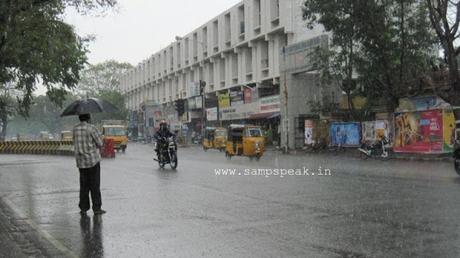 Strong
thunderstorm activity over the city has triggered cloud burst. All hell broke
loose about 7.30 pm, and the tempo remained till 8.30 pm. Though the Met
department had forecast rainfall and thunderstorm during evening and night
hours, the intensity of downpour was something that was not expected.Almost all
parts of the city have received heavy rainfall. At times, the rainfall was
coupled with gusty winds, rekindling memories of the storm during Cyclone
Vardah. Believe it or not, Chennai has received a cumulative rainfall of 61 mm
from January to July 8 this year, and it was breached in the matter of an
hour.
Indian
Express Chennai edition, quoting a noted weather blogger, who has the hourly
rainfall data from 1975, said Sunday’s rainfall in one hour is probably the
second intense spell received by the city in the last 40 years. The all-time
high was recorded in September 1996, when Chennai received 92 mm rainfall in
one hour.
Rains
! ~ did that make you happy ?and more importantly, how much did it add to our
water resources ?? ~ and who is to be blamed for these failure to store !!
With regards – S.
Sampathkumar
Strong
thunderstorm activity over the city has triggered cloud burst. All hell broke
loose about 7.30 pm, and the tempo remained till 8.30 pm. Though the Met
department had forecast rainfall and thunderstorm during evening and night
hours, the intensity of downpour was something that was not expected.Almost all
parts of the city have received heavy rainfall. At times, the rainfall was
coupled with gusty winds, rekindling memories of the storm during Cyclone
Vardah. Believe it or not, Chennai has received a cumulative rainfall of 61 mm
from January to July 8 this year, and it was breached in the matter of an
hour.
Indian
Express Chennai edition, quoting a noted weather blogger, who has the hourly
rainfall data from 1975, said Sunday’s rainfall in one hour is probably the
second intense spell received by the city in the last 40 years. The all-time
high was recorded in September 1996, when Chennai received 92 mm rainfall in
one hour.
Rains
! ~ did that make you happy ?and more importantly, how much did it add to our
water resources ?? ~ and who is to be blamed for these failure to store !!
With regards – S.
Sampathkumar
10th July 2017.