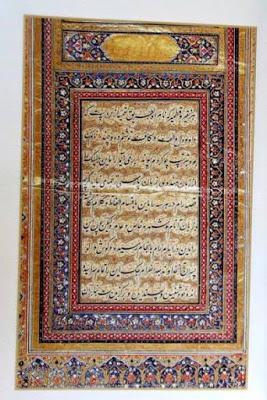
 Persian, also known
as Farsi, the predominant modern
descendant of Old Persian, is one of the Western Iranian languages within the
Indo-Iranian branch of the Indo-European language family. It is primarily
spoken in Iran, Afghanistan and Tajikistan.
Persian is a pluricentric language and its grammar is similar to that of
many contemporary European languages. Wikipedia states that there are approximately
110 million Persian speakers worldwide, with the language holding official
status in Iran, Afghanistan, and Tajikistan. For centuries, Persian has also
been a prestigious cultural language in other regions of Western Asia, Central
Asia, and South Asia by the various empires based in the regions.
Persian, also known
as Farsi, the predominant modern
descendant of Old Persian, is one of the Western Iranian languages within the
Indo-Iranian branch of the Indo-European language family. It is primarily
spoken in Iran, Afghanistan and Tajikistan.
Persian is a pluricentric language and its grammar is similar to that of
many contemporary European languages. Wikipedia states that there are approximately
110 million Persian speakers worldwide, with the language holding official
status in Iran, Afghanistan, and Tajikistan. For centuries, Persian has also
been a prestigious cultural language in other regions of Western Asia, Central
Asia, and South Asia by the various empires based in the regions.
The holy Ramayan has been translated in many languages. Valmiki Ramayan is available in many English versions. Way back in 1880 FS Growse translated Thulasidas Ramayan. In 1952, Oxford University Press published the work of W. Dagnal P Hill. Now we are reading more about one particular version of 1715, which has attracted so much of media attention, thanks to our PM Shri Narendra Modi. US President Obama’s historic visit to Hanoi, where he announced the U.S. is ending the 41-year U.S. arms embargo against Vietnam, and also oversaw new business deals worth about $16 billion was historical. More fraught part of the continent is that of three leaders—Iran’s President Hassan Rouhani, Indian Prime Minister Narendra Modi, and Afghan President Ashraf Ghani—signing a flurry of deals in Tehran on Monday, aimed at reworking political obstacles that have hobbled the region’s economies through years of war and economic boycotts. Shri Modi spoke thus - Centuries of free exchange of ideas and traditions, poets and craftsmen, art and architecture, culture and commerce have enriched both our civilizations. Our heritage has also been a source of strength and economic growth for our nations. The richness of Persian heritage is an integral part of the fabric of the Indian society. A part of Iranian culture lives in Indian hearts. And, a slice of Indian heritage is woven into the Iranian society. Our ancient heroes and epics bear striking parallels. .. .. .. .. .. The great medieval poets of India have called the Persian and Sanskrit the two sisters. India's religious epic Ramayana which has seen over a dozen translations in Persian is known to have about 250 words of Persian. It served as a court language in medieval India. But, its popularity is also because it is written on the hearts of the Indians. It is taught in around 40 universities in India. All India Radio has been running the Persian language service for last 75 years. India has a proud collection of almost 5 million manuscripts of Persian in public and private collections. There are more than 20 million documents in Persian in National and State Archives.
 More than the
speech, Indian Prime Minister Mr Narendra Modi, gifted the supreme leader of
Iran Ayatollah Sayyid Ali Hosseini Khamenei a specially commissioned
reproduction of a rare seventh-century manuscript of the Holy Quran attributed
to Hazrat Ali, the fourth caliph. Written in Kufic script, this manuscript is
stated to be a prized possession of the Ministry of Culture’s Rampur Raza Library.
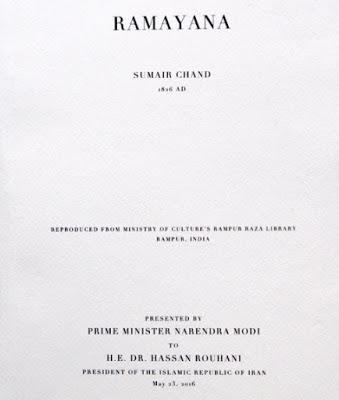
Modiji also gifted the Iranian President
Dr. Hassan Rouhani specially commissioned reproductions of Mirza Asadullah Khan
Ghalib’s collection of poetry in Persian, Kulliyat-e-Farsi-e-Ghalib, as also Sumair Chand’s Persian
translation of Ramayana.
Translated
into Persian in 1715 and copied in 1826, Sumair Chand’s Ramayana is a rare
manuscript at the Ministry of Culture’s Rampur Raza Library, and contains over
260 illustrations – possibly the largest number in any hand-written Ramayana
manuscript. Not
much was written about this earlier, but the media is all buzz about the
Persian language translation of holy Ramayana !
With regards – S.
Sampathkumar
More than the
speech, Indian Prime Minister Mr Narendra Modi, gifted the supreme leader of
Iran Ayatollah Sayyid Ali Hosseini Khamenei a specially commissioned
reproduction of a rare seventh-century manuscript of the Holy Quran attributed
to Hazrat Ali, the fourth caliph. Written in Kufic script, this manuscript is
stated to be a prized possession of the Ministry of Culture’s Rampur Raza Library.
Modiji also gifted the Iranian President
Dr. Hassan Rouhani specially commissioned reproductions of Mirza Asadullah Khan
Ghalib’s collection of poetry in Persian, Kulliyat-e-Farsi-e-Ghalib, as also Sumair Chand’s Persian
translation of Ramayana.
Translated
into Persian in 1715 and copied in 1826, Sumair Chand’s Ramayana is a rare
manuscript at the Ministry of Culture’s Rampur Raza Library, and contains over
260 illustrations – possibly the largest number in any hand-written Ramayana
manuscript. Not
much was written about this earlier, but the media is all buzz about the
Persian language translation of holy Ramayana !
With regards – S.
Sampathkumar
22nd May 2o16.