 Sri
Aurobindo, (15 August 1872 – 5 December 1950), born Aurobindo Ghose, was a
great Nationalist, philosopher, yogi, guru, and poet. He joined the Indian
movement for independence from British rule, for a while became one of its
influential leaders and then became a spiritual reformer, introducing his
visions on human progress and spiritual evolution. Aurobindo studied
for the Indian Civil Service at King's College, Cambridge, England. After
returning to India he took up various civil service works under the maharaja of
the princely state of Baroda and began to involve himself in politics. He was
imprisoned by the British for writing articles against British rule in India.
He was released when no evidence was provided. During his stay in the jail he
had mystical and spiritual experiences, after which he moved to Pondicherry,
leaving politics for spiritual work.
During his stay in
Pondicherry, Aurobindo developed a method of spiritual practice he called
Integral Yoga. The central theme of his vision was the evolution of human life
into a life divine. His main literary
works are The Life Divine, which deals with theoretical aspects of Integral
Yoga; Synthesis of Yoga, which deals with practical guidance to Integral Yoga;
and Savitri: A Legend and a Symbol, an epic poem which refers to a passage in
the Mahabharata, where its characters actualise Integral Yoga in their lives.
His works also include philosophy, poetry, translations and commentaries on the
Vedas,Upanishads and the Bhagavad Gita. He was nominated for the Nobel Prize in
Literature in 1943 and for the Nobel Prize in Peace in 1950.
In
1907, poet Rabindranath Tagore paid him
a visit after his acquittal, and wrote the now famous lines: “ O Aurobindo, bows to thee! O friend, my
country’s friend, O Voice incarnate, free, Of India’s soul! … The fiery
messenger that with the lamp of God. Hath come…
At Paris addressing
the gathering at UNESCO headquarters, PM
Narendra Modi said - “There is much that
we can learn from his humanism and spiritualism, from his belief in the unity
of individual consciousness with the world outside; the enlightened purpose of
education; the service of science; and, the unity of world, founded on national
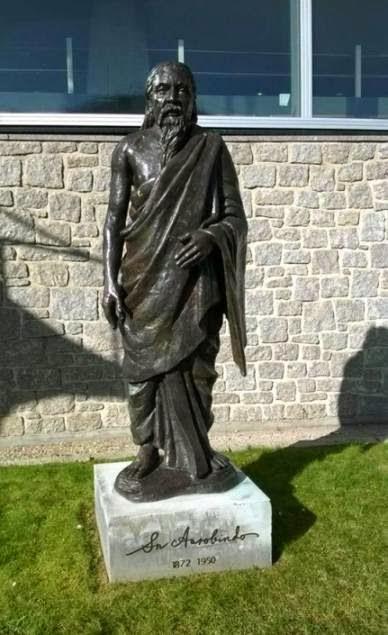
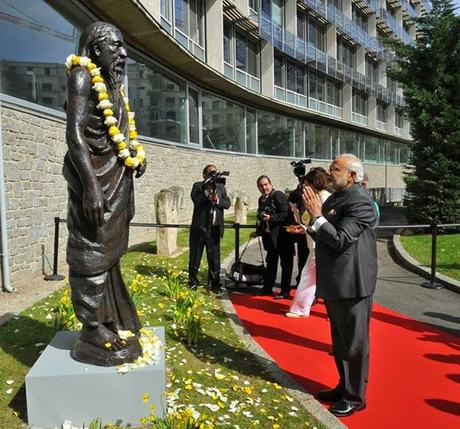
freedom, diversity of civilisations and autonomy of culture.” Mr. Modi made the address after paying a floral tribute
to a bronze statue of Sri Aurobindo which was installed at the UNESCO
headquarters in 2009.
Sri
Aurobindo, (15 August 1872 – 5 December 1950), born Aurobindo Ghose, was a
great Nationalist, philosopher, yogi, guru, and poet. He joined the Indian
movement for independence from British rule, for a while became one of its
influential leaders and then became a spiritual reformer, introducing his
visions on human progress and spiritual evolution. Aurobindo studied
for the Indian Civil Service at King's College, Cambridge, England. After
returning to India he took up various civil service works under the maharaja of
the princely state of Baroda and began to involve himself in politics. He was
imprisoned by the British for writing articles against British rule in India.
He was released when no evidence was provided. During his stay in the jail he
had mystical and spiritual experiences, after which he moved to Pondicherry,
leaving politics for spiritual work.
During his stay in
Pondicherry, Aurobindo developed a method of spiritual practice he called
Integral Yoga. The central theme of his vision was the evolution of human life
into a life divine. His main literary
works are The Life Divine, which deals with theoretical aspects of Integral
Yoga; Synthesis of Yoga, which deals with practical guidance to Integral Yoga;
and Savitri: A Legend and a Symbol, an epic poem which refers to a passage in
the Mahabharata, where its characters actualise Integral Yoga in their lives.
His works also include philosophy, poetry, translations and commentaries on the
Vedas,Upanishads and the Bhagavad Gita. He was nominated for the Nobel Prize in
Literature in 1943 and for the Nobel Prize in Peace in 1950.
In
1907, poet Rabindranath Tagore paid him
a visit after his acquittal, and wrote the now famous lines: “ O Aurobindo, bows to thee! O friend, my
country’s friend, O Voice incarnate, free, Of India’s soul! … The fiery
messenger that with the lamp of God. Hath come…
At Paris addressing
the gathering at UNESCO headquarters, PM
Narendra Modi said - “There is much that
we can learn from his humanism and spiritualism, from his belief in the unity
of individual consciousness with the world outside; the enlightened purpose of
education; the service of science; and, the unity of world, founded on national
freedom, diversity of civilisations and autonomy of culture.” Mr. Modi made the address after paying a floral tribute
to a bronze statue of Sri Aurobindo which was installed at the UNESCO
headquarters in 2009.
 For Puducherians
who were tuned in to the news, it was a matter of great pride. The Prime
Minister had paid tribute to a philosopher who has had a deep influence on
Puducherry and has left a lasting legacy. There was another reason for
Puducherians to be proud. The bronze statue, over
seven feet high, was made in Puducherry by a team led by Lalit Verma, current
president of the Alliance Francaise here and owner of the Aurodhan gallery.
With regards – S.
Sampathkumar
For Puducherians
who were tuned in to the news, it was a matter of great pride. The Prime
Minister had paid tribute to a philosopher who has had a deep influence on
Puducherry and has left a lasting legacy. There was another reason for
Puducherians to be proud. The bronze statue, over
seven feet high, was made in Puducherry by a team led by Lalit Verma, current
president of the Alliance Francaise here and owner of the Aurodhan gallery.
With regards – S.
Sampathkumar
14th April 2015.