Dolce Far Niente (1904) John William Godward
I bought the poster from Woolworths for a couple of quid and I adored the sultry, languid idleness of the image, from the lily-pond, still and mirror-shining, to the beautiful woman curled up on the fur rug. I thought that was how life would be when I was a grown-up. Well, I don't have a peacock feather fan yet, but otherwise it's remarkably similar.Years later, I was fascinated by this image by William Holman Hunt...

Dolce Far Niente (1866) William Holman Hunt
Not liked by many people, Hunt painted over the original face and hair (which belonged to Annie Miller) with those of his beloved Fanny, his wife. The over-painting is not entirely successful but the whole, tightly packed image has a luxurious, voluptuous feeling in keeping with the title of the picture. Dolce Far Niente means 'pleasantly doing nothing' or 'sweet idleness' and refers to the pleasure that lies in leisure. For the Victorians, it was a theme they would return to in art repeatedly...
Dolce Far Niente John William Godward
Godward liked the subject so much, he painted it twice. Again, he presents us with a supine lady on a fur, swathed in rich, translucent fabrics, engaged in nothing much. The air of luxury is essential for the images it seems, I suppose because the rich could afford the idleness cultivated with such splendour.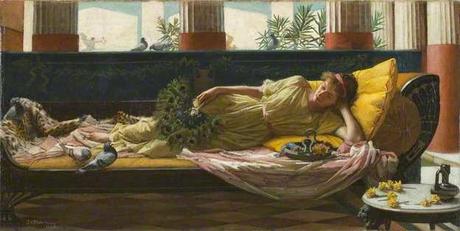
Dolce Far Niente (1880) John William Waterhouse
Waterhouse presents a woman who has at least got off the floor, but she holds a peacock fan. The peacock would be the perfect bird for these images as they aren't known for their industry or use, just their ornament and vanity, which may also have a resonance with the subjects of the paintings. Hunt's woman is unusual as reflected in her mirror are bookcases, hinting that she had been reading if nothing else. For the most part you have to ask what the women have stopped doing in order to be idle? Surely there has to have been action in order for the enjoyment of inaction to be appreciated?
Dolce Far Niente (1882) Lawrence Alma-Tadema
Maybe then it is the women who are the pleasures of idleness for the men who observe them. We, the presumably male viewer, can while away delightful hours, gazing upon these decorative creatures as they roll or loll about looking gorgeous. They are merely part of the pleasurable view, as inanimate as the peacock fan and equally as decorative. It's as simple as that, or is it?
Dolce Far Niente Frederick Arthur Bridgman
It could be there is a warning in the images. Arguably its history taints it, but Hunt's picture unsettles some people and makes them feel that Hunt is not endorsing the pleasure inherent in the title. Bridgman's voluptuous maiden above is the epitome of an idle pleasure, but possibly she is not so good for you. Having no worth other than her voluptuous pleasure is rendering her viewer powerless, idle and an idle man is not a good thing in 19th century terms. She is the siren luring her victims to a terrible fate of sitting and looking at her semi-naked splendour. Steady gentlemen, try to resist for a few moments at least. Remember you're British and Victorian at heart!
Dolce Far Niente (1884-87) Mortimer L Menpes
The Italian title and the oriental dress are somewhat at odds, but both have resonance with aestheticism. Rending oneself into a subjectless tableau of inaction, beautiful and inert, suits both the title and the movement as displayed by the rather bemused woman in a kimono above. She does look as if she has forgotten where she left her keys rather than enjoying idleness. She's standing up and everything.
Dolce Far Niente John Singer Sargent
Unusually, Sargent shows men enjoying the pleasure of idleness, but they aren't really idle in the true sense. Some read, some play suitably sensible games. I bet they are all thinking jolly hard about manly stuff too. Men are apparently rubbish at being idle, but then their natural state is very vigorous and active, so anything that doesn't involve striding across the countryside and wrestling wild animals counts as idleness.
Dolce Far Niente Stanley Cursiter
When women are idle, there are really only fans involved. The fans possibly hint at foreign parts, suggesting that for true idleness you have to look beyond English shores. With the delightful casual racism that garnished the 19th century, the inference is that foreigners are obviously more idle than good British girls. Add a bit of sexual racism in there too, then the sultry supine maidens take on another aspect. Is the danger of a idle woman, an idle foreign woman, that she may corrupt the upstanding British manhood she gets her sultry idle hands on? Gentlemen, please show a pretense of resisting, for heavens sake!
Dolce Far Niente William Quiller Orchardson
In order not to lose my gentlemen readership to the lure of idle, foreign temptresses, I will end my post with my favorite couple of idle women. Orchardson shows us a young woman on an oriental couch, leopard skin and fan on the floor but with a notable addition to the scene...
Dolce Far Niente Auguste Toulmouche
Her feet rest on a furry rug and she is surrounded by luxury, but on her lap is an open book. Both Toulmouche and Orchardson's women are idle during reading. How often, when reading a brilliant book, do you find yourself paused, gazing away, thinking of the plot, the characters, the world created by the wonder of the prose? The idleness of the title is simply an external state because inside these women they are racing through the imaginary worlds of their novels. The summer's heat renders me useless and there is no greater escape from the oppressive heat then to cradle a book and allow it to whisk you away. If the novel is wonderful then after a certain point you can step into the imagination of another and the book falls away briefly. You might be meeting a character, walking through a landscape, trying to make the right decision to reach your happy ending. Whatever captures you, when roused from your revelry by an onlooker and asked the foolish question of what you were thinking about, the answer is invariably 'Nothing...'Dolce Far Niente, indeed.