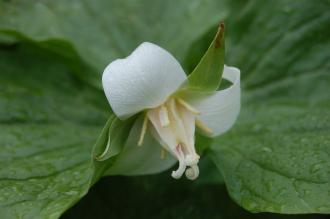
Trillium flexipes Flower (05/05/2012, Kew Gardens, London)
Position: Dappled to full shade
Flowering period: Late spring
Soil: Moist, well drained
Eventual Height: 50cm
Eventual Spread: 30cm
Hardiness: 3a – 9b
Family: Melanthiaceae
Trillium flexipes is a low growing, spreading herbaceous perennial. Its dark green leaves are almost stalkless, ovate to rounded with an acuminate tip and entire margins and appear in groups of three. Its white flowers contain three petals, are up to 5cm across and have a pink ting to its anthers. Its roots are thick rhizomes.
Trillium flexipes, commonly known as the Bent Trillium, White Wakerobin, Wood Lily, Trinity Flower, Nodding Trillium or Drooping Trillium, is native to mid eastern United States. The location of the flower position within this species is variable. In its native habitat it grows in deciduous forests, especially over limestone.
The etymological root of the binomial name Trillium is derived from the Latin triplum meaning ‘triple’, referring to the three-parted flowers common to the genus. Flexipes is from the Latin meaning ‘crooked footed’.
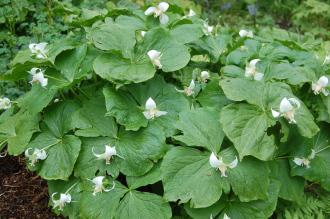
Trillium flexipes (05/05/2012, Kew Gardens, London)
The landscape architect may find Trillium flexipes useful as a low growing ground cover plant in shady locations, particularly in woodland locations.
Ecologically, T. flexipes is attractive to pollinating insects. It attracts ants as the elaiosome of the seed will evoke their corpse-carrying behavior, their seeds are also spread by wasps and Harvestmen.
T. flexipes prefers moist, humus rich, well-drained soils. It tolerates most pH of soil.
Trillium flexipes requires little maintenance. Large clumps may be divided in late summer to early autumn.