Quercus rubra Leaf (28/07/2012, Kew Gardens, London)
Position: Full sun
Flowering period: Late spring
Soil: Moist, well drained
Eventual Height: 35m
Eventual Spread: 25m
Hardiness: 3a – 9a
Family: Fagaceae
Quercus rubra is a fast growing, long lived, medium/ large, deciduous, spreading tree. Its dark green leaves are alternate, ovate to oblong with up to 9 bristle tipped lobes, up to 20cm long and 12cm broad. Its leaves turn bright red in autumn before they fall. Its stout branches tend to grow at right angles to the stem. Its trunk may achieve a diameter of up to 2m. Its grey/ brown bark has vertical ridges with shiny stripe in its troughs. Its flowers are monoecious, the male being yellow/ green catkins which are up to 10cm long, the female are small and insignificant. Its fruit are acorns which are up to 2.5cm long and take 18 months to mature.

Quercus rubra (28/07/2012, Kew Gardens, London)
Quercus rubra, commonly known as Northern Red Oak, Red Oak or Champion Oak is native to central and eastern North America. Quercus rubrais synonymous with Quercus borealis. It is the state tree if New Jersey, USA. It was introduced into the UK in 1724.
The etymological root of the binomial name Quercus is derived from the Latin name for an Oak tree, but some authorities believe it to be derived from the Celtic quer meaning ‘fine’ and cuez meaning ‘a tree’. Rubra is from the Latin meaning ‘red’ in reference to its autumn leaf colour.
The landscape architect may findQuercus rubra useful as a parkland tree. This tree is tolerant of urban pollution.
Ecologically, Quercus rubra acorns are attractive to some mammals and birds.
The Royal Horticultural Society has given Quercus rubra their prestigious Award of Garden Merit in 1993.
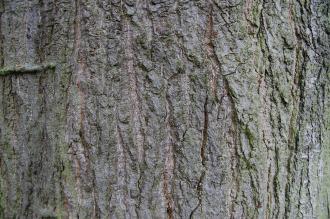
Quercus rubra Bark (28/07/2012, Kew Gardens, London)
Quercus rubra prefers moist, deep, fertile, well-drained soils. It tolerates most pH of soil, although it prefers an acidic pH.
Quercus rubrarequires little maintenance.