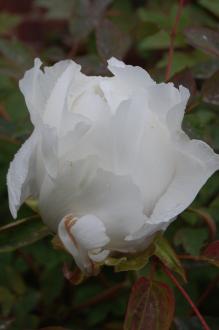
Paeonia rockii ‘Joseph Rock’ Flower (05/05/2012, Kew Gardens, London)
Position: Full sun to partial shade
Flowering period: Late spring to early summer
Soil: Moist, well drained
Eventual Height: 1.8m
Eventual Spread: 2m
Hardiness: 5a – 9b
Family: Paeoniaceae
Paeonia rockii ‘Joseph Rock’ is a large deciduous species of shrubby Peony. Its leaves are dark green on the upper surface, blue green on the underside, are bi or tri pinnate with up to 33 leaflets. The individual leaflets are lanceolate to ovate with entire margins. Its white solitary flowers are bowl shaped, have yellow anthers, appear at the ends of the stems and are up to 19cm across. Its fruit. Its roots are rhizomes and dislike disturbance.
The species Paeonia rockii , commonly known as Rock’s Peony or Rock’s Tree Peony, is native to mountains of mid west China. In its native habitat it grows at the margins of deciduous forests and shady slopes.
The etymological root of the binomial name Paeonia is named after Paeon, a Greek physician of the gods who, in mythology, was changed into a flower by Pluto. Rockii is named after Joseph Rock(1884 – 1962), an Austrian/ American botanist/ explorer.

Paeonia rockii ‘Joseph Rock’ (05/05/2012, Kew Gardens, London)
The landscape architect may find Paeonia rockii ‘Joseph Rock’ useful as a large specimen shrub which is particularly suited to a sheltered woodland setting.
Ecologically, P. rockii ‘Joseph Rock’ is attractive to pollinating insects.
P. rockii ‘Joseph Rock’ prefers moist, humus rich, fertile, well-drained soils. It tolerates most pH of soil.
Paeonia rockii ‘Joseph Rock’ requires little maintenance. Older stems may be removed to maintain a tidy appearance.