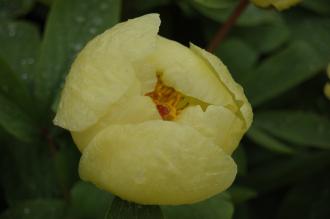
Paeonia mlokosewitschii Flower (05/05/2012, Kew Gardens, London)
Position: Full sun to dappled shade
Flowering period: Late spring
Soil: Moist, well drained
Eventual Height: 90cm
Eventual Spread: 90cm
Hardiness: 5a – 9a
Family: Paeoniaceae
Paeonia mlokosewitschii is a slow growing herbaceous perennial. Its light green/ blue leaves are biternate, with each leaflet being obovate with entire margins. Its leaves emerge with a copper tinge. Before the leaves appear in early spring bright ping bud emerge from the ground. Its pale yellow flowers are single goblets, each up to 12cm across. Its seeds are contained within capsules, these burst open to reveal its viable blue and nonviable red seeds.
Paeonia mlokosewitschii, commonly known as Golden Peony, Caucasian Peony and Mollie-the -Witch (a mispronunciation of mlokosewitschii), is native to the Caucasus mountains. In its native habitat it grows in Oak, Hornbeam or Beech forests.
The etymological root of the binomial name Paeonia is named after Paeon, a Greece physician of the gods who, in mythology, was changed into a flower by Pluto. Mlokosewitschii is named after Ludwik Mlokosiewicz (1831 – 1909), a Polish botanist who discovered this plant.

Paeonia mlokosewitschii (05/05/2012, Kew Gardens, London)
The landscape architect may find Paeonia mlokosewitschii useful as part of a mixed herbaceous border.
Ecologically, P. mlokosewitschii is attractive to pollinating insects.
The Royal Horticultural Society has given P. mlokosewitschii their prestigious Award of Garden Merit in 1993.
P. mlokosewitschii prefers moist, humus rich, well-drained soils. It tolerates most pH of soil. It will not tolerate water logging or drought conditions.
Paeonia mlokosewitschii requires little maintenance. The roots of this plant will not tolerate disturbance.