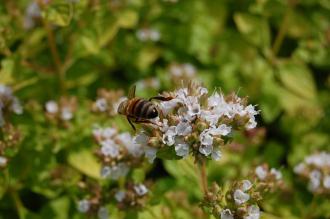
Origanum vulgare Flower (28/07/2012, Kew Gardens, London)
Position: Full sun
Flowering period: Summer to early autumn
Soil: Moist, well drained
Eventual Height: 50cm
Eventual Spread: 80cm
Hardiness: 5a – 9b
Family: Lamiaceae
Origanum vulgare is a low growing, semi-evergreen herbaceous perennial herb. Its light to dark green leaves are opposite, ovate with entire margins and up to 4cm long and 1.5cm broad. Its white/ pink flowers are produced in clusters at the end of erect spikes and are individually up to 4mm long. Its fruit is a group of four small nutlets.
Origanum vulgare, commonly known as Oregano or Wild Majoram, is native to the warm temperate regions of Europe and Asia (including the UK). In its native habitat it grows in grassland or scrub. This plant has a long history as a culinary and medicinal herb.
The etymological root of the binomial name Origanum is from the ancient Greek name for this herb. Vulgare is from the Latin, meaning ‘common’.
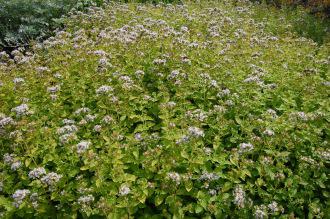
Origanum vulgare (28/07/2012, Kew Gardens, London)
The landscape architect may find Origanum vulgare useful in a community or wild life garden. Once established this plant is drought tolerant.
Ecologically, O. vulgare is very attractive to pollinating insects.
The Royal Horticultural Society has given O. vulgare their prestigious Award of Garden Merit in 1993.
O. vulgare prefers moist, fertile, well-drained soils. It tolerates most pH of soil. It will tolerate poor, alkali soils.
Origanum vulgare requires little maintenance. To keep a tidy appearance it may be cut to near ground in spring.