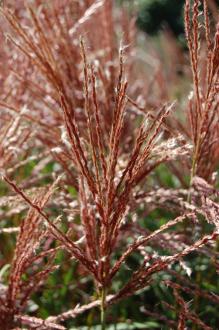
Miscanthus sinensis ‘Ferner Osten’ Flower (08/09/2012, Kew Garden, London)
Position: Full sun
Flowering period: Autumn
Soil: Moist, well drained
Eventual Height: 1.5m
Eventual Spread: 1.5m
Hardiness: 5a – 9b
Family: Poaceae
Miscanthus sinensis ‘Ferner Osten’ is a deciduous, perennial grass with a clump forming habit. Its mid green leaves are narrow, arching and bears a vertical band at the center of each leaf. Its leaves turn buff brown in late autumn and persist on the plant through the winter months. Its dark pink/ gray flowers are fan shaped panicles and appear above its leaves. These turn silver and persist on the plant through the winter months.
The species, Miscanthus sinensis, commonly known as Japanese Silver Grass, Chinese Silver Grass or Eulalia Grass, is native to much of eastern Asia including Korea, China and Japan
The etymological root of the binomial name Miscanthus is derived from the Greek miskos meaning ‘stem’ and anthos meaning ‘flower’, referring to the stalked spikelets. Sinensis is derived from the Latin meaning ‘from China’.
The landscape architect may find Miscanthus sinensis ‘Ferner Osten’ useful as a low maintenance, tall grass. It looks good when planted en mass in windy sites as its foliage and flowers sway in the a breeze. It can also form a component in prairie style planing. Once established it is drought tolerant.

Miscanthus sinensis ‘Ferner Osten’ (08/09/2012, Kew Garden, London)
Ecologically, Miscanthus sinensis ‘Ferner Osten’ may attract various species of birds that will use it as cover from predators.
The Royal Horticultural Society has given Miscanthus sinensis ‘Ferner Osten’ their prestigious Award of Garden Merit in 2001.
Miscanthus sinensis ‘Ferner Osten’ prefers moist, fertile, well-drained soils. It tolerates most pH of soil.
Miscanthus sinensis ‘Ferner Osten’ requires little maintenance. It may be cut down to ground level in late winter before the new foliage appears. Large clumps may be divided in spring.