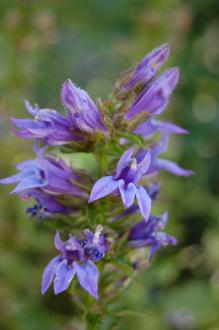
Lobelia siphilitica Flower (08/09/2012, Kew Gardens, London)
Position: Full sun to partial shade
Flowering period: Late summer to early autumn
Soil: Moist to wet
Eventual Height: 90cm
Eventual Spread: 50cm
Hardiness: 4a – 9b
Family: Campanulaceae
Sub Family: Lobelioideae
Lobelia siphilitica is a short lived, clump forming, deciduous herbaceous perennial. Its mid green leaves are lanceolate with mildly serrate margins, up to 20cm long and 5cm broad. Its blue flowers are tubular and has two lips, the upper has two segments, the lower has three. These are produced in dense terminal racemes at the upper part of erect stems and emerge from its leaf axils. Its fruit. This plant will readily self seed.
Lobelia siphilitica, commonly known as the Great Blue Lobelia or Blue Cardinal Flower, is native to eastern and central Canada and eastern and central USA. In its native habitat it grows in damp locations along stream banks, bogs, meadows and wooded areas.
The etymological root of the binomial name Lobelia is named after Matthias de l’Obel (1538 – 1616), a French botanist and herbalist who served James I. Siphilitica is derived from the Latin in reference to the fact that it was historically thought to be a cure for syphilis.
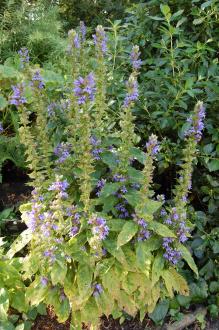
Lobelia siphilitica (08/09/2012, Kew Gardens, London)
The landscape architect may find Lobelia siphilitica useful as part of a damp woodland planting scheme. It is also suitable for planting where soils are permanently damp and may be used as part of a SUDS scheme.
Ecologically, Lobelia siphilitica is attractive to pollinating insects.
Lobelia siphilitica prefers moist to wet, humus rich, well-drained soils. It tolerates most pH of soil. It will not tolerate dry soils.
Lobelia siphilitica requires little maintenance. Large clumps may be divided in early spring. Unwanted seedlings may be removed any time of year.