


been enjoying the new season of Pit Bulls and Parolees…now that they have moved to New Orleans…
https://www.facebook.com/PitBullsandParolees/app_378878488848240
last night, there was an inspiring new show on afterwards, Addicts & Animals...
Addicts & Animals’ hero, Phil Aguilar, aka “Chief,” has made it his mission to help drug addicts, but he does it his way. He and his family run an in-home sobriety program that uses the responsibility and joy of pet ownership as a means for recovery. Once a heroine addict himself, Chief swoops up addicts from the doorsteps of Hell and helps them get their lives back, with the help of a few tail-wagging companions.
He rescues death row dogs/shelter dogs… which is very cool…and each addict, when ready, gets to take care of a dog.
Healing Trauma
The relationship between humans and pets has always been a close, cherished bond. Animals have a magical way of easing stress and relieving strain for individuals in need – even drug addicts. Research suggests that the hormones activated by drug abuse are also elevated by animal contact. Dopamine and serotonin levels increase with drugs like cocaine and heroin; the same feel good hormones increase from healthy activities, like taking care of a dog.
Health benefits of having a pet include:
• Lowers blood pressure
• Reduces stress
• Fights depressions
Animal-assisted therapy is being used in a wide variety of settings to help people with acute and chronic illnesses. This is based on the many physiological and psychological benefits documented in patients during interactions with animals. These include lowered blood pressure and heart rate, increased beta-endorphin levels, decreased stress levels, reduced feelings of anger, hostility, tension and anxiety, improved social functioning, and increased feelings of empowerment, trust, patience and self-esteem. Animal therapy is looked upon as both a learning and healing experience.
How can animals help with addiction? There is more than one reason for utilizing animals to help in addiction recovery.
The first reason is that animals like dogs and horses exhibit total emotional honesty, something that addicts need to learn themselves. A horse, for example, will show signs of fear when afraid, aggression when angry, exploration when curious, rather than trying to conceal these emotions in any way.
In addition, animals like horses reflect our emotions. If we are anxious near them, they will be anxious also. If we are relaxed, they will relax as well. This kind of feedback is especially helpful for addicts who are working on getting more in tune with what they feel. An addict may not be aware that he is feeling particularly tense, for example, when working with a horse. But the horse’s unease may alert him to that fact. The addict can then respond by concentrating on relaxing.
Horses are large and somewhat intimidating animals. How an addict responds to and behaves around the horse can tell an addictions therapist a lot about how this person interacts in other relationships. For example, someone who is aggressive, in personal relationships, will generally demonstrate the same behavior when working with a horse.
Another addict who is shy, reserved, or afraid to speak her mind will usually have a very difficult time setting boundaries with a horse. The horse will learn to respect those who earn it, and weak requests will not get that respect from a horse.
The horse is therefore a great teacher of assertiveness, the midpoint between aggression and passivity. A horse will often respond in fear or refused cooperation to aggression. They will generally ignore passive requests. Somewhere in the middle is assertiveness, the ability of the addict to be clear and honest about what he needs, without being overbearing.
Outside of therapy, animals can help a person in recovery cope with stress. Animal studies regularly demonstrate that the mere presence in the home of a dog or cat can lower a person’s blood pressure. Just petting a dog or cat can decrease heart rate, respiratory rate, and other symptoms of stress.
With stress being so imperative for addicts in recovery to manage, having a pet can be a big help in the recovery process. Pets can also help addicts work on service and compassion, as they learn to care for and love an animal that is dependent upon them for support. All of these benefits make animals an important addition to recovery.

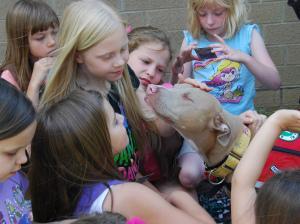
Therapy dogs, like Peaches the pit bull pictured above, typically work with their owners in hospitals, nursing homes, schools and rehabilitation centers. They play with abused children, give affection to the elderly, help the critically ill to laugh and forget their pain for a while, and sometimes provide a warm lick to wipe the tears away. The presence of dogs provides a sense of normalcy and reassurance to troubled individuals. Acceptance and non-judgment are perhaps the two most important gifts that these animals can offer. To dogs, humans are “perfect” just the way we are.
Shame, guilt, secrecy and hopelessness create a fertile ground for self-loathing, despair and an abnormal fear response. In an environment where people have proven to not be trustworthy – or, in the addict’s case if they cannot trust themselves – trained therapy dogs can potentially bridge the gap and make a difference in one’s recovery.
Benefits:
- Stabilized and Improve social skills by learning gentle ways to communicate and handle the animal, such as feeding and grooming.
- Brighten affect, mood, pleasure and affection while playing with the animal.
- Reduce abusive behavior and learn appropriate touch.
- Improve ability to express feelings by identifying how an animal might feel in a certain situation and/or recalling a client’s history with pets (sharing stories of grief or funny events).
- Reduce anxiety and fear by forming a bond of love and comfort with the animal.
- Learn how to better communicate with people by talking to the animal.
- Develop a cooperative plan to accomplish something with the animal.
Cynthia Chandler, author of Animal Assisted Therapy in Counseling, points out that the positive benefits to be gained from therapy can be more immediate when a therapy pet is involved, especially when working with a resistant client. The desire to be with the therapy pet can sometimes override the client’s initial defenses (Chandler, 2005). She further points to the natural relationship that occurs between dogs and humans which can result in quick bonding and trust between the client and dog in a therapeutic setting. According to Chandler, this bond between the pet and the client also helps to facilitate a bond with the therapist, as the feelings of affection and trust for the pet are eventually transferred to the pet’s therapist. Screening is required for clients in recovery who have a history of violence, animal abuse, animal phobias or allergies. However, most clients and pets will benefit from this type of therapy (Chandler, 2005).
According to Dr. Joseph Volpicelli and the U.S. Substance Abuse and Mental Health Services Administration (SAMHSA), “20 million Americans suffer from alcohol abuse disorders, yet only about 2 million are in any kind of treatment program.”
Stories of getting sober and being aided in staying sober fill the halls of AA and other recovery centers, and now, with the expansion of the field of AAT, perhaps the use of animals at treatment centers will one day become commonplace.
Love is considered by many to be the universal healer. Is it any less comforting if the source is not human? According to a study done at the Waltham Center for Pet Nutrition in Leicestershire, England, a pet’s love can help reduce anxiety, lower blood pressure and triglyceride levels, moderate the effects of stress, and build a sense of empathy. Love creates a bond that undeniably aids in the health, happiness and a sense of belonging that makes life worth living (Meunier, 2003). These nurturing qualities can easily be translated into a treatment plan for a recovering addict.
http://www.santimeunier.com/ART_dog_assist.phpImagine all of the shelter animals that can be saved and given new life/loving homes when more animals are utilized to help people recover from addiction, illnesses, war, trauma and injuries, PTSD and more…







