
Title: Phoenix Wright Ace Attorney: Dual Destinies
Genre: Courtroom ADV
Publisher: Capcom
Developer: Capcom
System: 3DS
Release Date: October 24, 2013
Ever since 2007′s Ace Attorney 4 that featured a seven-year timeskip and starred new lawyer Apollo Justice, the main story of the Ace Attorney games had been at a lull with the developers pouring their efforts into the spin-off series starring everyone’s favorite prosecutor instead. Although there had been rumors for years, it was not until 2013 that the fifth game finally manifested in the form of a software sold to consumers. And thus, the review of the long awaited fifth entry of the Ace Attorney series.
For some general information, Ace Attorney is a series of adventure games where the player takes on the role of a defense attorney and is tasked with defending murder suspects in court. The games revolve around the Japanese court system where one is guilty until proven innocent, which means that more often than not, the player must determine the true killer and the why and how behind the crime.
Each game has a set number of chapters (usually 4-5) with each chapter revolving around a case. Most cases are split into an investigation phase and a courtroom phase. During the former, the player investigates the crime in the style of standard adventure games with a point-and-click environment, a list of items, and characters that can engage in conversation as well as react to items presented to them. After a day of investigation comes the courtroom, where attorney part kicks in and you must defend the defendant in court by pointing out contradictions in witness testimonies and disproving the prosecution’s reasoning. This is easily the most exciting part of the game, with loud table-slamming, screams of “Objection!”, and plenty of silly reactions from both lawyers and witnesses alike.
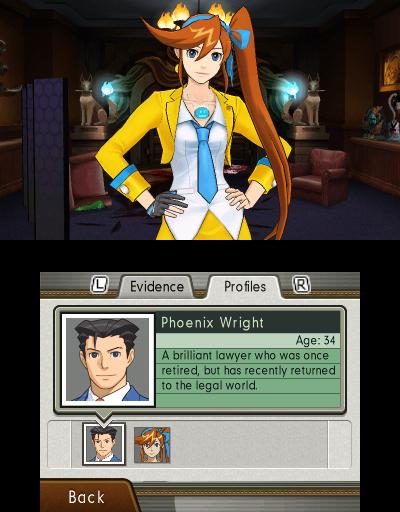
The original Ace Attorney trilogy featured Phoenix Wright as the protagonist, but the fourth game shifted focus to new rookie lawyer Apollo Justice and demoted our old hero to a hobo pianist. With this fifth entry in the series, Phoenix is back to being a defense attorney per popular demand, and five new cases are presented.
Story-wise, this is definitely a worthy sequel. Due to specific incidents that occurred eight years ago, modern society has entered a dark age of the law where lawyers and prosecutors will use any means to get their verdicts rather than piecing together the truth. While the murders keep getting more and more ridiculous (which could be a good or bad thing depending on the person), the cases connect well and the buildup at the end is excellent. The final cases try to do something that has never been done before in the series, and the final villain did indeed come off as a surprise. It is no doubt that the final case is usually the best case in the game, and that holds true for this game as well.
In Dual Destinies, a new female lead is introduced in the form of Athena Cykes, an 18-year-old rookie lawyer who studied in Europe (because in Ace Attorney-verse, that’s where you go if you feel like skipping grades). She ends up working under Phoenix and replaces the role of the teenage female assistant always present in the previous games, but with a catch: she actually gets a case to herself! Bringing her studies of analytical psychology into the courtroom, she is able to get the truth out of witnesses through their emotions. Being highly energetic and somewhat forceful, Athena makes a great compliment to Apollo. She also gets her share of character development and an important backstory, making her second to only Maya Fey (who played the assistant role for three whole games, unlike the others) in development and likability.

Of course, with a new game a new prosecutor is introduced. Sitting on the prosecution bench is Simon Blackquill, a prosecutor who is currently serving time in prison. Being an inmate who looks the opposite of friendly and is capable of breaking out of his shackles through sheer force, Simon is a challenging and menacing prosecutor in ways different from previous prosecutors. He also gets the character development spotlight shed on him later on, and turned out to be suitably sympathetic. Oh, and he has a hawk friend and likes to pretend to be going the way of the samurai.
The defining trait of the Ace Attorney series is its wacky, creative characters and their silly reactions in a decidedly serious crime and courtroom setting, and those are well-preserved in the returning characters and the new lawyer and prosecutor. However, the same could not be said of the new supporting cast, who are not all that memorable.

The increased linearity and streamlined structure of the game makes it less frustrating, but also hurts some of the fun. In previous games you could examine all locations and many entertaining conversations would pop up when examining objects not related to the case at hand. This game restricts examination to only the scene of crime, and so none of the other areas could be examined. Since some of the best dialogues came from examining random things, this was a great disappointment. In addition, you no longer have the ability to present character profiles to people.
What this game does well, though, is its way of providing nostalgic fanservice for long-time fans. While Apollo Justice tried to avoid the old cast as often as possible, Dual Destinies acknowledges their existence and involvement in Phoenix’s current life, and also brings some of them back for brief supporting roles. Not only do you get to mess around with Athena’s Mood Matrix, the new gimmick to get your witnesses to speak the truth, but you also get brief uses of Apollo’s bracelet and Phoenix’s Magatama. Apollo gets character development, which he managed to avoid in his own game.
Overall, this was an enjoyable, worthy sequel. Although it is not the best game in the series (departure of the original writer is probably the reason), it sure wasn’t lacking in exciting moments and nostalgic feelings. A newcomer to the series should definitely begin with the original trilogy, but for existing fans…well, you probably don’t need me telling you what to do. Unrealistic courtrooms are unrealistic, but they sure are fun. Investigation is a step down due to the limited amount of places that can be examined, but in return you get the characters in their glorious 3D models with fluid movements and a great soundtrack.