


Like other southern European and Latin American populations, Italians require less "personal space" compared to northern Europeans or North Americans. According to , the study of interpersonal communication, personal space is the cylinder of air surrounding each person which people consider as an extension of their body, where no one else is allowed. The personal radius varies according to who's in its proximity, the largest being between strangers, and shrinking down the more people are close to one another (reaching physical contact for parent-child and for couples). The personal radius also tends to vary according to the difference in social ranking, where individuals demand more personal space when surrounded by people that they consider of lower social status, as a form of respect.
In North America, the standard socially acceptable distance between acquaintances having a conversation is around 4 feet. In Italy, instead, the norm is 2-3 feet(1), a distance that North Americans tend to reserve for intimate relationships. In Italy, it's also common for people to establish extended physical contact during a conversation. As an example, a friend may reach for your forearm as a way to communicate openness and honesty, or a coworker (of any gender) may walk arm in arm with you as they discuss something confidential.
This can also be seen in the way people greet one another. In Italy, especially in the south, the standard greeting between acquaintances switches between the business-like handshake to the double kiss on the cheeks. In North America the hug (which is the equivalent of the double kiss) is reserved for close friends and family.
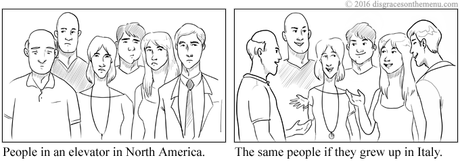
When forced to be close in a tight environment, people adopt strategies to cope with the invasion of personal space. A theory is that people start to see others as lifeless(2), they avoid eye contact, and turn on their don't-talk-to-me face, a standard behavior often seen in overcrowded transit vehicles. Instead, things get really interesting when there is enough space for people to decide how to arrange themselves, but not enough for them to fulfill their personal space requirements. This is the case for instance in a 10-person occupancy elevator, with 6 people in it.
- In North America, people tend to line up towards the door, staring at the void and trying to move to the back when they know they're going to be the last out, and to the front if they're going to be first.
- In Italy people consider it rude to turn their back to others, even strangers, since they don't want to prevent them from starting a conversation or even just sharing a smile. This, combined with their general tendency to refuse to line up, results in the Italians orienting themselves in a circle, turning their backs to the elevator's walls.
The higher tolerance of Italians for an invasion of personal space (or inclination to violate somebody else's!) can be seen daily in other situations as well. As an example, when queuing up in a crowded post office, it's relatively normal for people to end up shoulder to shoulder or in physical contact with the person in front, leaning towards them slightly, as to apply a gentle push (perhaps under the unconscious assumption that this can make the line go faster). This can also be observed when people crowd towards the counter when waiting to order their espresso, an operation which requires catching the barista's eyes as soon as they inquire for who's next.
But what is the cause for the different social behaviors and the varying level of interpersonal contact? One theory is that less personal space may be the result of living in densely populated cities. But this is not a sufficient condition. The Japanese, for instance, live in even tighter spaces than in Italy, and yet they are notoriously a no-contact society.
A more likely theory is that the populations of southern Europe and Latin America are traditionally used to living a communal life, centered around churches and piazzas, due to the necessity of helping one another in regions of scarce resources, and facilitated by the clemency of the weather. People belonging to these populations have become accustomed to collaborating with one another, which has made them emotionally and physically closer.
Beside the need for interaction, the tendency to grab people's arm and pull them closer during a conversation may actually derive from the necessity to be discrete when sharing private information. In that regard, a great example of confidential exchange is the one that catholic Italians are exposed to during confession, a sacrament bound to secrecy which requires the penitent and confessor to come close and whisper to one another. When not used to such proximity, one can take the confidentiality as an invasion of personal space.
In some cases, however, Italians intrude upon other people's privacy by behaving exactly in the opposite way than coming closer for discretion - they choose to be overly loud in public to establish their territory. This can be exemplified in the way some Italians talk on the phone: even in a business conversation, they may raise their voice and begin gesticulating. One may think that the person speaking got carried away by the conversation forgetting they're in public, but in reality they are often well aware of it - what they say and how they move is carefully chosen to project a precise image of self (confidence, wealth, power). In doing so, they establish their social status and therefore enlarge their personal space.
There is one place, however, where Italians seem to require more privacy than North Americans: public toilets. In North America, in fact, the stalls are often only partially enclosed, and the urinals can be side by side without any screens between them, or they may even be replaced with a communal trough. The reason for this difference is not clear, but one theory could be that by building open bathrooms, people are forced not to take advantage of these spaces as if they were personal (e.g. to conduct something illegal or immoral in it). Italians instead are less concerned with illegality or immorality, they care more about how they appear in public and therefore demand more privacy when they can't look at their best. As a result, Italian public bathrooms are constructed with urinals that are well divided, and stalls that are fully enclosed.
As a North American who traveled or moved to Italy:
- Do/did you experience a reduction in your personal space?
- What do you think about the seemingly deliberate lack of privacy in public toilets in North America?
As an Italian who traveled or moved to North America:
- Do/did you miss the amount of physical interaction that you experienced in Italy?
- How do/did you deal with the unquestionable lack of privacy in North American public toilets?
(1) Edward T. Hall (1990). The Hidden Dimension.
(2) Sommer, Robert (1967). Sociofugal Space. American Journal of Sociology.
Featured Image: Palio di Siena by Janus Kinase [CC BY-SA 2.0], via Wikimedia Commons.





