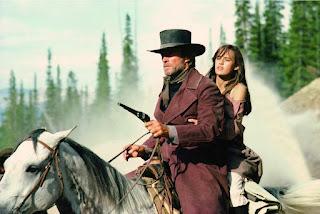
Clint Eastwood went nearly a decade between The Outlaw Josey Wales (1976) and his next Western, Pale Rider (1985). Clint seemed genuinely tired of the genre which made him a star, dividing that interval between paycheck action movies (Any Which Way But Loose) and offbeat personal projects (Escape from Alcatraz, Honky Tonk Man). And Pale Rider, though perfectly watchable, offers little that Eastwood's older oaters couldn't offer - if anything, it plays almost like a Greatest Hits reel of earlier films.
The Preacher (Clint Eastwood) arrives in the California mining town of LeHood, where he rescues mild-mannered farmer Hull Barret (Michael Moriarty) from a gang of thugs. The Preacher discovers that LeHood is run by greedy boss Coy LaHood (Richard Dystart), who uses force, intimidation and crooked legal rulings to subdue hardscrabble "tin pan" miners like Hull. The Preacher befriends Hull, encouraging him to stand up against the big shot, and develops a close connection to his wife (Carrie Snodgrass) and teenage daughter (Sydney Penny). Coy winds up enlisting Marshal Stockburn (John Russell) to force the miners back in line, leading to the inevitable showdown.
Western fans will immediately recognize Pale Rider as a riff on Shane, in the plot (albeit with miners instead of ranchers), the dynamic between The Preacher and his adopted family and specific scenes that are copied, almost shot-for-shot (namely the Marshal's brutal murder of a miner, which mirrors Jack Palance killing Elisha Cook Jr.). Problem is that Eastwood has been playing variants on this character since A Fistful of Dollars, and while he's reliably taciturn he seems unable to find new wrinkles to his persona. The Preacher might be a supernatural being who can seemingly teleport off-screen? Great, we've already seen High Plains Drifter. Maybe the freshest angle is that he prefers ax handles to six guns, at least until the climax. Though we do get an uncomfortable subplot where the adolescent Megan falls for the Preacher, and even tries to seduce him.
Michael Butler and Dennis Shryack's script is similarly schematic. Besides the heavyhanded religious allegory, the film stresses the hardworking, simple miners and the corrupt corporations who destroys the environments, abuses their employees, intimidates competition and generally act like baddies from an old serial. When Eastwood needs to up the villainy, he has LeHood's goons murder Megan's dog, or his bullying son (Christopher Penn) tries to rape her. The Marshal doesn't show up until the final third, and they receive less development than LeHood's random henchmen. Pale Rider also subverts the climax of High Plains Drifter, where the Stranger abandons his community just before a final showdown - but here, it's just to retrieve his six gun from a safe deposit box.
Admittedly, Pale Rider touches on interesting ideas. Coy LeHood shows shades of nuance, a corrupt man but willing to negotiate (he offers the miners a generous buyout) and trying to avoid violence. Similarly, the second act features the miners forming class solidarity, valuing their community's independence over money offered by the corporations. Hull himself evolves from a meek nebbish to a proletariat hero, standing alongside The Preacher in his destruction of LeHood's headquarters. Lest we find this nuanced portrait of masculinity too appealing, however, The Preacher seduces Hull's wife and sets out to vanquish Stockburn's posse himself. Thus we run into The Magnificent Seven problem: no matter how much the text tells us to admire the simple Everyman, viewers naturally gravitate towards the invincible superhero.
Pale Rider is handsomely shot by Bruce Surtees, with a mixture of picturesque landscapes (shot in California and Idaho) and striking interior photography. The action scenes are enjoyable, with some amusing wrinkles (the funniest has The Preacher squaring up against a goon played by Richard Kiel). But by the final act, when The Preacher takes on a dozen villains singlehanded, it's hard not to feel that we've seen this before. Fortunately, the next time Clint returned to the Western genre, he actually did have something to say: and the result was Unforgiven.