


Last Updated on 23 April, 2026
Plunging into the world of Alchemy Factory requires more than just connecting conveyor belts and harvesting simple crops. The true challenge lies in deciphering the enigmatic Cauldron, a secretive device that can quickly drain your resources if you misunderstand its hidden mathematics. This guide completely decodes those underlying mechanics, providing you with the exact numerical values and highly guarded formulas needed to instantly optimize your assembly lines. Prepare to transform your chaotic facility into an incredibly profitable empire by learning exactly how to manipulate this magical machinery to your advantage.
 Did You Know? During its Early Access run in late 2025, the developers faced a bit of community drama regarding the game’s soundtrack. It was discovered that the third-party artist they outsourced the music to allegedly used AI to generate the tracks and potentially included copyrighted material.
Table of Contents
- 1. The Inner Workings of the Bubbling Pot
- 2. Why You Should Embrace the Brew
- 3. Unearthing the Best Formulas
- 4. Crunching the Numbers and Avoiding Penalties
- 5. The Grand Ledger of Ingredient Cauldron Values
- 6. The Ultimate Roster of Output Target Values
- 7. High Level Tactics for Factory Dominance
- 8. My Personal Vault of Optimized Blueprints
- 9. Conclusion
1. The Inner Workings of the Bubbling Pot
This unique workstation operates as one of the most robust and captivating mechanics within Alchemy Factory.
The Rule of Three
The device functions on a deceptively basic premise. You toss exactly three distinct items together to forge a completely new fourth item. However, the game engine utilizes a completely hidden mathematical framework to decide exactly what materializes from your mixture.
Decoding the Hidden Mathematics
Every single object you encounter in the game harbors a specific internal Cauldron Value. Conversely, every item you can successfully forge inside this workstation possesses a strict Cauldron Target score.
When you drop your three chosen ingredients into the liquid, the system tallies the sum of their individual Cauldron Values. It then scans the internal database to locate the specific output item whose Cauldron Target score rests closest to your combined input sum.
The Proximity Payout
Because the game relies entirely on this proximity system, you will constantly experience situations where you overpay or underpay for your final product. If your three components add up to a mathematical sum slightly below your desired artifact, you might still successfully generate it! The official Alchemy Factory Wiki identifies this lucrative payout gap as the Cauldron Distance.
The True Alchemist’s Mindset
Understand this critical reality. Not all combinations deliver equal worth. An item’s Cauldron Value and its corresponding Cauldron Target remain completely disconnected from its actual production cost or its manufacturing complexity. A brilliant player will pinpoint the exact combination of raw materials to hit the desired target value while maintaining a perfect balance of convenience, simplicity, and overall factory cost.

 Pro Tip: Always calculate your Cauldron Distance before finalizing a massive automated production line to ensure you do not accidentally overpay for a remarkably cheap output!
2. Why You Should Embrace the Brew
You might question why you should dedicate time to this complex system when straightforward manufacturing paths already exist in your build menu. Mastering this mechanic delivers three monumental advantages for your industrial empire.
Monumental Space Reduction
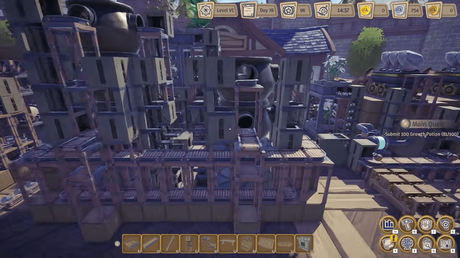
First, you achieve incredible floor space optimization. As your facility expands, highly complex assembly lines demand an outrageous amount of room. These magical pots condense those sprawling, chaotic belts into compact, highly efficient processing nodes.
Unbelievable Financial Retention
Second, you unlock unmatched wealth generation. While tossing random junk into the liquid will absolutely drain your treasury, carefully calculated formulas function as massive cost savers. When you bypass the standard, expensive manufacturing chains for high tier items, you rapidly supercharge your entire economy.
The Pure Joy of Magic
Finally, you get to experience the pure joy of the theme. We are playing a game focused entirely on mystical science! Blending strange potions together to trigger magical consequences delivers an immense amount of satisfaction. The visual flair looks incredible, and this feature lets you fully embrace your ultimate fantasy as a medieval wizard or witch.

 Pro Trick: Set up a dedicated brewing room in the center of your factory just for the visual thrill of watching magical potions and rare gems pop into existence!
3. Unearthing the Best Formulas
You have several different avenues available for uncovering the best mixtures.
The Blind Experiment
Your first option involves embracing the genuine spirit of the setting and conducting blind experiments! You purchased an alchemy simulation to be a mad scientist. Tossing random items into the liquid and documenting the outcomes provides a tremendously authentic and entertaining experience.
The Digital Calculator Tool
Your second option involves utilizing external community resources like the Alchemy Codex online. Their dedicated Cauldron Calculator tool allows you to plug in specific choices and filter for precise outputs or inputs.
Be warned that this specific digital tool demands significant manual effort. The total possible combinations reach astronomical figures. You should probably budget a full day or two simply to sift through the data and isolate what functions best for your specific layout.
The Secret Hoarder
Your third option involves outright stealing the finest blueprints from other players. A traditional chemist gladly shares knowledge and publishes documented experimental results like a wimp. A true alchemical genius hoards their knowledge, operates in absolute darkness, and guards their secrets until the end of time.
However, since you are reading this specific guide, you clearly want the easy answers. I have provided a spoiler filled directory of my finest blueprints near the end of this post. Make sure to check the comment section of this guide for additional recommendations from fellow players!

 Pro Tip: Do not let glittering promises of peer reviewed facts seduce you. Keep your most successful experimental combinations a total secret to maintain your competitive edge!
4. Crunching the Numbers and Avoiding Penalties
Before you start dropping your most valuable resources into the bubbling liquid, you must comprehend the severe mathematical mechanics running under the hood.
The Duplication Penalty
The system heavily rewards ingredient diversity. If you use the exact same item twice in one mixture, the game slashes your total combined value down to exactly 65 percent of the original sum. If you recklessly use the exact same item three times, the game brutally reduces your total combined value down to exactly 50 percent of the original sum. Therefore, you must always diversify your inputs. Let us review some practical mathematical scenarios.
Scenario One: The Perfect Match
Let us add one Stone (Cauldron Value 4), one Linen Thread (Cauldron Value 9), and one Linen Rope (Cauldron Value 13) into the mix.
Your total content value equals 26. The two closest target numbers belong to Clay (Cauldron Target of 20) and Coke (Cauldron Target of 30). Because 26 sits slightly closer to 30 than it does to 20, your final output becomes Coke.
Scenario Two: The Lower Tier Tie
Now let us lower the input sum by swapping out the Linen Thread for one Redcurrant (Cauldron Value 12).
Your new total content value equals 25. The two closest options remain Clay (20) and Coke (30). Because the number 25 sits directly in the middle, creating a perfect tie, the game defaults to favoring the lower value output. You will produce Clay.
Scenario Three: The Math Tax
Finally, let us observe the duplication penalty in action. We will mix two Linen Threads (Cauldron Value 9 each) and one Linen Rope (Cauldron Value 13).
Normally, you would expect a total sum of 31. However, because you duplicated the Linen Thread, the game applies the 65 percent penalty to your entire input sum. This leaves you with a modified total value of just 20.2. Because of this massive penalty, you end up manufacturing Clay instead of your intended Coke.

 Pro Trick: If your mathematical sum lands exactly equidistant between two target items, always remember that the engine breaks the tie by giving you the cheaper, lower tier material!
5. The Grand Ledger of Ingredient Cauldron Values
To construct your own hyper efficient production lines, you require raw data. Below is the master record of every object’s designated Cauldron Value, broken down into highly specific categories for your convenience.
Basic Woods and Gears (Tier 1)
- Small Wooden Gear Value: 0.33
- Logs Value: 0.8
- Plank Value: 1
- Large Wooden Gear Value: 1.5
Foundational Minerals and Coins (Tier 2)
- Copper Coin Value: 0.68
- Limestone Value: 3
- Stone Value: 4
- Sand Value: 4.5
- Iron Nails Value: 5
- Iron Ore Value: 10
Introductory Botanicals and Powders (Tier 3)
- Flax Value: 2
- Charcoal Value: 2
- Charcoal Powder Value: 2.5
- Flax Fiber Value: 2.5
- Sage Value: 3
- Sage Powder Value: 3.5
- Plant Ash Value: 4
Processed Earth and Filth (Tier 4)
- Quicklime Value: 6
- Rotten Log Value: 6.5
- Quicklime Powder Value: 7
- Basic Fertilizer Value: 10
- Mortar Value: 18
- Clay Value: 21
- Clay Powder Value: 22
Woven Goods and Foraged Fruits (Tier 5)
- Linen Thread Value: 9
- Redcurrant Value: 12
- Linen Rope Value: 13
- Linen Value: 60
- Flax Seeds Value: 115
Smelted Metals and Refined Fuels (Tier 6)
- Iron Ingot Value: 15
- Iron Sand Value: 15.5
- Coke Value: 29
- Coke Powder Value: 31
- Coal Ore Value: 37
- Coal Value: 40
- Pyrite Ore Value: 45
Soaps, Glass, and Fungus (Tier 7)
- Soap Value: 23
- Soap Powder Value: 24
- Brick Value: 25
- Gloom Fungus Value: 26
- Glass Value: 27
Potions and Planetary Bodies (Tier 8)
- Healing Potion Value: 30
- Jupiter Value: 34
- Vitality Potion Value: 125
- Transformation Potion Value: 240
- Saturn Value: 714
Salts and Advanced Agriculture (Tier 9)
- Rock Salt Value: 35
- Chamomile Value: 55
- Chamomile Powder Value: 57
- Advanced Fertilizer Value: 58
- Salt Value: 65
- Yeast Powder Value: 88
Bronze Era Mechanics (Tier 10)
- Bronze Rivet Value: 51
- Copper Bearing Value: 137
- Impure Copper Powder Value: 150
- Bronze Ingot Value: 155
- Copper Powder Value: 290
- Copper Ingot Value: 300
Steel Era Upgrades (Tier 11)
- Steel Ingot Value: 161
- Steel Gear Value: 170
Rare Flora and Spores (Tier 12)
- Sage Seeds Value: 175
- Lavender Value: 180
- Gloom Spores Value: 220
- Gentian Value: 400
- Gentian Nectar Value: 420
- Gentian Powder Value: 430
- Redcurrant Seeds Value: 650
Volatile Chemicals and Ores (Tier 13)
- Turquoise Value: 108
- Black Powder Value: 145
- Sulfur Value: 166
- Sulfur Powder Value: 200
- Quartz Ore Value: 230
- Malachite Value: 367
Shards and Essences (Tier 14)
- Crude Shard Value: 272
- Oblivion Essence Value: 600
- Broken Shard Value: 824
- Vitality Essence Value: 900
- Dull Shard Value: 1,548
Mid-Game Catalysts and Astronomy (Tier 15)
- Unstable Catalyst Value: 746
- Pocket Watch Value: 789
- Meteorite Value: 800
- Silver Coin Value: 949
- Mars Value: 1,678
Advanced Cosmetics and Explosives (Tier 16)
- Blast Potion Value: 1,197
- Perfumed Soap Powder Value: 1,216
- Perfumed Soap Value: 1,216
Silver Tier Processing (Tier 17)
- Crude Silver Powder Value: 1,274
- Impure Silver Powder Value: 2,547
- Silver Powder Value: 4,742
- Silver Ingot Value: 4,746
High Tier Botanicals and Dusts (Tier 18)
- Chamomile Seeds Value: 2,300
- World Tree Leaf Value: 2,500
- Venus Value: 2,550
- Fairy Dust Value: 3,060
- Star Dust Value: 4,149
Precious Gems and Volcanic Matter (Tier 19)
- Topaz Value: 1,206
- Shattered Crystal Value: 3,496
- Volcanic Ash Value: 5,290
- Obsidian Value: 5,290
- Crude Crystal Value: 6,692
High Tier Catalysts and Medicines (Tier 20)
- Fertile Catalyst Value: 4,068
- Lavender Seeds Value: 6,000
- Panacea Potion Value: 15,306
Gold Tier Processing (Tier 21)
- Crude Gold Dust Value: 10,805
- Impure Gold Dust Value: 21,611
- Gold Dust Value: 42,357
- Pure Gold Dust Value: 84,715
- Gold Ingot Value: 87,223
- Gold Coin Value: 89,723
Elite Gemstones and Amulets (Tier 22)
- Polished Crystal Value: 14,384
- Lapis Lazuli Value: 15,825
- Silver Amulet Value: 25,317
- Diamond Value: 65,536
- Perfect Diamond Value: 131,072
Endgame Catalysts and Metals (Tier 23)
- Resonant Catalyst Value: 23,869
- Mercury Value: 26,928
- Adamant Value: 30,768
Mythical Artifacts and Ultimate Riches (Tier 24)
- Gentian Seeds Value: 29,000
- Luna Value: 187,168
- Ruby Value: 200,000
- World Tree Core Value: 250,000
- Sapphire Value: 400,000
- Moonlit Soap Value: 487,893
- Emerald Value: 600,000
- Crown Value: 854,168
- Philosopher’s Stone Value: 1,000,000
- Eternal Catalyst Value: 1,193,042
- World Tree Seed Value: 5,000,000
- Sol Value: 5,587,946

 Pro Tip: Memorize the exact numbers for cheap filler items like Stones and Wooden Gears. You will constantly use them to slightly adjust your final mathematical sums!
6. The Ultimate Roster of Output Target Values
Now that you know the exact weight of your raw materials, you must understand the finish lines the game engine tries to match. Here are the required Cauldron Target Values for every craftable object.
Foundation Outputs
- Plank Cauldron Target Value: 0.1
- Charcoal Cauldron Target Value: 2
- Stone Cauldron Target Value: 4
- Quicklime Cauldron Target Value: 6
Earth and Fuel Outputs
- Iron Sand Cauldron Target Value: 15
- Clay Cauldron Target Value: 20
- Coke Cauldron Target Value: 30
- Coal Cauldron Target Value: 40
Powders and Basic Chemicals
- Salt Cauldron Target Value: 65
- Yeast Powder Cauldron Target Value: 88
- Black Powder Cauldron Target Value: 150
- Sulfur Cauldron Target Value: 246
- Gloom Spores Cauldron Target Value: 280
Copper Tier Outputs
- Turquoise Cauldron Target Value: 108
- Impure Copper Powder Cauldron Target Value: 180
- Copper Powder Cauldron Target Value: 350
- Malachite Cauldron Target Value: 427
Shards and Essences
- Crude Shard Cauldron Target Value: 512
- Oblivion Essence Cauldron Target Value: 600
- Vitality Essence Cauldron Target Value: 900
- Broken Shard Cauldron Target Value: 1,024
- Dull Shard Cauldron Target Value: 2,048
Mid Tier Magical Constructs
- Unstable Catalyst Cauldron Target Value: 746
- Topaz Cauldron Target Value: 1,406
- Fertile Catalyst Cauldron Target Value: 3,568
- Fairy Dust Cauldron Target Value: 3,760
- Star Dust Cauldron Target Value: 6,149
Silver Tier Outputs
- Crude Silver Powder Cauldron Target Value: 1,674
- Impure Silver Powder Cauldron Target Value: 3,347
- Silver Powder Cauldron Target Value: 4,742
Crystal and Obsidian Outputs
- Shattered Crystal Cauldron Target Value: 4,096
- Obsidian Cauldron Target Value: 5,290
- Crude Crystal Cauldron Target Value: 8,192
- Polished Crystal Cauldron Target Value: 16,384
Gold Tier Outputs
- Crude Gold Dust Cauldron Target Value: 13,805
- Impure Gold Dust Cauldron Target Value: 27,611
- Gold Dust Cauldron Target Value: 52,357
- Pure Gold Dust Cauldron Target Value: 99,715
Elite Jewels and Metals
- Lapis Lazuli Cauldron Target Value: 18,825
- Adamant Cauldron Target Value: 32,768
- Diamond Cauldron Target Value: 65,536
- Perfect Diamond Cauldron Target Value: 131,072
- Ruby Cauldron Target Value: 200,000
Peak Alchemical Masterpieces
- Resonant Catalyst Cauldron Target Value: 22,869
- Sapphire Cauldron Target Value: 400,000
- Emerald Cauldron Target Value: 600,000
- Philosopher’s Stone Cauldron Target Value: 1,000,000

 Pro Trick: Keep this specific target list open on a secondary monitor while you play so you always know the exact threshold your mixture needs to cross!
7. High Level Tactics for Factory Dominance
If you have read this far into the guide, I assume you ignored my earlier warning about discovering things for yourself. We now leave the comforting realm of mystical pseudoscience completely behind us and dive headfirst into brutal data optimization. We operate as scientists here.
The Cost Reduction Methodology
To maximize your factory profits, you need to identify the most cost effective ingredients in the entire simulation. We calculate this by looking at the ratio of an item’s Cauldron Value compared to its base Production Cost in copper coins.
The coin costs listed below represent the standard production cost assuming you have purchased zero game upgrades. If you purchase fuel or fertilizer upgrades during your playthrough, the items utilizing those mechanics will become even cheaper to produce.
Early Game Winners (The Golden Ratio)
- Flax Fiber requires 1.4 Copper Coins and yields 2.5 Cauldron Value.
- Sage Powder requires 2 Copper Coins and yields 3.5 Cauldron Value.
- Linen Thread requires 4.2 Copper Coins and yields 9 Cauldron Value.
- Soap requires 13.3 Copper Coins and yields 23 Cauldron Value.
- Soap Powder requires 13.3 Copper Coins and yields 24 Cauldron Value.
- Healing Potion requires 20.4 Copper Coins and yields 30 Cauldron Value.
Mid Game Powerhouses (The Golden Ratio)
- Linen requires 42 Copper Coins and yields 60 Cauldron Value.
- Salt requires 43.5 Copper Coins and yields 65 Cauldron Value.
- Yeast requires 61.3 Copper Coins and yields 88 Cauldron Value.
- Bandage requires 82.8 Copper Coins and yields 120 Cauldron Value.
- Lavender requires 133 Copper Coins and yields 180 Cauldron Value.
- Gloom Spores requires 153 Copper Coins and yields 220 Cauldron Value.
- Unstable Catalyst requires 433 Copper Coins and yields 746 Cauldron Value.
- Perfumed Soap requires 889 Copper Coins and yields 1,216 Cauldron Value.
Late Game Titans (The Golden Ratio)
- Fertile Catalyst requires 1,705 Copper Coins and yields 4,068 Cauldron Value.
- Lapis Lazuli requires 8,705 Copper Coins and yields 15,825 Cauldron Value.
- Resonant Catalyst requires 11,958 Copper Coins and yields 23,869 Cauldron Value.
- Silver Amulet requires 16,951 Copper Coins and yields 25,317 Cauldron Value.
- Sapphire requires 131,505 Copper Coins and yields 400,000 Cauldron Value.
- Moonlit Soap requires 140,222 Copper Coins and yields 487,893 Cauldron Value.
- Emerald requires 160,000 Copper Coins and yields 600,000 Cauldron Value.
- Philosopher’s Stone requires 470,000 Copper Coins and yields 1,000,000 Cauldron Value.
- Eternal Catalyst requires 649,000 Copper Coins and yields 1,193,042 Cauldron Value.
Bypassing the Duplication Tax
While many standard ingredients maintain a boring one to one ratio, the items isolated on this specific list offer significantly better returns. To formulate recipes that preserve your wealth, you should exclusively select three or more components from this power list.
Your goal involves combining them until their total sum falls just below your output’s Target Value. You must ensure they do not drop close enough to the next lower tier to alter your final product.
Do not forget the duplication penalty! Remember that some of the most efficient items on this power list exist as zero cost variants of one another. You can effortlessly combine Soap with Soap Powder, or mix Flax with Flax Fiber, to heavily stack a cheap ingredient in your formula. This bypasses the mathematical punishment completely.
Mastering the Green Thumb
The assembly line simplification strategy requires very little explanation. The most advanced items near the end of the game inherently stand as the most outrageously expensive and complicated objects to manufacture. You can totally bypass this nightmare by planning ahead. Simply configure your factory to mass produce monumental quantities of cheap, basic items and funnel them directly into an array of magical pots to synthesize the endgame materials.
I strongly recommend mastering plant cultivation. You should continuously purchase upgrades to make your fertilizer super efficient. Then, mass produce enormous fields of plants to mix into literally everything else in the game. The simulation places absolutely no limit on the number of times you can upgrade fertilizer efficiency. Your planter output faces limits only from the speed of your conveyor belts and the sheer effectiveness of your fertilizer. You can literally build the entire universe from items crafted out of cheap foliage!
Targeting Bulk Bottlenecks
Furthermore, I highly advise using this workstation to generate all your Bronze, Clay, and Gloom Powder. These three specific resources demand vast quantities and consume significant factory floor space. Synthesizing them in bulk at your earliest convenience will save you massive headaches later. You should also strongly consider generating your Salt this way.

 Pro Tip: Upgrade your fertilizer technology relentlessly. This single action massively reduces the production cost of all plant based brewing operations across your entire factory!
8. My Personal Vault of Optimized Blueprints
Do you find calculating all these specific numbers far too exhausting? Do not worry. For the low cost of absolutely nothing, I will happily share a curated selection of my absolute favorite formulas with you.
Please note that I primarily utilize this mechanic to drastically reduce my manufacturing costs and heavily increase my profit margins. Therefore, my personal collection leans heavily toward the most aggressively cost efficient approaches possible.
Early Game Foundations
- Quicklime: Combine Flax, Flax Fiber, and a Plank.
- Salt: Combine Soap, Soap Powder, and Linen Thread.
- Black Powder: Combine Flax, Linen Thread, and a Bandage.
- Sulfur: Combine Flax, Flax Fiber, and a Gloom Spore.
Mid Game Copper Progressions
- Turquoise: Combine Chamomile, Chamomile Powder, and Flax.
- Impure Copper Powder: Combine Flax Fiber, Flax, and Lavender. This formula performs incredibly well for mass producing bronze ingots.
- Copper Powder: Take your previously crafted Turquoise and combine it with Lavender and Chamomile for an exceptionally easy copper generation line.
Late Game Crystal Tech
- Malachite: Combine Vitality, a Bandage, and Lavender.
- Topaz: Combine Flax, Flax Fiber, and Perfumed Soap.
- Broken Shard: Combine Flax, an Unstable Catalyst, and a Gloom Spore.
- Dull Shard: Combine Flax, Perfumed Soap Powder, and Perfumed Soap.
- Vitality Essence: Combine Salt, Linen, and an Unstable Catalyst.
- Silver Powder: Combine Flax, an Unstable Catalyst, and a Fertile Catalyst.
- Obsidian: Combine Flax, Perfumed Soap, and a Fertile Catalyst.
- Shattered Crystal: Combine Flax, Flax Fiber, and a Fertile Catalyst.
- Polished Crystal: Combine Flax, Flax Fiber, and Lapis Lazuli.
- Resonant Catalyst: Combine Flax, a Fertile Catalyst, and Lapis Lazuli. This specific combination saves you approximately one entire silver coin per cycle!
Endgame Wealth Generation
- Impure Gold Dust: Combine a Resonant Catalyst, Perfumed Soap Powder, and Perfumed Soap.
- Adamant: Combine two Resonant Catalysts and a Fertile Catalyst.
- Gold Dust: Combine a Resonant Catalyst, a Fertile Catalyst, and Lapis Lazuli.
- Diamond: Combine a Resonant Catalyst, a Silver Amulet, and Lapis Lazuli.
- Pure Gold Dust: Combine a Resonant Catalyst, a Silver Amulet, and Adamant.
- Philosopher’s Stone: Combine a Sapphire, a Plank, and Moonlit Soap.
 Pro Trick: Implement the Impure Copper Powder combination as early as possible in your playthrough to completely eliminate the massive floor space requirements of standard early game metal smelting!
9. Conclusion
Conquering this mystical workstation elevates your entire industrial strategy by dramatically slashing material costs and saving crucial factory floor space. Armed with our extensive value ledgers and highly efficient blueprints, you now possess the exact knowledge to bypass the most frustrating manufacturing bottlenecks in the game. Bookmark this resource to keep these optimized numbers close at hand as you continually expand your magical operations. Ignite those industrial burners and start brewing your path toward absolute alchemical domination today!

 Fun Fact: According to the developer’s early 2026 roadmap updates, they are actively working on adding a Character Shrinking Machine to the game, opening up new ways to interact with factory setups.






