“I can't believe in anything bigger than a home, or anything vaguer than a human being.”
I hadn’t read Graham Greene before. My only connection to his works was his script for The Third Man, set in post-WW2 Vienna, a work that in my mind has always been part of a trilogy of sorts about the place I grew up in in that captures the city as it was when my parents were born. I’ve walked through the city sewers on a tour, backlit by a projection of the shadow play from Carol Reed’s film. I think that it captures an essence of the place in a way that it can only be seen by someone who is an observant visitor, who picks up on a background vibration better than those who marinate in it every day, while at the same time remaining at enough of a remove that the actual people remain, to an extent, unknowable.
I think this is also true of both The Quiet American, published in 1955, a year after Vietnam gained independence from France, and Our Man in Havana, which came out the year before the Batista regime was overthrown by Fidel Castro. In the text of the first, Greene’s main character Fowler acknowledges that “one never knows another human being” when considering the inner life of his lover Phuong, a young Vietnamese woman whom he cannot marry because his Catholic wife won’t grant him a divorce: limited to his perspective, Phuong remains a cypher throughout the book, and Fowler’s admission is perhaps Greene’s own about his inability to inhabit her or imagine her thoughts. After publishing Our Man in Havana, Greene admitted that in writing a book about the absurdities of the British Secret Service, he had “minimized the terror of Batista's rule” – both books are about and by a white man and his blind spots, and yet they are also both eerily prescient about the future.
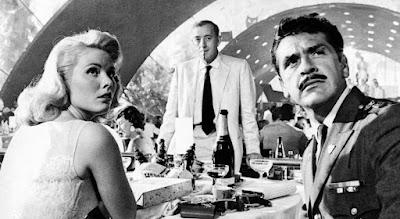
These two books have a lot in common in spite of the fact that they are tonally radically different. Our Man in Havana is a satire about the workings of the British Secret Service. Its main protagonist is a vacuum cleaner salesman named Wormold (played in the 1959 film adaptation by Alec Guinness, who wanted to make him more blundering but was told to just play him straight – not to act, but to be), a British expatriate in Havana who was left by his wife and has a a teenage daughter. His love and care for his daughter – who goes on elaborate shopping trips, her latest resulting in the purchase of a horse – is the reason for why he does what he does. One day, a mysterious man (played by legendary stage actor Noël Coward) recruits him to be a spy. After conversing with his good friend, a German doctor (who is, in very interesting ways, the moral center of the story), he decides to simply feed his handler lies – about other spies he’s recruited, about secret weapon plans based on his newest vacuum model, with the money he is supposedly spending on his network going straight into his daughter’s horse (and future education at a Swiss private school). Instead of presenting this as pure opportunism, Hasselbacher (the doctor) suggests this is the moral option: by lying, he is doing the least amount of damage to actual people. It works out perfectly because the Secret Service is unbelievably gullible and eager to believe that their “man in Havana” is proving himself useful beyond expectation, until it works out too well, when his fake sub-spies turn up dead and Wormold’s own life becomes threatened. There’s a turning point to both Wormold as a character and the tone of the story when Hasselbacher is murdered: it’s a moment of radicalisation, when Wormold realises that his own actions have resulted in the death of his best friend, that much more is at stake then he knew. The film and book also provide a romantic foil: the Secret Service sends him a trained secretary, Beatrice (Maureen O’Hara), who is meant to professionalise his operation but is obviously also constantly on the verge of realising that it is all a sham. There isn’t much connection to actual history in this story: it is, as Greene says, mainly about the absurdity of spycraft, not about the particular place. The only real connection to Cuba is the presence of an infamous police officer, called the Red Vulture, who is rumoured to be a torturer and is carrying what might or might not be a walled made of human skin (it’s confirmed to be so in the book: made from the skin of a police officer who tortured his father, the film, perhaps less willing to shock its audience, leaves this detail out). One of the most chilling monologues of the film belongs to Captain Segura when he explains the concept of “torturable classes”, which works to both explain the reality of the place that Wormold has called his home for so long and yet marks him as an outsider to it, who lives cushioned by his British passport. As high as the stakes are, Our Man in Havana remains a satire and Wormold a privileged character. Even when he takes his revenge on the killer of his friend, he returns safely to London, protected by Segura’s care for his daughter, and is awarded a teaching position in the Service and an OBE (the lowness of the honours considered punishment enough) even after his deceit is discovered, to cover up the blunder of these suited and uniformed men when they believed his tall tales.
In contrast, The Quiet American is specifically a story about Vietnam, with a much more relevant and local sense of history. It feels like a story with more urgency than Our Man in Havana. Thomas Fowler (I watched the 2002 film, not the 1958 one with “input from the CIA”, because it is truer to the book – Fowler is played by Michael Caine), a reporter from London, has lived in Saigon for a considerable amount of time. He has acquired a local lover, Phuong, whom he depends on, an opium habit, he seems to have more or less stopped doing his work, as he has only submitted a limited amount of stories to the newspaper that employs him. He states, when he makes the acquaintance of a young and idealistic American Pyle (Brendan Fraser), that he is a reporter, not a correspondent: he takes no sides, and even having an opinion would be picking a side. His decision to remain at a remove from everything that happens is a deliberate one, and it echoes in an interesting way what Beatrice from Our Man in Havana says (only in the book, not in the film: that she can only believe in a home and in a human being). The political situation is escalating around him, but Fowler has no opinion on it, he only lives his languid life. Meeting Pyle changes that in various ways. Pyle takes an interest in Phuong and becomes his rival, because as an unmarried and well-situated American, he can offer her more than Fowler can (a fact that her opportunistic sister picks up on very quickly). Pyle also indirectly gives him a new passion for his work. Since London wants to recall him, he has to prove his usefulness, and so he begins chasing a story about a newly emerging force in Vietnam. He finds a massacre in the North that he figures out wasn’t committed by the communists, as the French attempt to claim, and realises that mysterious Americans, including Pyle, are attempting to build a “third force” under the command of a general, to counteract both the French and Ho Chi Minh. The story is built to create pressure on Fowler’s claim to uninvolved objectivity, and it puts in question the morality of Pyle’s opposite obsession about involving himself in a country that he only has the vaguest idea about, based on the ideological writings of a political scientist he admires (Fowler says about Pyle: “I never knew a man who had better motives for all the trouble he caused.” and that he is “impregnably armored by his good intentions and his ignorance”). Initially, he doesn’t take Pyle seriously because he comes across as naïve, both about Vietnam and about Phuong, who acts as a symbolic representation of the country (both in the book and to Pyle himself). Then things escalate and Fowler realises that Pyle is a lot more serious than he realised: he is involved in a false flag massacre against civilians, bombs in a heavily trafficked intersection. Even covered in the blood of the people he’s helped murder; he doesn’t realize that his obsession about deciding the political future of Vietnam is wrong. As in Our Man in Havana, it’s a turning point for Fowler, it rips him out of his inaction. He takes a side to remain human, and helps kill Pyle, which will not change anything in the long run. It’s as if Greene sees the writing on the wall about American involvement in Vietnam long before it happens – and it feels almost ironic that this second film adaptation was released in 2002. Greene presents an open-eyed portrait of the human consequences when ideology overrides concern about actual lives, but also, in both stories, captures a moment where characters that were previously eager to remain uninvolved and distant find moral reason to act.
The Quiet American (2002), directed by Phillip Noyce, starring Michael Caine, Brendan Fraser, Do Thi Hai Yen, Rade Serbedzija, Tzi Ma.
Our Man in Havana (1959), directed by Carol Reed, starring Alec Guinness, Burl Ives, Maureen O'Hara, Ernie Kovacs, Noël Coward.