 Our guest today is
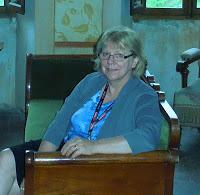
Judy Hudson, a writer/ photographer who lives on Vancouver Island. Today, she’s
writing about Cremona, Italy, which holds a special place in her heart. She
first went to Cremona in the 1980’s with her husband, a bowmaker, to visit their friend Peter who was a student
at the Scuola di Liuteria (Violinmaker’s school). They return often to this center of everything violin.
Our guest today is
Judy Hudson, a writer/ photographer who lives on Vancouver Island. Today, she’s
writing about Cremona, Italy, which holds a special place in her heart. She
first went to Cremona in the 1980’s with her husband, a bowmaker, to visit their friend Peter who was a student
at the Scuola di Liuteria (Violinmaker’s school). They return often to this center of everything violin.
Judy loves to travel and writes travel articles. You can see more of her photographs on her photo website www.judyhudsonphotos.com . She is currently working on her first mystery featuring Rocky and Bernadette, a travel writing and photography team, and plans to set the second book in the series in Cremona.
Roaring over the Brenner Pass, we sailed down the sunny side of the mountains into Italy. The temperature outside the Skoda soared.
The twelve hour drive from Prague to Cremona is beautiful, but harrowing. Trucks go 90 km/hour (55 miles/hour), but BMWs and Mercedes zoom up out of nowhere at180 (110). I brake, ducking in and out between the slower moving trucks. After two hours, my knuckles are white and it’s time to switch drivers. Luckily we have three drivers on the trip, my husband, our old friend Peter, and I.
 Peter always has a
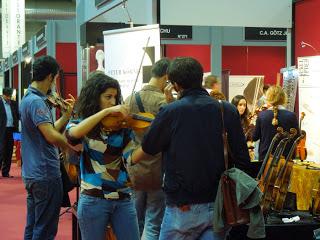
booth at Mondomusica , the annual violin
trade show in Cremona, Italy. Forget your impressions of staid classical
musicians, when the Italians are hosting, it’s one big musical party. The real
competition is about who can give the most passionate performance.
Peter always has a
booth at Mondomusica , the annual violin
trade show in Cremona, Italy. Forget your impressions of staid classical
musicians, when the Italians are hosting, it’s one big musical party. The real
competition is about who can give the most passionate performance.
Cremona is the home of Stradivari, Amati, Guarneri, and the legion of 16th Century violinmakers who founded the still unmatched Cremonese school of violinmaking. Today Cremona is home to more than one hundred violinmakers. Most are Italian, but the Scuola di Liuteria founded there in 1938, has a large contingent of international students and, over the years, some have settled in the city after finishing the three-year course.
We always arrive in Cremona just as the sun is setting, when the gates of the Fiere, the arena, open, and trucks and vans stuffed with instruments from all over Italy and Europe pour in, ready to set up their booths.
 We arrive in our
Skoda wagon, stuffed with people and luggage and boxes of shoulder rests. Although
he is a violinmaker, because of the logistics involved in bringing instruments
from Quebec, Peter only brings shoulder-rests to Mondomusica, a violin add-on
that eases the strain on players necks, made by his relatives in the Czech
Republic.
We arrive in our
Skoda wagon, stuffed with people and luggage and boxes of shoulder rests. Although
he is a violinmaker, because of the logistics involved in bringing instruments
from Quebec, Peter only brings shoulder-rests to Mondomusica, a violin add-on
that eases the strain on players necks, made by his relatives in the Czech
Republic.
The other vendors, everything from small time makers to international companies like Yamaha, set up elaborate displays in the dramatic red and black booths. We put together our scrounged folding tables and chairs, assemble do-it-yourself IKEA shelves, roll out the latest poster Peter has had made, and last but not least, stick a small Canadian flag high on the end of the booth, a beacon for his regular customers and friends in the rows and rows of look-alike aisles. (For the full flavor of the show, check out my Mondomusica Montage video.)
Dinner is sausage, cheese and beer, European style, then it’s off to Lago Scuro, our accommodation for the week.
The first time I stayed there, Peter had only been there once, the year before. “It’s a castle,” he told us. Sure, I thought. “And a cheese factory.” I tried to picture it, but with no success.
 In typical Italian
style, the bridge was closed, so we took another bridge, and another road, and
got totally lost. The flat back roads of the Po River plain surrounding Cremona
were pitch dark, and, to my eye, had few landmarks, just flat fields and the
odd, seemingly abandoned clusters of medieval houses.
In typical Italian
style, the bridge was closed, so we took another bridge, and another road, and
got totally lost. The flat back roads of the Po River plain surrounding Cremona
were pitch dark, and, to my eye, had few landmarks, just flat fields and the
odd, seemingly abandoned clusters of medieval houses.
Half an hour later, we stumbled on the far end of the closed bridge and headed off into the darkness again. But this time with some success. We ended up on a narrow dirt road beside a crumbling stone wall.
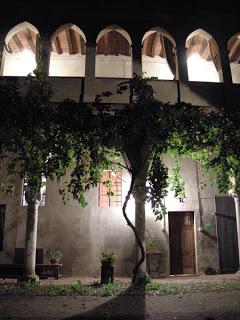
“We’re here,” Peter said. I was dubious. Then we passed through a tall wrought iron gate and, under the light of a full moon, got our first view of Lago Scuro. A fortified farm of the 1700’s, complete with a crenellated roofline and turrets.
Peter rapped at the darkened door and spoke in Italian to a man with a big bushy beard who led us into a courtyard. A soft light illuminated an old grape vine winding up to the gallery above. The servants quarters, built two hundred years ago. Enchanting.
My husband and I had a large room furnished in a whimsical blend of mismatched furniture. The bathroom was down the hall, but was new and everything worked. That’s all I ask. We fell into bed.
The next morning I opened the two layers of wooden shutters and swung wide the small-paned windows onto a fairy tale scene. A turret rose just outside our window, backed by a misty garden. Regardless of the sometime inconvenience of staying at Lago Scuro, I’d return anytime for the setting alone.
 That and the
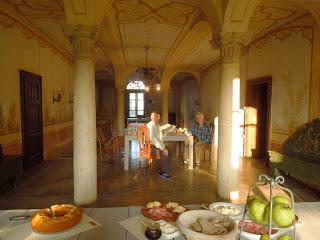
breakfasts. Lago Scuro (Dark Lake) is an Agriturismo, (www.agriturismolagoscuro.net ) an organic farm
B&B, and these were not the normal urban Italian dry-biscuits-and-espresso
type breakfast. It’s homemade cheeses, hard and soft, home-cured meats, freshly
baked cakes and granola, endless Italian coffee, and milk straight from the
cows. I put on a pound a day when I stay there, and I’m sure it’s from the
breakfasts alone. On this weekend every year, the B&B is full of violinmakers
from all over Europe, who meet every morning at breakfast on the long dining
table.
That and the
breakfasts. Lago Scuro (Dark Lake) is an Agriturismo, (www.agriturismolagoscuro.net ) an organic farm
B&B, and these were not the normal urban Italian dry-biscuits-and-espresso
type breakfast. It’s homemade cheeses, hard and soft, home-cured meats, freshly
baked cakes and granola, endless Italian coffee, and milk straight from the
cows. I put on a pound a day when I stay there, and I’m sure it’s from the
breakfasts alone. On this weekend every year, the B&B is full of violinmakers
from all over Europe, who meet every morning at breakfast on the long dining
table.
Then back to the Fiere and Mondomusica. The days start quietly—musicians are not early risers. But the students from the Scuola are there first thing, searching out the best wood in the booths of Eastern European wood dealers.
The noise level rises as the crowd arrives and musicians try out the thousands of stringed instruments on display. We escape the bedlam for a few hours every afternoon and head into town to walk Cremona’s medieval streets. The Po valley has been breadbasket of Italy for thousands of years. Recently a Roman road was uncovered, the Via Postumia, from Genoa to Aquileia on the Adriatic. Even in those days, Cremona was an important point at which to cross the river.
 Now a refreshingly
vibrant city of 70,000, it is not really a tourist town, despite its large,
beautiful old center, and 13th and 14th century main
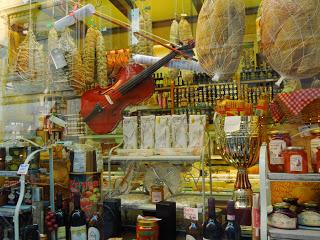
square. The storefront windows, in buildings centuries old, display the latest
fashions in clothing and home furnishings because, after all, Cremona is less
than an hour’s drive from Milan. But the focus of the city is clearly the
violin.
Now a refreshingly
vibrant city of 70,000, it is not really a tourist town, despite its large,
beautiful old center, and 13th and 14th century main
square. The storefront windows, in buildings centuries old, display the latest
fashions in clothing and home furnishings because, after all, Cremona is less
than an hour’s drive from Milan. But the focus of the city is clearly the
violin.
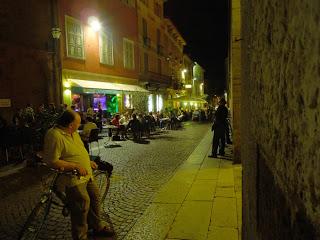
We often return to the square for dinner, to sit for the evening in the balmy air, greeting old friends as they wander by, sharing wine and conversation.
Last year, after the cacophonous noise of Mondomusica, the squeaky beds and the night time mosquitoes (the first time for that!), we swore it would be our last trip. But now, as I remember the fabulous meals, the friends we see, and the mist rising from the gardens in the morning at Lago Scuro, I’m sure that two years from now we’ll forget the mosquitoes and hit the road with Peter again, heading for Cremona.