


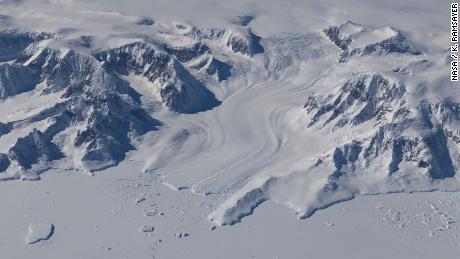
New NASA research shows that Antarctica and Greenland's ice caps have lost 118 gigatons and 200 gigatons of ice on average per year. This would fill more than 127 million Olympic swimming pools.
According to NASA, the amount of ice lost could cover New York Central Park in ice more than 1,000 feet thick, reaching more than the Chrysler Building.
This loss of ice caused sea levels to rise by about half an inch between 2003 and 2019. This is just under a third of the total amount of sea level rise observed in the world's oceans , according to the study.
And although East Antarctica has gained ice, this gain is little compared to the total amount of ice lost in other regions.
Warmer summer temperatures are the main cause of this loss of ice, according to NASA. Warm temperatures have melted ice from the surface of glaciers and ice caps.
NASA said it has recorded data from its Ice, Cloud and Land Elevation Satellite 2 (ICESat-2), which was launched in 2018 to perform detailed global elevation measurements, including on frozen regions of the Earth. These data were then compared to measurements taken by the original ICESat from 2003 to 2009, allowing researchers to generate a complete picture of the complexity of the ice cap change and prospects for the future of Greenland and Antarctica. .
"If you observe a glacier or an ice cap for a month or a year, you're not going to learn much about what the climate is doing there," said Ben Smith, a glaciologist at the University of Washington and lead author of the new paper.
He told NASA, "We now have a 16-year gap between ICESat and ICESat-2 and can be much more confident that the changes we are seeing in the ice have to do with long-term climate change."

Alex Gardner, a glaciologist at NASA's Jet Propulsion Laboratory in Southern California and co-author of the scientific article, told NASA that the new analysis reveals the ice caps' response to climate change in great detail, revealing clues to why and how the ice caps react as they are.
The NASA study also examined the ice shelves: the floating masses of ice at the downstream end of the glaciers. Researchers have discovered that ice shelves are losing mass in western Antarctica, where many of the continent's fastest-moving glaciers are also located, according to NASA.
NASA explains that the ice melting from ice shelves does not raise sea level because it is already floating - just like an ice cube already in a full cup of water does not spill out of the glass when it melts. But the ice shelves provide stability to the glaciers and the ice caps behind them.
"It's like an architectural buttress that supports a cathedral," says Helen Amanda Fricker, glaciologist at the Scripps Institution of Oceanography at the University of California at San Diego, and co-author of the scientific article.
She told NASA, "The ice trays hold the ice cap. If you remove the ice trays, or even if you thin them, you reduce that downforce, so that the melted ice can flow faster . "
This study was conducted over 16 years and published online in Science on April 30.
Source link





