


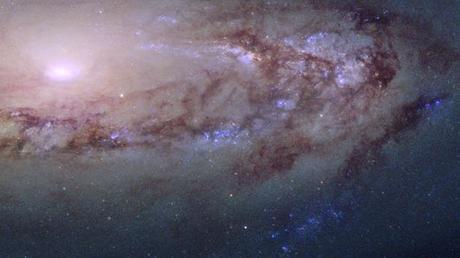
Titanic, runaway thermonuclear explosion. A disappearing act. Nature's atomic bomb. NASA certainly knows how to describe a supernova, the last moments of a star's existence.
70 million light years away in the scenic spiral galaxy NGC 2525, a white dwarf exploded and the Hubble Space Telescope was in its final days. NASA and the European Space Agency, which jointly operate Hubble, have released a rare time-lapse of the supernova's fading brightness.
The space telescope began observing the supernova named SN 2018gv in February 2018. The time-lapse includes nearly a year of Hubble observations.
The supernova initially outshone the other stars in its home galaxy. "If a star releases as much energy in a few days as our sun does in billions of years, you know it won't stay visible for long," NASA said in a statement Thursday.
Hubble observed the supernova, while scientists it worked to understand the expansion rate of the universe better. "In addition to providing celestial fireworks, supernovae can also be used as milestone markers to measure distances to galaxies," NASA said. "This yardstick is needed to calculate how fast galaxies appear to be flying apart, which in turn gives an estimate of the age of the universe."
While supernovae are relatively common across the universe, Hubble's time-lapse gives us a rare glimpse into the dramatic process and a poignant reminder that even stars are not permanent.






