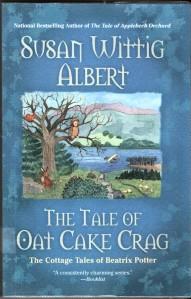
The Tale of Oatcake Crag (2010) by American mystery writer Susan Wittig Albert is a curiosity that I came across in my ongoing search for detective stories featuring historical figures. Similarly to spotting the Groucho Marx crime series, I was so intrigued by the premiss of Beatrix Potter (1866-1943) as an amateur detective that I searched the online library catalog to see what I could reserve. As before, I was forced to settle for a large print edition, as there is very little else of this series available nationally. So it is thanks to Cork City Libraries for the loan of this Chivers edition.
I was not sure what to expect from the novel, but I was not really surprised that this turned out to be a very gentle country tale indeed. No bodies in libraries, trains or anywhere else for that matter. It is one of a series, (The Cottage Tales of Beatrix Potter) imagining children’s writer Beatrix Potter as an amateur detective in her Lake District home and mixing real-life people with fictional characters. The eight-novel series began with The Tale of Hill Top Farm (2004), set around 1905 when the real Beatrix Potter’s fiancé Norman Warne has sadly died aged only thirty-seven. Potter subsequently bought Hill Top Farm in Near Sawrey with the proceeds from a legacy and the proceeds from her Peter Rabbit book, having become very attached to the Lake District over many years of visiting. She spent as much time as she could in this part of the country, when she was able to leave her parents for a while. Locations in the village feature in her books and illustrations.
Now, I have not read the earlier stories for comparison, but as I said, this one is very much in the cosy crime vein as there is indeed no murder (bloody or otherwise). The central mystery in the novel is the authorship of some poison pen letters, sent to the Vicar’s fiancée, Grace Lythecoe, apparently a respectable widow. Who would want to threaten the happiness of the seemingly well-liked couple? Grace asks her friend Beatrix to investigate the matter, which she does with the help of her present (unofficial) fiancé, William Heelis. The village animals also contribute to the investigations, which along with the dragon (yes, I did say dragon) requires a suspension of disbelief on the part of the reader.
The fictional poison pen letter affair is set against action inspired by real-life events; the literal ups and downs of the test flights of a hydroplane and the aggrieved local reaction to this. The test flights took place from 1911-12 and Wittig Albert has used details of the regular test flights over Lake Windermere as part of a sub-plot. The businessman backing the sea plane project has a fall and is seriously injured. An accident? Possibly suspicious, but again, no murder. Some details relating to the sea plane’s history in Windermere have been substantially altered but you will have to read the book to see what I mean (clue: the dragon is involved).
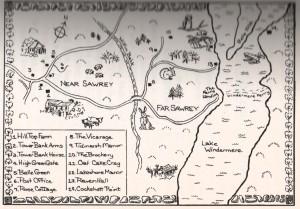
We have gossip galore amongst the villagers of Near Sawrey, on the shores of Lake Windermere (though it has to be said that it is not merely the humans who gossip). However, with the chapters alternating between human and animal protagonists, it can really feel like reading a Peter Rabbit story for grownups. The author uses Potter’s affinity with animals to suggest that she can interpret what they are saying. Overall, this all has its charm but it does make me wonder who exactly is the intended audience for the series. Beatrix Potter solving the poison pen letters mystery is oddly convincing, as she does this by chatting to various people on her village rounds, in a perfectly natural way. She is very much a respected figure in her adopted home and her social class plays its part too. The overriding impression of reading this novel (if you discount the talking animals and a glowing green dragon) is of the dramas of village life as told in Miss Read’s tales of village goings-on in Fairacre and Thrush Green.
The descriptions of the area around Lake Windermere are beautifully done, as for example here, ‘I think it is fair to say that there is no place on this earth that gives the sun so much pleasure as this lovely green land, with its rambling rock walls, quiet lanes, tranquil waters, and long sweet silences.’ Lake District village life of the 1910s is well recreated, although with an awareness of the increased threat to the landscape from so-called progress. As Potter fans will know, she was instrumental in helping to preserve the landscape that she loved, via the National Trust, for future generations. At the end of the book, Wittig Albert includes some traditional recipes (though sadly without a conversion from cup measurements) as well as a glossary of local expressions, presumably aimed at her American audience.
I am not sure whether I would go out of my way to read another in the series, but this was an amusing and entertaining addition to my list of historical detectives. And all the better for not trying to shoehorn Potter’s fictional persona into a grittier or feistier role. I am still not convinced about the dragon though. Perhaps it deserves its own series.